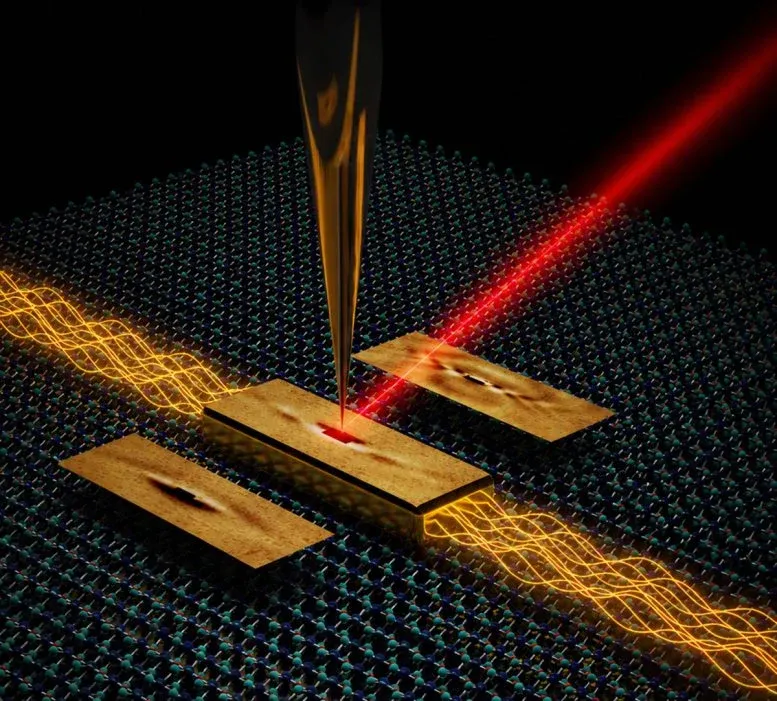
Photonic-crystal surface-emitting lasers (PCSELs) are advanced semiconductor lasers. They are useful in defense and aerospace. Usually, these lasers have repeating patterns.
New research introduces a different kind of laser. It's called a quasi-periodic photonic-crystal surface-emitting laser (QPCSEL). This new laser uses patterns that do not repeat.
A New Way to Make Lasers
Professor Kent Choquette's lab led this research. They used a special "buried dielectric platform" to build their device. This method could lead to more tunable and reliable semiconductor lasers. Their findings were published in Applied Physics Letters.
We're a new kind of news feed.
Regular news is designed to drain you. We're a non-profit built to restore you. Every story we publish is scored for impact, progress, and hope.
Start Your News DetoxOne problem with PCSELs has been how they are made. The patterns are fixed, limiting how much researchers can change them. Erin Raftery, a graduate student, wanted to find a more flexible way. Her goal was to make a repeating structure non-repeating.
Raftery got ideas from other work on "topologically protected" patterns. These patterns also do not repeat. She combined this idea with her group's existing buried dielectric platform. They first showed this platform in 2025.
Most semiconductor materials are made by etching tiny holes straight down. But Raftery etched a layer of silicon dioxide. Then, she covered it with a semiconductor material, embedding it inside the device.
This new structure worked. It successfully produced laser light at room temperature.
More Flexible and Reliable Lasers
This new approach from the Illinois researchers is a practical step forward. It could lead to high-performance QPCSELs that are flexible and not tied to specific shapes.
"We've shown that we can have a nonperiodic pattern and more flexibility to tune it," Raftery said. "It's a different way to control the light to get the laser properties we want."
The main benefit of this platform is how versatile and uniform the buried dielectric pattern is.
"Right now, you can only grow one type of structure at a time," Choquette explained. "But with our method, we can mix and match on the same base material. This could help us build more reliable, better-performing lasers."
The engineers are now working to make a more practical semiconductor laser. They hope to create an electrically injected diode in the future. This would be a bigger challenge but has many commercial uses.
"We've proven the science works," Choquette said. "Now we need to show it can be a practical device."
Deep Dive & References
Buried dielectric quasi-photonic-crystal surface-emitting lasers - Applied Physics Letters, 2026