Imagine trying to get a tiny beam of light to go exactly where you want it, without building a single physical channel for it. That's essentially what a team of scientists just pulled off, and it could completely change how we build the minuscule, light-powered devices of the future.
Normally, when you want light to travel in a specific direction — say, inside your fiber optic cable or on a tiny computer chip — you have to etch microscopic pathways for it. Think of them as super-tiny highways for photons. Building these is fiddly, expensive, and a general headache for engineers.
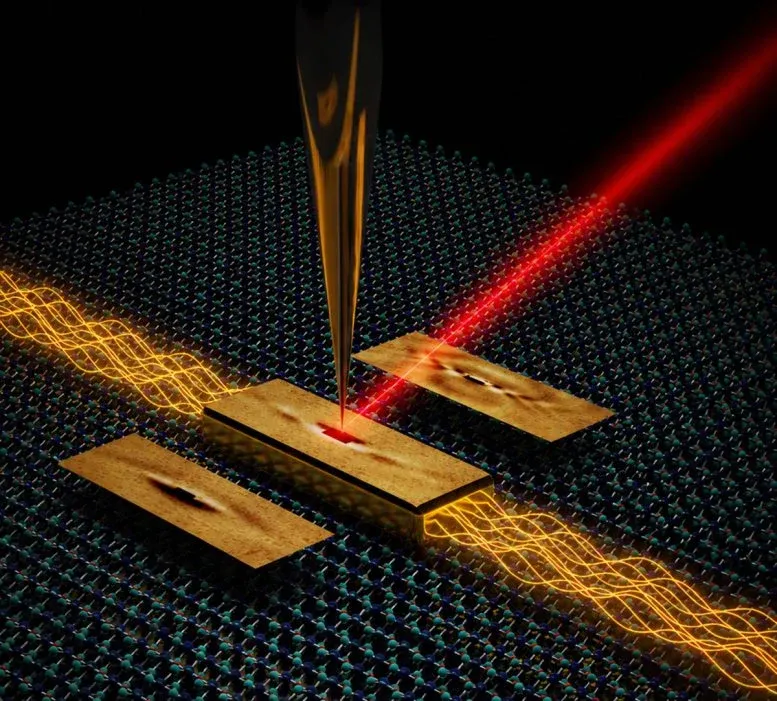
But researchers at the University of Stuttgart and the Istituto Italiano di Tecnologia (IIT) had a different idea. They took a crystal, specifically one called molybdenum oxy-dichloride (MoOCl₂), and simply plonked a tiny gold antenna on it. Then, they zapped it with an infrared laser.
We're a new kind of news feed.
Regular news is designed to drain you. We're a non-profit built to restore you. Every story we publish is scored for impact, progress, and hope.
Start Your News DetoxWhat happened next was the real magic: The light didn't scatter. It didn't spread out. It traveled in a single, narrow, perfectly guided beam. No physical channels required. It was like the crystal itself whispered, "This way, please," to the light.
The Crystal's Secret Life
This isn't just any old rock. The MoOCl₂ crystal is what scientists call anisotropic, which is a fancy way of saying its properties change depending on which direction you look at it. In one direction, it acts like a metal, letting waves of electrons (called "plasmons") zip through, carrying the light's energy.
But turn it 90 degrees, and suddenly it's an insulator, blocking those plasmons cold. This extreme Jekyll-and-Hyde optical personality forces the light into a tight, narrow path. The scientists are calling it "plasmon canalization," which sounds like something you'd read in a sci-fi novel, and frankly, it's pretty accurate.
Even wilder? The path the light took changed based on its color, or wavelength. At about 4 micrometers, it went straight. At 5 micrometers, it spread into a ring. At 3 micrometers, it formed an open hyperbolic shape. So, simply by tweaking the light's color, you can tell it where to go and how to behave. Which, if you think about it, is both impressive and slightly terrifying.
This "invisible" waveguide could slash manufacturing steps for photonic chips, leading to smaller, more efficient optical connections and even advancing quantum tech. Because apparently, we've decided that wires are for suckers, and now crystals are doing all the heavy lifting.