
Inside a unique magnetic material, electrons are behaving in an unexpected way. They are slowing down significantly while moving together in a coordinated quantum state.
Researchers at the University of Chicago Pritzker School of Molecular Engineering (UChicago PME) made this discovery. They found that electrons in a material called Fe₅GeTe₂ can enter a "charge-ordered state." In this state, electrons move collectively, stay quantum coherent, and travel much slower than expected.
This finding could change how scientists understand magnetism in this material. It might also lead to new ways of storing information by switching between different electronic and magnetic states.
We're a new kind of news feed.
Regular news is designed to drain you. We're a non-profit built to restore you. Every story we publish is scored for impact, progress, and hope.
Start Your News DetoxShuolong Yang, an assistant professor at UChicago PME, called this a fundamental discovery that goes against current theories. He noted that scientists now need to rethink the magnetic interactions in this material. This also opens up new possibilities for memory devices.
The research was published in Science Advances.
Why Fe₅GeTe₂ is Special
Fe₅GeTe₂ is part of a group called van der Waals magnets. Unlike typical 3D solids, these materials are made of strong atomic sheets held together by weaker forces between layers. This structure allows for very thin samples. These thin samples can have properties that are very different from traditional magnetic materials.
Two-dimensional magnets are drawing a lot of attention. Making magnetic parts just a few atomic layers thick could lead to thinner, easier-to-control electronic and spintronic devices.
Fe₅GeTe₂ is especially interesting because its magnetism can last at unusually high temperatures for a van der Waals material. Previous studies showed ferromagnetism near room temperature in thin Fe₅GeTe₂ films. Some 12-nanometer films stayed ferromagnetic up to 293 kelvins, and bilayer material remained ordered up to about 229 kelvins.
A Surprising Flat Electronic Band
The newly observed collective electron behavior lasted up to about 100 kelvins (about -280°F). While still very cold, this is warmer than the temperatures needed for many other delicate quantum phenomena.
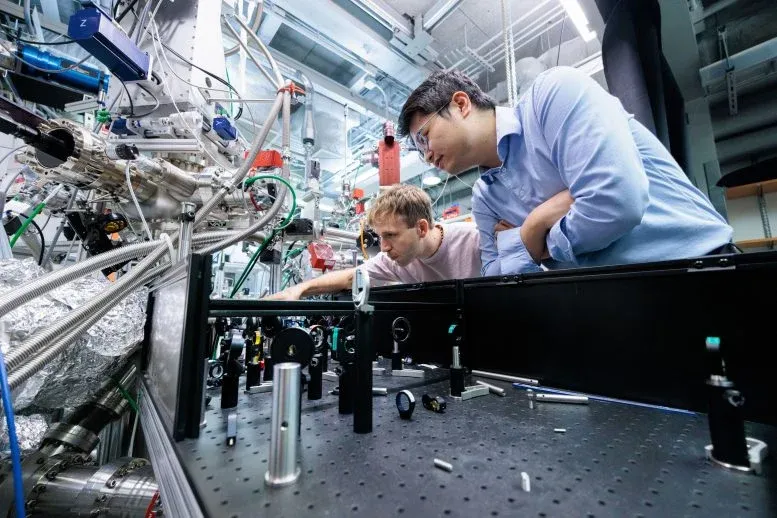
Yang's team, including postdoctoral scholars Gabriele Berruto and Qiang Gao, studied Fe₅GeTe₂ using angle-resolved photoemission spectroscopy (ARPES). This method involves shining photons onto a material and measuring the electrons that are released. By analyzing their energies and momenta, scientists can map the material's electronic band structure, which shows the states electrons can occupy.
Using an ultraviolet laser, the researchers found something unexpected: a part of the electronic band was remarkably flat. The slope of an electronic band relates to how fast electrons move through a material. A steep band means faster motion. A flat band means electrons move much slower.
Yang compared this to water flowing downhill. Water speeds up on a steep slope but moves slowly on a shallow one.

In Fe₅GeTe₂, the electrons are not just slow; they also move collectively. Yang explained that they are measuring the interaction of thousands or millions of electrons moving together coherently. This is a quantum many-body phenomenon, which is quite unusual.
This collective behavior is important because strongly interacting electrons can create properties that wouldn't be predicted if each electron was considered alone. Superconductivity, magnetism, and other exotic states of matter can come from interactions among many particles.
A Quantum State Theory Missed
These interactions seem to create both the flat band and an unexpected charge order. Fe₅GeTe₂ was already known as a complex material. Its atomic structure can vary, including how iron atoms are arranged. Earlier research found that iron vacancies and different iron sites can greatly affect its magnetic behavior. This is why scientists have found it hard to create a simple model of its magnetism.
The newly found phase adds another layer to this mystery. Berruto noted that it suggests the magnetic interactions within the material are completely different from what theory predicts.
The electrons are not just reacting to an existing magnetic structure. Their interactions might be helping to create a more complex electronic state that current theories don't account for.
Moving Towards Quantum Memory Devices
Modern memory stores information by putting a physical system into distinct states. If Fe₅GeTe₂ can be reliably switched between different magnetic or electronic phases, these states could potentially store data. Researchers are now testing if they can control this switching.
The team is using a microfocused laser to switch the material between the new quantum many-body phase and other phases. Their experiments suggest this switching is possible. This raises the idea of controlling information with light instead of only using traditional electrical methods.
This is still a research goal, not a ready-to-use memory technology. There are still challenges, like seeing if the effect can work at much higher temperatures.
The Next Step: A Single Atomic Layer
Gao, now a research scientist at Lawrence Berkeley National Laboratory, said that for use in a memory device, it needs to work at room temperature.
Next, the team plans to make Fe₅GeTe₂ into a single atomic layer. They will then test if the same electronic behavior remains. If it does, this would bring the phenomenon closer to the ultrathin limit that makes van der Waals materials so appealing for future devices.
This study was also among the last research publications of Peter Littlewood, a distinguished UChicago physicist who passed away on June 15. Yang dedicated the paper to him, calling him a great theoretical physicist and a leader in quantum materials research at UChicago.
Deep Dive & References
Interaction-driven flat band and charge order in Fe5GeTe2 - Science Advances, 2026