A 520-million-year-old fossil shows how early cephalopods learned to float. These ancient creatures, which include modern octopuses and squids, used a small tube in their shells to control their position in the ocean.
Cephalopods, both living and extinct, have always needed to manage their buoyancy. This is true whether they have a hard outer shell or not.
Ancient shelled cephalopods used structures like chambers and a siphuncle to move up and down in the water. The siphuncle is a tube that runs through the shell's chambers. It helps regulate the balance of water and gas inside the shell. This system was a key evolutionary step that set cephalopods apart from other mollusks. However, how it first developed has been unclear due to missing fossils.
We're a new kind of news feed.
Regular news is designed to drain you. We're a non-profit built to restore you. Every story we publish is scored for impact, progress, and hope.
Start Your News DetoxAn Ancient Fossil Reveals Cephalopod Origins
An international team of researchers has found the oldest known cephalopod with a siphuncle. This fossil comes from early Cambrian rocks in South China. It offers clues about when cephalopods first appeared and how their unique body structure began to evolve.
Bing Pan from the Nanjing Institute of Geology and Paleontology, Chinese Academy of Sciences, led the research. He worked with scientists from China, the UK, and the US. They described a new species called Eoceras shaanxiense. This fossil was found in the Shuijingtuo Formation in South China, which is about 520 million years old.
The findings were published in Nature on July 29.
Tiny Fossils Fill a Big Gap
Before this discovery, Plectronoceras cambria was considered the earliest widely accepted cephalopod. It lived during the late Cambrian, about 30 million years after molecular estimates suggest cephalopods first appeared during the Cambrian Explosion.
Scientists have been looking for older evidence, especially among "small shelly fossils." These tiny fossils are common in early Cambrian rocks. They include many mollusks and related groups, making them a good source for finding the first cephalopods.
The researchers studied small shelly fossils from the Shuijingtuo Formation. They found 32 specimens of Eoceras shaanxiense. Their analysis showed these fossils were from an early cephalopod.
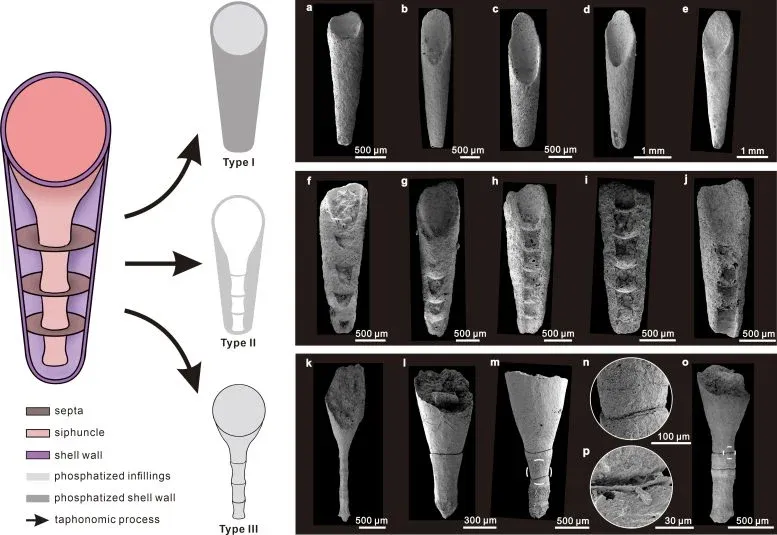
The fossils were preserved through a process called phosphatization, which kept fine details of their anatomy. Researchers used scanning electron microscopy (SEM) and micro-computed tomography (micro-CT) to study them. This allowed them to reconstruct the species' outer shape and inner structures.
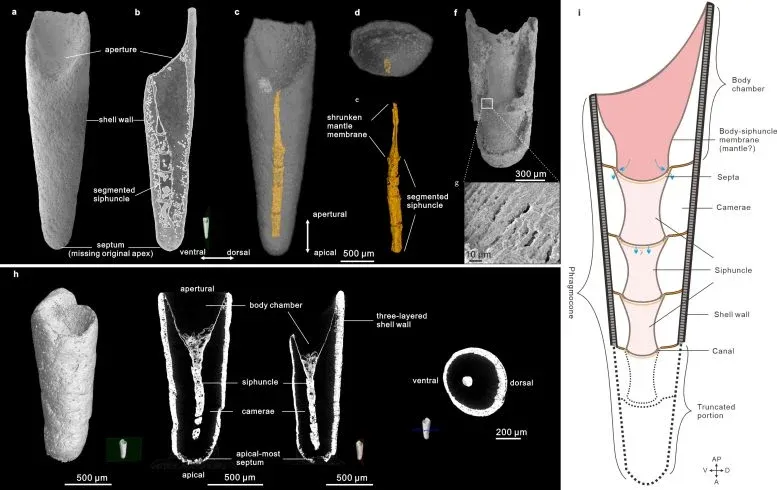 Overall out morphology and inner anatomy of the shell of Eoceras. Credit: NIGPAS
Eoceras was only a few millimeters long and had a straight, cone-shaped shell. It also had an angled opening, several internal walls (septa), and a segmented tube along the underside of its shell. Tiny canals seemed to connect this tube across the septa.
Comparing Eoceras to typical cephalopods with siphuncles showed that its segmented tube was indeed a siphuncle. This makes Eoceras the earliest known cephalopod with this buoyancy structure. Researchers believe Eoceras is a transitional form between older animals with chambered shells and later cephalopods with more advanced buoyancy systems.
Buoyancy Evolved in Stages
This anatomy helped researchers propose how early cephalopods evolved. The lineage might have started with animals that had straight shells divided by many septa. Then, a sealed, segmented siphuncle developed inside the shell. Later cephalopods evolved a more complete siphuncle with septal necks and connecting rings.
Because its buoyancy system was still simple, Eoceras likely spent most of its life near the seafloor. However, the fossil does not show all the features found in later cephalopods, and its soft body parts are still unknown. More Cambrian fossils are needed to fully understand the earliest stages of cephalopod evolution and how their unique shell structures came to be.
Deep Dive & References
Earliest siphuncle-bearing cephalopod from the early Cambrian - Nature, 2026