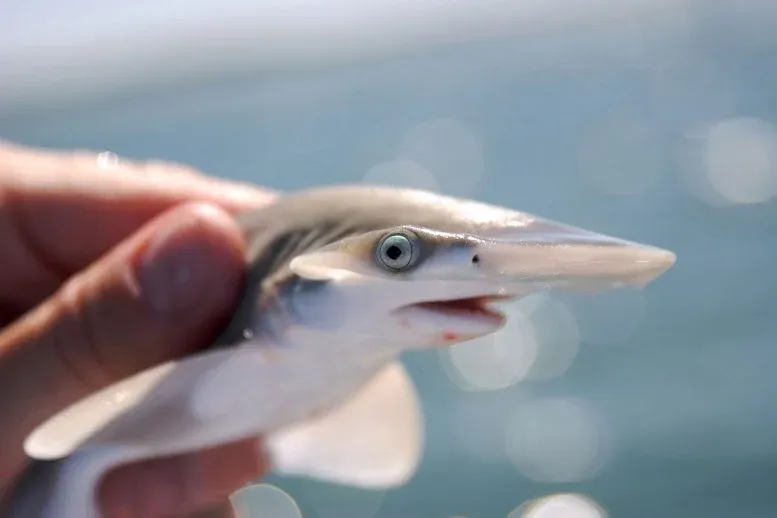
For years, scientists thought male bonnethead sharks developed pointed heads as they matured. Because, you know, masculinity. Turns out, the sharks were just having a bit of fun with us. New research has flipped that idea on its, well, head.
Here’s the real story: all young bonnetheads, male and female, start with a cute little pointed noggin. As they grow up, their heads get rounder. But here's the twist – females go way rounder, while males keep a noticeable point. Which, if you think about it, is both impressive and slightly terrifying for anyone who thought they understood shark development.
The Great Head-Shape Deception
Bonnetheads are the smallest hammerhead sharks and the only shark species where the sexes have such distinct head shapes. This phenomenon, known as sexual dimorphism, has always been a bit of a head-scratcher. Hammerheads use their wide heads (cephalofoils, if you want to sound fancy) for sensing prey and spacing out their eyes and nostrils. But what do these subtle differences mean for swimming, sensing, or just general sharky behavior? That's still a work in progress.
We're a new kind of news feed.
Regular news is designed to drain you. We're a non-profit built to restore you. Every story we publish is scored for impact, progress, and hope.
Start Your News DetoxResearchers from the University of Miami studied 144 bonnetheads from Florida's Biscayne Bay and Tampa Bay. Their findings, published in Integrative Organismal Biology, didn't just look at head development; they also checked out what these sharks were munching on. Because, naturally, if your head is changing, maybe your lunch menu is too.
Lead author Kathy Liu confirmed the plot twist: pointed heads aren't some exclusive male club that develops later. Nope, everyone starts pointy. It's the rounding that happens with maturity, and females just commit harder to the smooth, aerodynamic look.
It's Not What's for Dinner
Naturally, the next question was: does diet play a role? If lady sharks are losing their points because they're eating different things or hunting in different spots, that would make some kind of sense. Bonnetheads are already weirdos in the shark world, being the only known omnivorous shark species. They're not just about crabs and invertebrates; they also happily munch on and digest seagrass, absorbing nutrients like some kind of underwater cow.
To unravel this dietary mystery, the team analyzed muscle samples from 137 sharks. They looked at carbon and nitrogen isotopes, which are like tiny, edible diaries of an animal's long-term diet. The verdict? While everyone's diet shifted a bit as they grew, males and females in the same bay were basically sharing the same local buffet. "Our findings provided no evidence that differences in diet or foraging were driving the development of the sharks’ sex-specific head shapes," Liu stated. So, scratch diet off the list. The head-shape differences likely come down to other factors like growth rates, reproductive needs, swimming efficiency, or even prenatal development. Co-author Catherine Macdonald noted that this study, at least, helps narrow down the bewildering possibilities.
So, the mystery continues, but with far fewer red herrings. Scientists are now hypothesizing that a pointed snout might be better for young, smaller sharks trying to zip around, while a rounder head could be more advantageous for larger, reproductive females. Future experiments will likely involve measuring swimming efficiency and perhaps even peeking at shark embryos to see exactly when these divergent head-shape paths begin. Because when it comes to bonnetheads, apparently, nothing is as it seems.