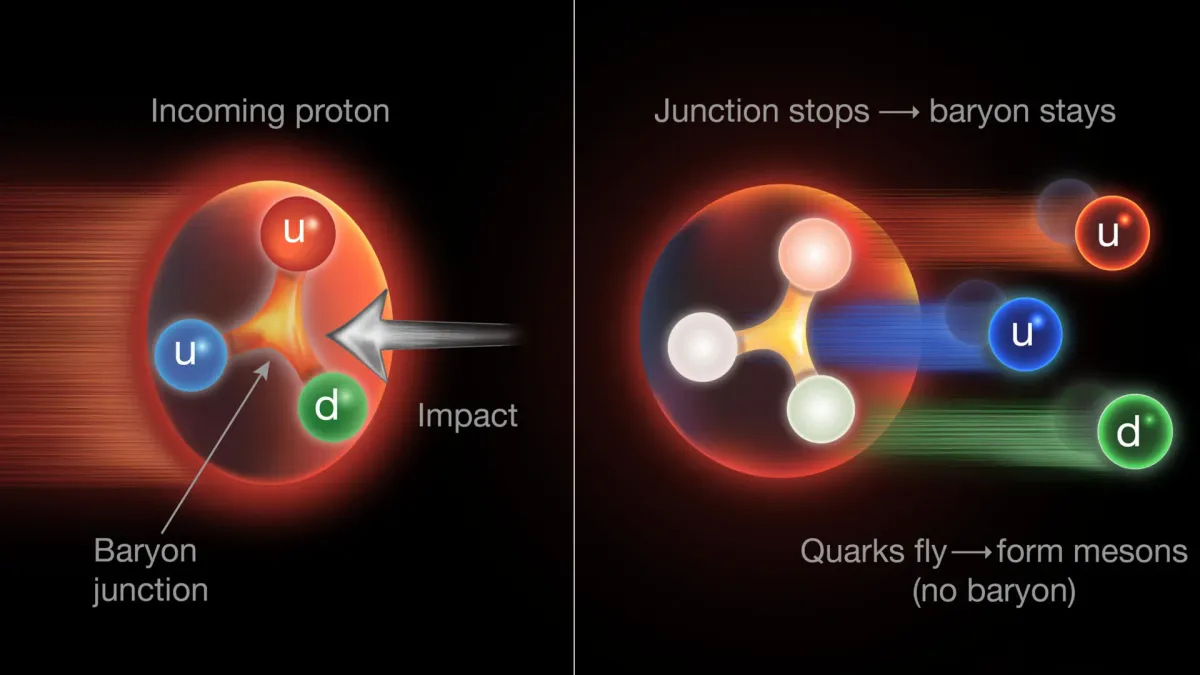
Physicists may have found a hidden feature inside protons. This feature helps keep one of matter's most basic properties stable. Data from RHIC collisions suggest that "baryon number" is not just carried by three quarks. Instead, it might be carried by a Y-shaped junction of gluons that connect the quarks.
This discovery challenges what textbooks have taught for decades. It could help us better understand why protons, and all matter, remain stable.
New findings from the STAR detector at the Relativistic Heavy Ion Collider (RHIC) are changing how we understand a proton's quantum properties. The results suggest that gluons, which are particles that act like glue holding quarks together, might carry and preserve baryon number.
We're a new kind of news feed.
Regular news is designed to drain you. We're a non-profit built to restore you. Every story we publish is scored for impact, progress, and hope.
Start Your News DetoxThis evidence comes from high-energy particle collisions at RHIC. RHIC is a U.S. Department of Energy (DOE) facility that operated at Brookhaven National Laboratory from 2000 to early 2026.
A New Role for Gluons
The new study, published in Science, suggests that baryon number might be linked to a Y-shaped "junction" of gluons. This junction connects the proton's three main quarks. If this is true, it would challenge the long-held belief that baryon number belongs only to those quarks.
Zhangbu Xu, a professor at Kent State University and Brookhaven Lab, explained that scientists traditionally thought each of the three main "valence" quarks in a proton or neutron carried one-third of the baryon number.
An Old Idea Revisited
Physicists first suggested the baryon junction, also called a gluon junction, in the 1970s. It was a way to describe how gluons connect the valence quarks inside a proton. In 1996, Dmitri Kharzeev, a theoretical physicist, proposed that this junction might do something even more important. He suggested the junction itself, not the valence quarks, could be responsible for carrying baryon number.
The STAR collaboration has now found a way to test this idea using different types of collisions at RHIC.
Xu noted that their results, from various RHIC collisions, suggest baryon number isn't simply carried by individual quarks. He added that their findings strongly support the idea that gluons, in this special configuration, are more likely to carry and transport baryon number.
Why Baryon Number Matters
Understanding what carries baryon number is important beyond just the proton's structure. In RHIC collisions, baryon number conservation means the total number of baryons (three-quark particles like protons and neutrons) must stay the same before and after a collision. This same rule applies to the entire universe.
Nicole Lewis, a STAR physicist at Rice University, said that since the Big Bang, the number of protons and neutrons has never changed. She noted that the reasons for this conservation are not fully understood. It's a mystery of the universe, linked to why there is more matter than antimatter.
Baryon number conservation also explains why protons are incredibly stable. Protons are a key part of atomic nuclei and don't seem to decay under normal conditions.
Lewis stated that a proton's lifetime is believed to be longer than the universe's lifespan. This stability allows atomic nuclei to form, which means matter, as we know it, can exist.
A More Complex Proton
The idea that gluons carry baryon number would change the simple picture found in many textbooks. Textbooks often show a proton with a baryon number of plus one, divided equally among its three main valence quarks. Each quark then carries one-third of the baryon number, similar to how the proton's electric charge is spread among its quarks.
However, real protons are much more complex than this simple model.
Tommy Tsang, formerly a postdoc at Kent State University, explained that the simple quark model shows only three quarks inside a proton. But in reality, there are also many gluons interacting and connecting these quarks. Quarks and antiquarks also pop in and out of existence, making the proton a very complex object.
Quantum chromodynamics (QCD), the theory describing these interactions, has successfully explained the strong force between quarks and gluons. Still, QCD-inspired models often need extra assumptions to match the particle patterns seen when RHIC smashes nuclei together.
An Unexpected Excess of Baryons
One observation particularly caught the STAR team's attention. The detector consistently recorded more baryons than antibaryons coming out sideways from the collisions, perpendicular to the incoming beams.
Tsang noted that they consistently see an excess of baryons coming out perpendicular to the collision. He added that it's not surprising to have more baryons than antibaryons since the collisions start with matter.
These energetic collisions turn a lot of energy into thousands of new particles. The puzzle for researchers wasn't just that more baryons than antibaryons were produced. It was where the extra baryons appeared.
If only valence quarks carried the baryon number, explaining the excess away from the beamline would mean all three valence quarks from one proton would have to stop near the detector's center. Then, they would convert from matter to energy and back to matter, creating new baryons that move outward.
The STAR researchers suspected another explanation.
Using Electric Charge as a Test
The team found a way to investigate this mystery by using another property of valence quarks: electric charge. Scientists compared the net baryon number measured in different RHIC collisions with how electric charge was spread out in those same events.
Zebo Tang, a professor at the University of Science and Technology of China, explained that measuring the electric charge coming out perpendicular to the collision gives a clear way to measure how many quarks stop and transform into new particles.
The comparison showed a clear mismatch. Researchers observed about twice as many baryons as expected based on the electric charge linked to stopped quarks.
According to QCD models, this means too few quarks were stopping to account for all the baryons seen in the detector.
This left an important question: What was carrying the extra baryon number?
The STAR physicists suggest gluons offer a possible answer, specifically the three-pronged gluon junction that connects the proton's valence quarks.
How the Gluon Junction Could Carry Baryon Number
This proposed idea depends on what happens when protons inside colliding nuclei reach very high energies. The STAR team believes the "gluon junction" or "baryon junction" that links the quarks might be much easier to stop in a collision than the three quarks themselves.
If the junction stops, its energy can turn into new baryons that travel outward, perpendicular to the beams. Meanwhile, the valence quarks that were connected by the junction can keep moving forward along the beampipe.
Understanding why requires looking at how a proton's internal structure changes as its energy increases.
Prithwish Tribedy, a STAR physicist at Brookhaven Lab, said the baryon junction is always there, even as protons speed up. But at high energy, gluons inside the proton split and multiply.
As the number of gluons grows, the proton's momentum spreads among more of them. Each individual gluon, including those in the junction, carries less of the proton's total momentum. However, the valence quarks still carry much of the proton's forward motion.
So, when a collision happens, the slower three-pronged gluon junction should be easier to stop and convert into new particles than the fast-moving quarks.
Tribedy added that stopping one connected structure is also simpler than stopping three separate quarks, making such an interaction more likely. He noted that in a collision, the baryon junction gets left behind, and the quarks continue on.
Building New Particles
Quarks and gluons cannot stay isolated. After a collision, they quickly combine with other particles.
For example, a quark continuing down the beampipe could join with an antiquark to form a two-quark particle called a meson. At the same time, the three-pronged gluon junction could act like a Y-shaped magnet, pulling in three new quarks from the vacuum and creating a new baryon.
Actual RHIC collisions are much more violent and complex.
Rongrong Ma, a Brookhaven Lab physicist, explained that even though they start with nuclei containing about 100 protons and 100 neutrons, these collisions create thousands of new particles. She said 99% of the energy turns into new particles.
The STAR team found that collisions producing more particles also showed a greater excess of "midrapidity" baryons. This was compared to predictions based on the simpler idea that only quarks carry baryon number.
The researchers say that the fact so many of these baryons emerge perpendicular to the beamline strongly suggests the baryon junction exists and plays an important role in transporting baryon number.
Rethinking a Fundamental Property
These results suggest that one of the proton's key quantum properties might not just be in its three valence quarks. Instead, the gluon structure connecting those quarks could be central to how baryon number is carried through energetic collisions.
Ma stated that their research challenges the long-held idea that baryon number is simply divided among and carried by the three quarks. She added that this new understanding changes how we think about matter's structure and deepens our knowledge of the fundamental element responsible for the universe's current form.
Deep Dive & References
Tracking the baryon number with nuclear collisions - Science, 2026