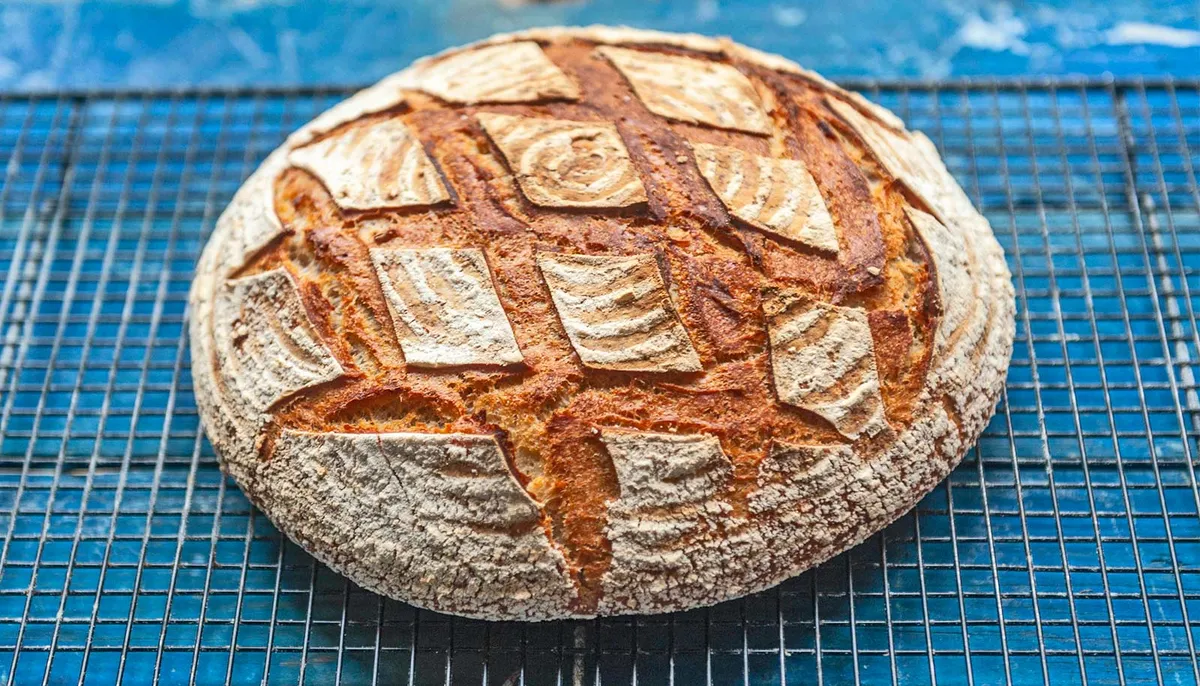
Your kitchen's sourdough starter is a working laboratory. Inside that bubbly jar of flour and water lives a tiny ecosystem—bacteria and yeast negotiating which species thrive together and which fade away. Researchers at Tufts University just figured out how to predict those negotiations, and the implications reach far beyond bread.
The question sounds simple: if you know how two microbial species behave together, can you predict what happens when you add a third, fourth, or ninth species to the mix? Ecologists have debated this for years. Skeptics argued that real microbial communities are too complex, too messy, too unlike the sterile lab conditions where most studies happen. Nature doesn't cooperate with neat pairwise experiments.
But sourdough starters do something useful: they're naturally diverse yet predictable. Most contain just a handful of bacterial species and one or two types of yeast, consistently appearing in the same combinations. "Sourdough starters include a wide diversity of microbes overall," says Lawrence Uricchio, the study's senior author at Tufts. "Yet within these starters, certain species consistently appear together in non-random patterns." It's the perfect place to test whether simple rules can predict complex reality.
We're a new kind of news feed.
Regular news is designed to drain you. We're a non-profit built to restore you. Every story we publish is scored for impact, progress, and hope.
Start Your News DetoxThe researchers isolated microbes from actual sourdough cultures and measured how they grew alone and in pairs. Using those measurements, they built a mathematical model and then watched what happened when up to nine species grew together in lab dishes. The model predicted correctly. Seven of nine species behaved exactly as the equations forecasted.
But here's where it gets interesting. The two species that didn't fit the predictions were ones that could theoretically outcompete others—except they grew so slowly that they never actually did. "When we accounted for the repeated reduction of the microbial population followed by growth that happens in actual starters, our model revealed that these particular species do not reproduce to the point where they actually drive out some of the other species," explains Kasturi Lele, the doctoral student who co-led the work.
That detail matters everywhere microbial communities face boom-and-bust cycles. When antibiotics wipe out gut bacteria, the survivors repopulate in patterns this model could predict. When food-processing plants sanitize equipment, microbial communities rebuild in predictable ways. The same logic applies to farms, hospitals, and the fermentation vessels that make everything from yogurt to kimchi.
The researchers aren't stopping here. Lele is now building models that track how these microbes evolve over time—how genetic changes gradually reshape a once-stable community. That matters because a sourdough starter that's been refreshed for a hundred years isn't the same ecosystem it was a decade ago. Your gut microbiota shifts with age and diet. Understanding those long-term drifts could help predict when a microbial community tips from stable to chaotic, whether that changes the flavor of your bread or your health.