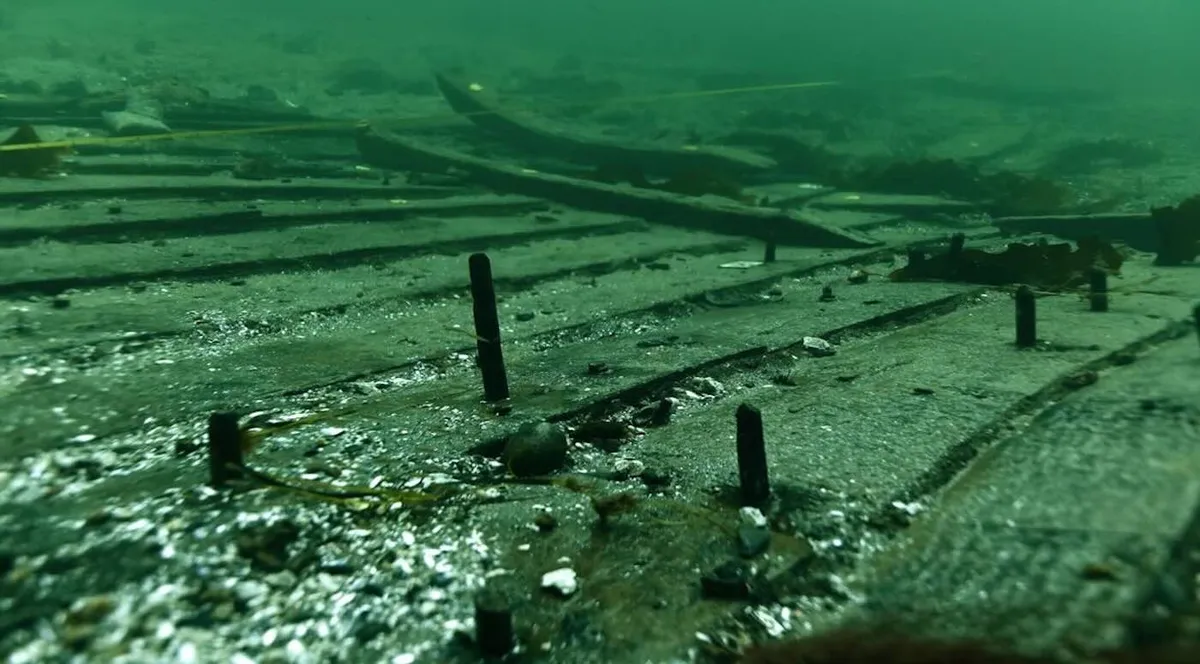
For 600 years, the Oresund strait between Sweden and Denmark kept its secret locked in mud. Now archaeologists have pulled up something that rewrites what we thought possible in the 1400s: the largest medieval cargo ship ever found, so well preserved that sailors' combs and rosary beads still lay scattered in its hold.
The ship, called Svaelget 2, was a "cog"—the workhorse of medieval trade. At 98 feet long and 25 feet wide, it could carry 300 tons of cargo with a small crew. Tree-ring dating shows the Polish oak used to build it was felled around 1410. The vessel sank while sailing north from the Netherlands, apparently empty, but that emptiness turned out to be archaeology's gain. The starboard side buried itself in protective mud, preserving not just the wooden frame but rigging, a brick galley, and even a covered "castle deck" where sailors could shelter from the weather.
"The find is a milestone for maritime archaeology," says Otto Uldum, who led the excavation at the Viking Ship Museum. "It is the largest cog we know of, and it gives us a unique opportunity to understand both the construction and life on board the biggest trading ships of the Middle Ages."
We're a new kind of news feed.
Regular news is designed to drain you. We're a non-profit built to restore you. Every story we publish is scored for impact, progress, and hope.
Start Your News DetoxWhat makes Svaelget 2 extraordinary isn't just its size—it's what size tells us about medieval ambition. Cogs evolved from the clinker-built longboats of the Viking age, designed to carry bulk cargo like timber, salt, and bricks across northern Europe's trade routes. But how big could they actually get? For centuries, we had only drawings and fragments. Now we have proof that medieval shipbuilders pushed the design to an extreme.
The brick-built galley is a small detail with big implications. More than 200 bricks and a dozen tiles survived, arranged around a fireplace where sailors could cook hot meals. For men who'd grown up hearing stories of their ancestors huddled on open Viking ships, this was a revolution in comfort. The preserved rigging—the pulleys and lines that controlled the sails—shows how pilots managed a vessel this size with minimal hands on deck.
"Perhaps the find does not change the story we already know about medieval trade," Uldum reflects. "But it does allow us to say that it was in ships like Svaelget 2 that this trade was created. We now know, undeniably, that cogs could be this large."
That matters because ships this size don't exist without reason. A merchant willing to build and crew a 300-ton vessel was betting on routes, volumes, and networks substantial enough to justify the investment. Svaelget 2 is physical evidence that medieval Europe's trade networks were far more sophisticated and ambitious than we could prove before. It's a reminder that progress isn't always about inventing something new—sometimes it's about building bigger, better versions of what already works.