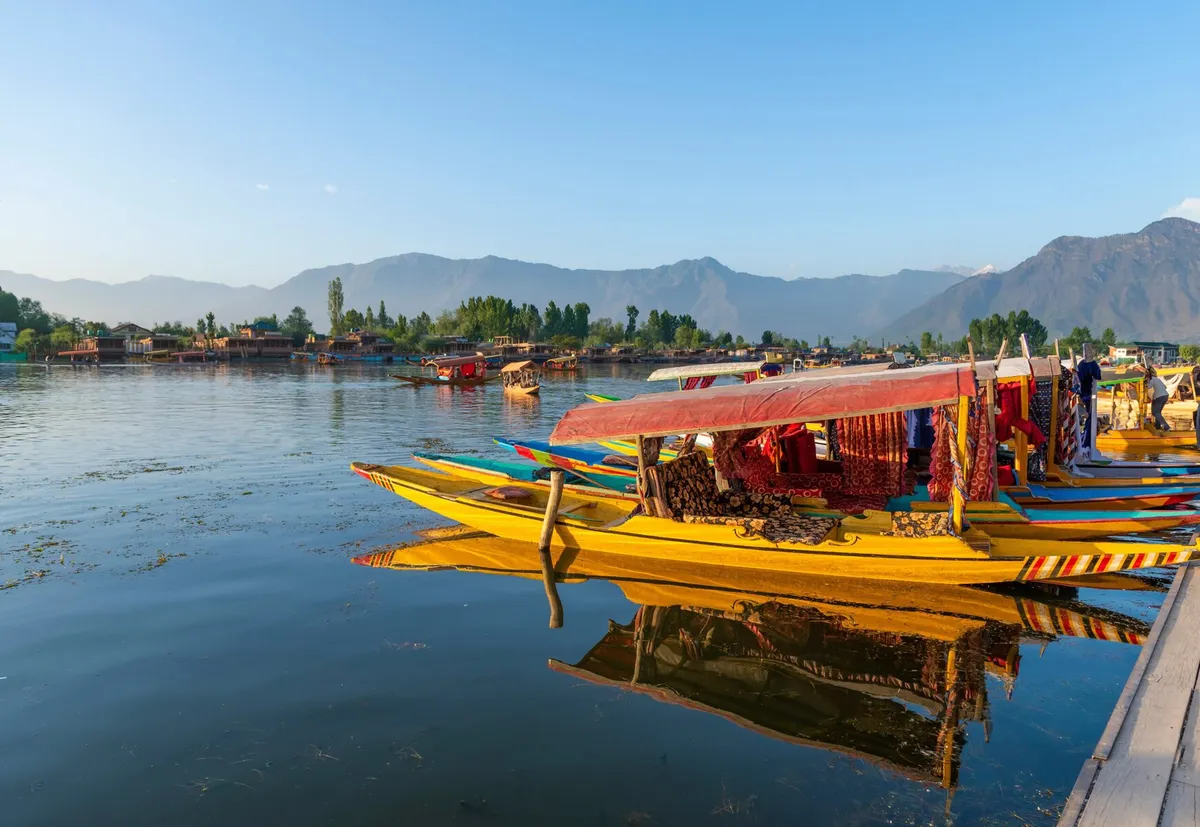
Each weekday morning, as mist lifts off Dal Lake, wooden boats push out from houseboats and island homes. Children in school uniforms sit between oars and lunch pails, some rowing themselves, others ferried by family. In this part of Kashmir, the school day doesn't begin with a bell — it begins with the rhythm of water and paddles.
For the families who live in dongas, or wooden houseboats, scattered across Dal Lake's islands, reaching school has never been straightforward. There are no roads connecting their homes to Srinagar, the nearest city. Just narrow canals, shifting water levels, and a long paddle to land. Eleven-year-old Mahira's boat ride takes nearly 40 minutes each way, navigating waterways lined with lilies and algae. Her older brother rows.
Schools Born from Necessity
The first floating school appeared in 2020, when the pandemic closed classrooms across the valley. Families on the lake decided to act. They cleared space on floating land, set up benches and a blackboard, and began teaching. Today, three teachers share lessons in English, Urdu, math, science, history and geography across what remains a small, unaffiliated school — but one that pulses with ambition.
We're a new kind of news feed.
Regular news is designed to drain you. We're a non-profit built to restore you. Every story we publish is scored for impact, progress, and hope.
Start Your News Detox
What sets these schools apart isn't credentials. Parent Habibullah puts it simply: "This is not a place for degrees. This is a place for learning." Classes are smaller. Teachers give individual attention. Parents stay closely involved. The result: children who once lagged behind are now confidently ahead of their peers.
The curriculum reflects the world students actually inhabit. Geography traces the canals they row through each morning. Science explains the freezing of the lake in winter, or the plants that grow beneath the water. A handful of similar schools now exist across the lake's island communities.
Beyond the Classroom

For students, these schools are spaces of belonging. Attendance and engagement have improved, especially for girls. When temporary closures come — snow, unrest, lockdowns — teachers don't stop. They row out with storybooks or host lessons on verandas, inside small shikaras, in sunlit corners of wooden homes. Parents, even those without formal education themselves, take turns ensuring no child falls behind.
The impact is spreading. Educators in Nepal's Terai region and NGOs in Bangladesh's char islands are now looking to Kashmir's lake schools for inspiration. Across South Asia's floodplains and wetlands, schools often close when waters rise. Here, they float instead.