Before screens and virtual reality, there was Pennsylvania. Specifically, Pennsylvania's early 20th-century amusement parks, which lured city dwellers with the irresistible promise of fresh air and gravity-defying thrills. And boy, did they deliver.
By the 1920s, companies like the legendary Philadelphia Toboggan Company were crafting wooden behemoths that used nothing but physics and lumber to create stomach-lurching drops and glorious moments of airtime. The truly wild part? Many of these mechanical marvels are still rattling along today, proving that sometimes, the old ways are simply the best. Pennsylvania, it turns out, is practically a living museum for the golden age of the wooden coaster.
Still Kicking: The Grand Old Dames of the Track
Take the Jack Rabbit at Kennywood Amusement Park. This centenarian opened in 1920 and is famous for its audacious double-dip drop. Its secret weapon? Engineer John A. Miller's "underfriction" wheels, which basically told gravity, 'Nice try, but we're staying on the track.' Over a hundred years later, that 70-foot drop still gets screams. Kennywood also boasts the Thunderbolt (1924), dishing out G-forces that'll rearrange your internal organs, and the Racer (1927), a "Mobius loop" design where two trains start on opposite sides and race each other. Because apparently, even roller coasters need a little competition.
We're a new kind of news feed.
Regular news is designed to drain you. We're a non-profit built to restore you. Every story we publish is scored for impact, progress, and hope.
Start Your News DetoxThen there's the Thunderhawk at Dorney Park & Wildwater Kingdom. Born in 1923 as "The Coaster," it's one of the last designs from Herbert Paul Schmeck, a name synonymous with Pennsylvania's coaster legacy. This classic "out-and-back" ride weaves through its own wooden skeleton at a modest 45 mph, proving that sometimes, simplicity is the ultimate thrill.
Over at Idlewild & SoakZone, the Rollo Coaster (1938) literally grew out of the landscape. Much of its timber came from the park's own property, and Schmeck designed it to hug the wooded hillside, creating a family-friendly ride that's perfect for easing new recruits into the world of wooden thrills. It even got spiffy new cars in 2018, because even a classic needs a facelift now and then.
But the award for 'Most Epic Relocation Story' goes to The Phoenix at Knoebels Amusement Park. This beauty started life in 1947 as the Rocket in Texas. After almost 40 years, it was slated for demolition. Enter the Knoebels team, who, like true roller coaster whisperers, carefully disassembled every single piece of wood, numbered them, shipped them to Pennsylvania, and rebuilt the entire thing. Now, the Phoenix consistently wins Amusement Today's #1 wooden roller coaster award. Because if you're going to save a coaster, you might as well save the best.
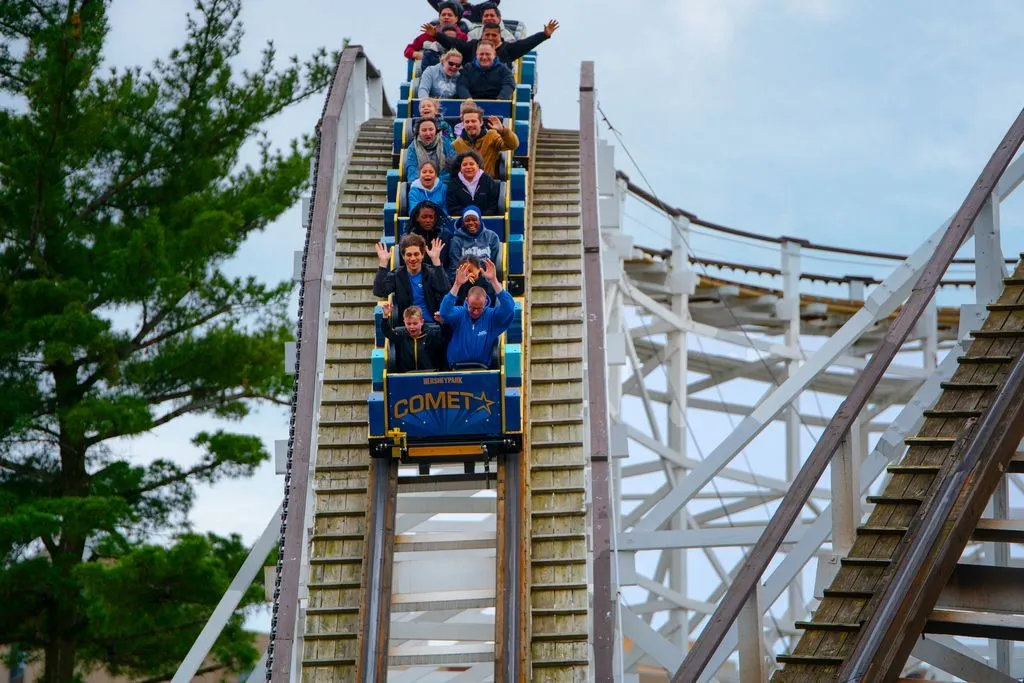
Hersheypark's The Comet has a similar tale, having started its life in Canada in 1946 before finding its forever home in Pennsylvania in the 1970s. Generations have enjoyed its nearly 80-foot drop and those glorious moments of airtime. It's so iconic, the American Coaster Enthusiasts gave it Landmark status. Which, if you think about it, is both impressive and slightly terrifying for a ride that still tries to throw you out of your seat.
Not Just History: Wooden Thrills Still Being Built
Lest you think wooden coasters are only for the history books, meet the Ravine Flyer II at Waldameer Park in Erie. Built in 2008, this modern marvel is Pennsylvania's tallest and fastest wooden coaster, dramatically leaping over a public road. It combines classic looks with modern engineering, boasting 120- and 105-foot drops, four tunnels, and a 165-foot bridge. It's proof that old-fashioned thrills can still feel brand new.
Hersheypark also features the Lightning Racer, a 2000-era masterpiece that's actually two wooden coasters named Thunder and Lightning, racing each other on 3,400 feet of intertwining track. Designed by Great Coasters International, it's a symphony of near misses and close finishes, consistently ranked among the world's 25 best wooden roller coasters. Because why ride one wooden coaster when you can ride two, and have them try to beat each other?
Pennsylvania's wooden coasters aren't just rides; they're living, breathing pieces of history, still delivering that pure, unadulterated, gravity-powered joy. And honestly, isn't that a breath of fresh air?