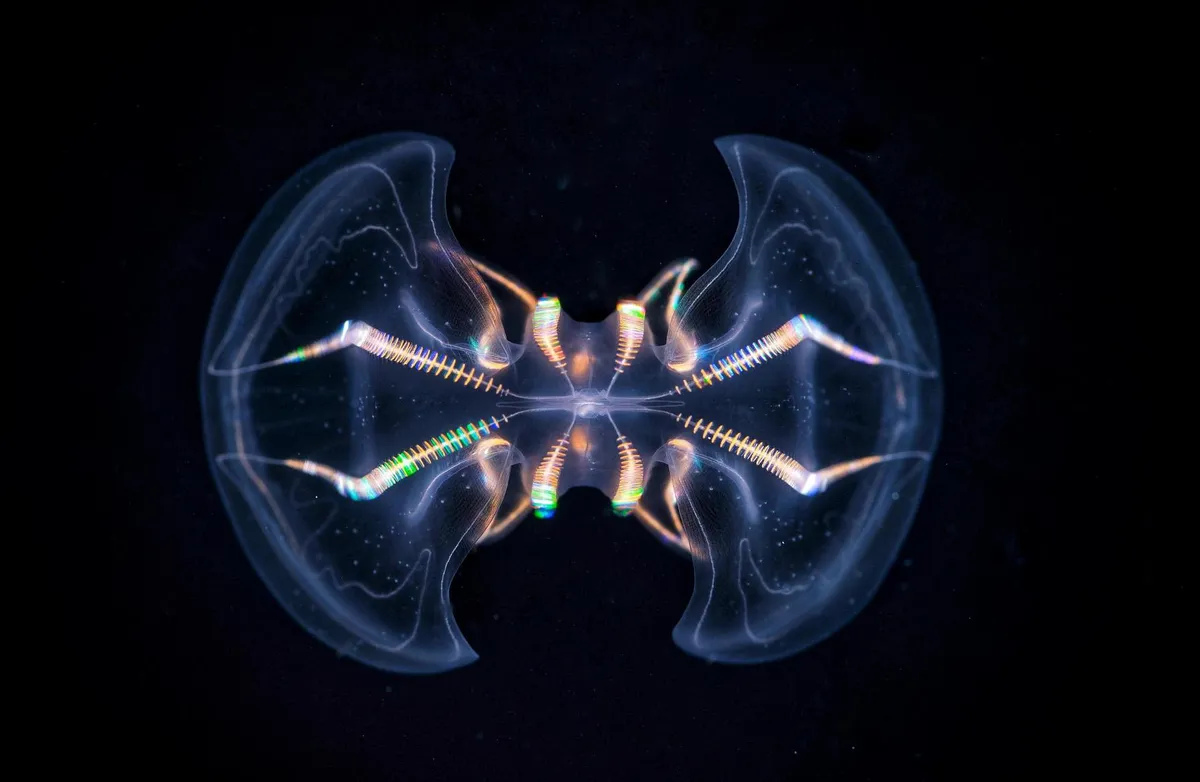
Comb jellies might be gelatinous blobs drifting through the ocean, but they're hiding something surprising: a sensory organ so complex it functions almost like a brain.
Scientists just mapped the internal structure of this organ in remarkable detail, and what they found rewrites how we think about when nervous systems first evolved on Earth. The research, published in Science Advances, reveals that ctenophores—these creatures' formal name—possessed a level of neural sophistication that nobody expected from animals that first appeared roughly 550 million years ago.
"The aboral organ is a complex and functionally unique sensory system," says Pawel Burkhardt, who led the research at the University of Bergen. "Our study profoundly enhances our understanding of how behavioral coordination evolved in animals."
We're a new kind of news feed.
Regular news is designed to drain you. We're a non-profit built to restore you. Every story we publish is scored for impact, progress, and hope.
Start Your News DetoxWhat They Found
Using advanced electron microscopy, researchers built three-dimensional reconstructions of the aboral organ—the sensory structure comb jellies use to detect gravity, pressure, and light. The surprise: it contains 17 different cell types, 11 of which had never been identified before.
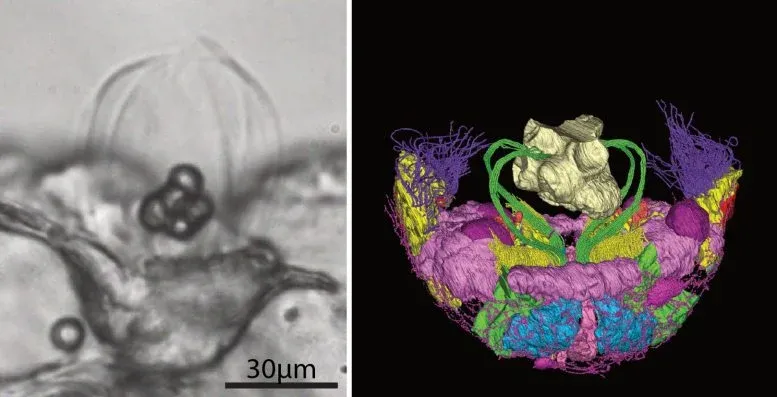
Anna Ferraioli, the study's first author, describes the moment of discovery: "I was amazed almost immediately by the morphological diversity of the aboral organ cells. Working with this data feels like discovering new exciting things every day. The complexity is striking."
But here's where it gets really interesting. The organ doesn't communicate with the rest of the nervous system in just one way. It uses a hybrid approach: direct synaptic connections (like synapses in our brains) plus something called volume transmission, where cells release chemical signals that spread through surrounding tissue. It's a sophisticated two-way communication system.
The team also examined which genes are active in comb jellies and found something unexpected: while many of the same developmental genes exist in comb jellies as in other animals, they're turned on and off in completely different patterns. This suggests that comb jellies invented their own version of a centralized nervous system independently—evolution solving the same problem in multiple ways.
How It Actually Works
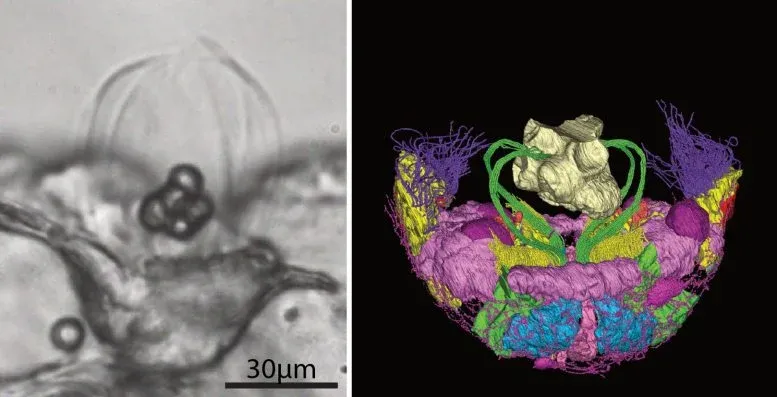
Another research team, led by Kei Jokura in Japan and collaborating with Burkhardt, took this further. They reconstructed the neural wiring of the gravity-sensing organ by mapping over 1,000 individual cells. What they discovered: networks of fused neurons that coordinate the beating of tiny hair-like structures on different sides of the animal's body. This synchronized movement lets comb jellies stay upright as they drift through water.
"The similarities to neural circuits in other marine organisms suggest that comparable solutions to gravity sensing may have evolved independently," Jokura notes.
What's genuinely wild here is the timeline. These creatures were developing sophisticated sensory systems before most other animals had anything resembling a brain. It suggests that early nervous systems were far more organized and centralized than scientists previously thought.
Ferraioli is clear about one thing: "The aboral organ is definitely not like our brain. But it could be defined as the organ that ctenophores use as a brain."
Next, researchers plan to dig deeper into the molecular makeup of these newly discovered cell types and explore how the aboral organ influences comb jelly behavior. The work hints at a bigger picture: that nervous systems didn't evolve just once, but multiple times, each solution finely tuned to what an animal needed to survive.