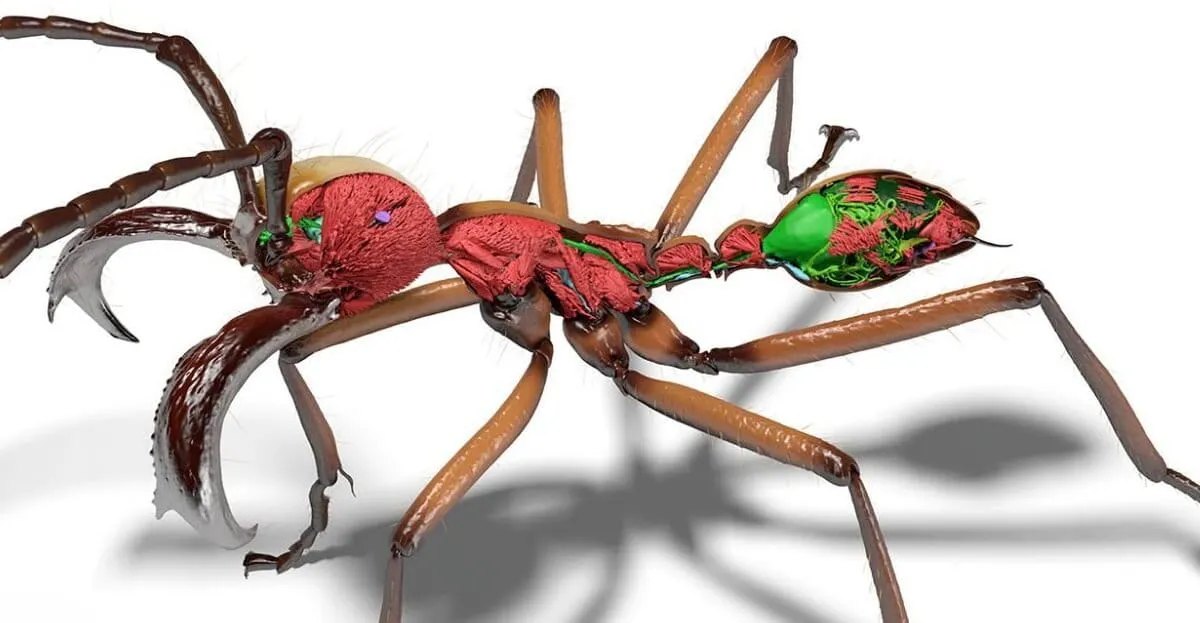
Scientists have developed a new robotic method to quickly create detailed 3D images of ants. This project, called Antscan, is the world's first digital library of nearly 800 ant species from 212 genera globally.
Scanning Ants with X-rays
The team used microtomography, similar to human CT scans, to capture X-ray images of the ants' internal organs. While human scans are fast, tiny ants need much higher resolution. This means one ant scan can take 10 to 15 hours, according to Evan Economo from the University of Maryland.
The researchers scanned thousands of ant specimens from museums and collections worldwide. This process would normally take years. However, with the new technique, it was completed in just one week at the Karlsruhe Institute of Technology in Germany. Jessica Ware, an expert not involved in the study, called this "transformative" due to the large number of scans.
We're a new kind of news feed.
Regular news is designed to drain you. We're a non-profit built to restore you. Every story we publish is scored for impact, progress, and hope.
Start Your News DetoxWhy a 3D Ant Library Matters
A library of 3D ant images can greatly improve our understanding of these insects. Ants live in almost every habitat and have complex societies. A detailed 3D view of their bodies, inside and out, can reveal much about how they evolved.
For example, Economo and his team used Antscan images in a 2025 study. They measured ant cuticles, which are their protective exoskeletons. They found that ant species with thicker cuticles had smaller, less diverse colonies. This idea had been a hypothesis for a long time but was hard to prove because ant cuticles are as thin as human hair.
Julian Katzke, a co-author, explained that the 3D data allowed them to measure the ratio of cuticle volume to body volume. This helped them study hundreds of species at once and understand the evolution of this trait.
Broader Impact and Future Possibilities
This public collection of detailed insect images can also help evolutionary biologists, computer scientists, graphic artists, and animators. Economo noted that if creators of animated insect movies had this resource, they could avoid mistakes like "legs coming out of the wrong spot."
One day, it might even be possible to have a public library of scans for every species on Earth. Economo said this makes information accessible worldwide that would otherwise be hidden away in museums.
Deep Dive & References
- New technique - Nature, 2026
- Antscan
- Study on ant cuticles - Science Advances, 2025