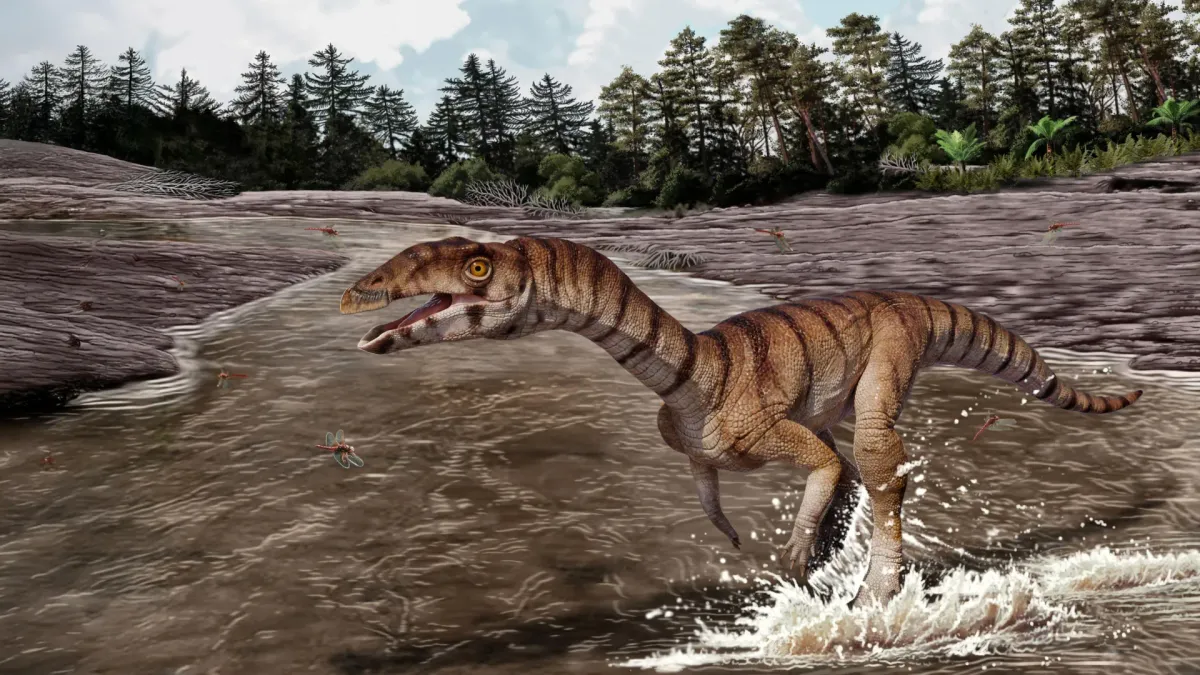
Imagine a crocodile. Now, imagine it stood on two legs, had tiny arms, and sported a beak instead of a mouthful of teeth. Congratulations, you've just pictured Labrujasuchus expectatus, a newly discovered relative from the Triassic Period that apparently decided to cosplay as an ostrich-like dinosaur.
This ancient creature, recently unearthed by scientists, is a stunning reminder that evolution often throws out the rulebook just to see what sticks. While modern crocodiles are all about the four-legged, toothy predator vibe, Labrujasuchus clearly marched to the beat of its own drum – or rather, strutted on two legs to it.
The Crocodile Who Thought It Was a Dinosaur
Published in the Journal of Vertebrate Paleontology, this find is a shuvosaur, a small family of ancient crocodile relatives that consistently fooled everyone by looking exactly like two-legged theropod dinosaurs. It’s like finding out your distant cousin is actually a world-famous mime. They're related, but the career paths are wildly different.
We're a new kind of news feed.
Regular news is designed to drain you. We're a non-profit built to restore you. Every story we publish is scored for impact, progress, and hope.
Start Your News DetoxDr. Alan Turner, the lead author, points out that this is a prime example of convergent evolution. Basically, different species independently develop similar traits because those traits are just really good ideas. Walking on two legs? Great idea for dinosaurs. And, apparently, for this branch of the crocodile family tree. Who knew?
And Labrujasuchus expectatus isn't the only weirdo from the Triassic. This was a true golden age for evolutionary experiments. You had lagerpetids, tiny two-legged dinosaur relatives whose descendants became pterosaurs (the flying reptiles). There was Drepanosaurus, a tree-dweller with a sloth-like claw and another one on its tail. And Vancleavea, an armored aquatic reptile often described as a tiny tank. The Triassic was basically Earth's first fever dream.
The Ranch of the Witches Reveals Its Secrets
This particular ostrich-croc was found at Ghost Ranch in New Mexico, a site so rich in fossils it almost feels like cheating. The name Labrujasuchus is a nod to its origins, combining "Ranchos de los Brujos" (old Spanish for Ranch of the Witches, which is just fantastic) with the Greek word for crocodile, suchus.
According to co-author Dr. Nate Smith, the original rancheros named it that to scare off cattle rustlers. Which, if you think about it, is a pretty brilliant deterrent. Who wants to steal cattle from the Ranch of the Witches? Not me. I have plans. And those plans do not involve being turned into a newt.
The "expectatus" part of the name is equally charming. Paleontologists had found shuvosaur fossils from older and younger rock layers in the region, strongly suggesting there was a missing link right in the middle. Labrujasuchus expectatus slid right into that spot, proving that sometimes, even in the wild world of prehistoric discoveries, things go exactly as planned. It's almost anticlimactic, but in the best possible way.
Ghost Ranch, famous for its landscapes painted by Georgia O'Keeffe, continues to be a treasure trove, with Dr. Smith and his team celebrating 20 years of excavations this summer. It seems the Ranch of the Witches still has a few unexpected tricks up its sleeve, revealing the weird and wonderful ways life found a way, millions of years ago.