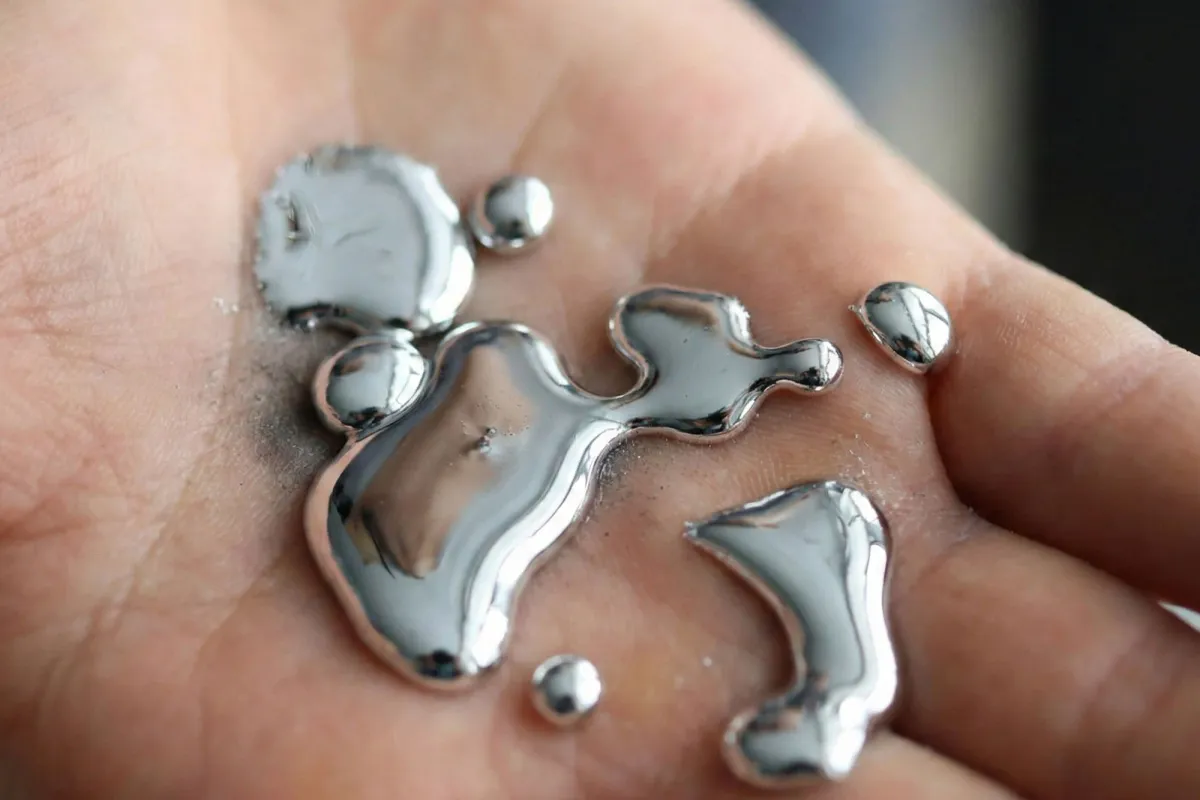
Gallium. You know, that metal that turns into a shimmering puddle if you hold it for too long? It's been pulling a fast one on scientists for decades, and they've finally called its bluff.
Turns out, this unassuming element, first discovered in 1875 and a common resident in your semiconductors and LEDs, has been hiding a secret about its liquid form. For over 30 years, researchers believed they had a handle on its atomic structure once it melted. They were wrong.
The Great Gallium Deception
Solid gallium is already a bit of an oddball. Its atoms pair up, sharing electrons like nonmetals, and unlike most substances, its solid form is less dense than its liquid form. Think ice floating on water, but for a shiny metal. Wild, right?
We're a new kind of news feed.
Regular news is designed to drain you. We're a non-profit built to restore you. Every story we publish is scored for impact, progress, and hope.
Start Your News DetoxScientists long assumed that these electron-sharing bonds stuck around when gallium melted, explaining its weird electrical resistance. When it melts, it conducts electricity better. But then, as the liquid gets hotter, that resistance goes up again. A real head-scratcher.
Enter the University of Auckland team. Using some seriously detailed computer simulations, they found that those bonds? They vanish when gallium melts. Poof. Gone. But here's the kicker: as the liquid gets hotter, those bonds start to reappear. It's like they went on vacation and decided to come back for the summer.
This disappearing and reappearing act is the key to that bizarre electrical resistance. More structure at higher temperatures means more resistance. Apparently, gallium just likes to keep us on our toes.
As Professor Nicola Gaston put it, a fundamental assumption about liquid gallium's structure, held for three decades, was simply not true. Oops.
Why This Matters (Beyond Melting in Your Palm)
This isn't just a fun fact for your next dinner party. Gallium is a superstar in the burgeoning field of liquid metals, which are pretty much the cool kids of future tech. Because it stays liquid at low temps, it can dissolve other metals, creating alloys for everything from energy systems to advanced manufacturing. These materials can even self-assemble, turning a chaotic mess of atoms into useful patterns.
Understanding gallium's shape-shifting ways means scientists can design liquid metal systems with surgical precision. Imagine better batteries, flexible electronics that bend and twist, and super-efficient catalysts. All thanks to knowing when gallium's atoms are playing footsie and when they're not.
The Surface-Level Surprise
And just when you thought gallium couldn't get any stranger, the same team found that even its surface has hidden layers of organization. Liquids are supposed to be all random and chaotic, right? Not gallium. Its surface forms subtle geometric patterns, extending about three atomic layers deep before it finally gives in to liquid disorder.
It's like finding out your perfectly messy desk actually has an intricate, invisible filing system. Even a single bismuth atom can disrupt this delicate surface order, proving just how finicky this metal is. Gallium continues to be the ultimate contrarian, showing that even in apparent disorder, there can be surprising levels of structure.