A few years ago, a metal detectorist in Scotland found an ancient bronze brooch. It is less than 2.5 inches long and decorated with red and yellow enamel. This artifact was found near Pathhead village. It shows how Roman influence shaped British artisans after the Romans invaded the island in the first century C.E.
Fraser Hunter, a curator at National Museums Scotland, called the Pathhead brooch a "miniature masterpiece." He noted its exquisite details. He said that fancy Roman pieces like this were rare even then. They were used to show off status in local society.
The brooch will soon be displayed for the first time. It will be part of the National Museums' upcoming exhibition, "Roman Scotland: Life on the Edge of Empire."
We're a new kind of news feed.
Regular news is designed to drain you. We're a non-profit built to restore you. Every story we publish is scored for impact, progress, and hope.
Start Your News Detox
Roman Influence and Local Craftsmanship
Researchers believe the brooch was once covered in tin, giving it a silvery shine. They date it to between 100 and 160 C.E. However, its shape and design recall older Celtic art.
Hunter explained that the basic idea for these brooches came from Roman designs brought to northern Britain. Local craft workers then adapted these traditions. This shows a powerful blend of cultures.
Before the Romans arrived in Britain, the island was home to various tribes. In what is now Scotland, multiple tribal peoples lived. The Romans later called them the Caledonii.
Emperor Claudius invaded southern Britain in 43 C.E. Decades later, the Roman military began invading Scotland.
Rome's Disjointed Conquest
In the second century, Emperor Hadrian built his famous wall across Britain. This marked Rome's northwestern border. However, this border was not fixed. The next emperor, Antoninus Pius, pushed his forces beyond Hadrian's Wall. He built the lesser-known Antonine Wall, a turf border across Scotland's narrowest point.
The Romans offered tribes a choice: join the empire or face their army. The National Museums note that "If they resisted, they were crushed. This was a brutal army of occupation." However, rebellious tribes used guerilla tactics against the Romans. Each Roman campaign into Scotland was short-lived.
Rome never fully controlled Scotland's wild areas. Scholars still debate why. Was it the fierce local warriors, the rough landscape, or difficult conditions? Or perhaps the rewards did not justify the effort, or it was simply too far away.
The brooch might show peaceful interactions during this time of colonization. Experts believe a Roman may have given it to a native Scottish leader. It could have been a symbol of status and favor. Other artifacts found nearby suggest that the area around Pathhead was an Iron Age British settlement that interacted with the Romans.
Hunter stated that "Whoever wore it would have been out to impress."
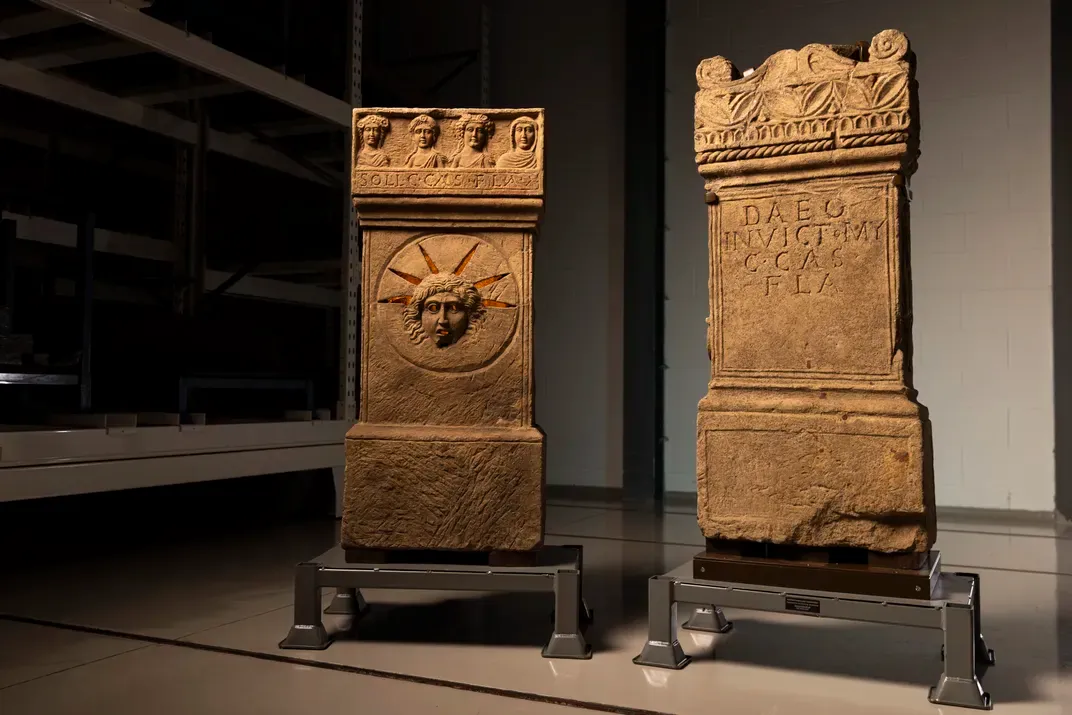
The exhibition will also feature discoveries from a second-century Roman fort in Inveresk. These include two carved stone altars from its religious temple. The temple was dedicated to Mithras, a Persian god adopted by some Romans, specifically the secretive, all-male Roman Cult of Mithras.
The National Museums stated that these rare altars "are among the finest examples of sculpture from Roman Britain."
"Roman Scotland: Life on the Edge of Empire" will be on display at the National Museum of Scotland in Edinburgh from November 14, 2026, to April 18, 2027.