

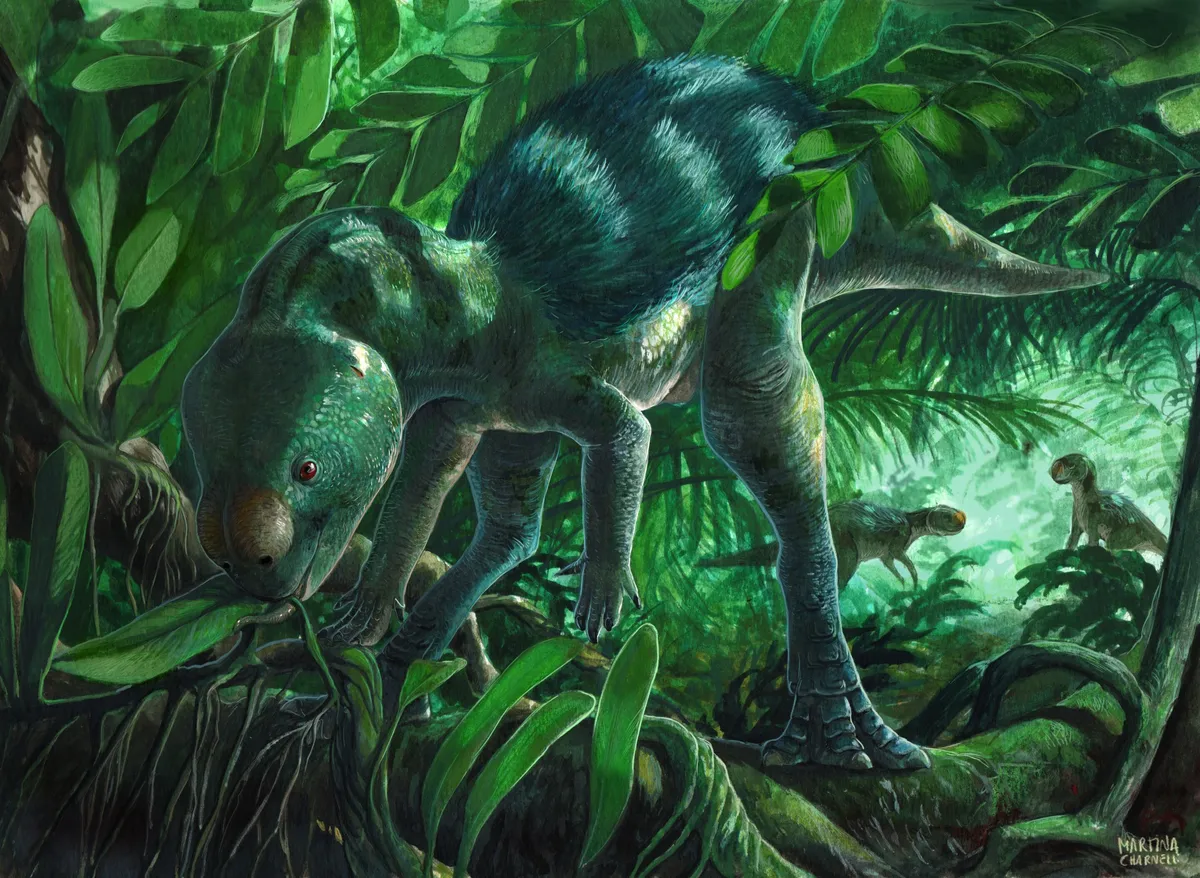
Half a meter long. That's how small Foskeia pelendonum was—roughly the size of a modern chicken, yet packed with anatomical surprises that scientists didn't expect to find at all.
Paleontologists in Spain uncovered fossils of this Early Cretaceous dinosaur, and what struck them immediately wasn't what they found, but what it meant. "From the very first moment anybody sees this animal, one is staggered by its extreme smallness," says Paul-Emile Dieudonné, who led the international team describing the discovery. "And yet it preserves a highly derived cranium with unexpected anatomical innovations."
The bones came from at least five individuals, unearthed near Burgos in northern Spain. Fidel Torcida Fernández-Baldor, who first discovered them at the Dinosaur Museum of Salas de los Infantes, knew immediately they were exceptional. "It is equally impressive how the study of this animal overturns global ideas on ornithopod dinosaur evolution," he notes.
We're a new kind of news feed.
Regular news is designed to drain you. We're a non-profit built to restore you. Every story we publish is scored for impact, progress, and hope.
Start Your News DetoxWhat makes Foskeia remarkable isn't just its size—it's what that size reveals about how evolution works. Miniaturization, it turns out, didn't mean simplification. The creature's skull was "weird and hyper-derived," in the words of researcher Marcos Becerra, packed with specialized features that suggest Foskeia was fundamentally different from anything we'd seen before. "This is not a 'mini Iguanodon,' it is something fundamentally different," explains Táabata Zanesco Ferreira.
Filling a 70-million-year gap
Here's where Foskeia becomes genuinely important: it bridges a massive gap in the fossil record. Thierry Tortosa, a researcher at Sainte Victoire Natural Reserve, describes it as "a small key that unlocks a vast missing chapter"—70 million years of European dinosaur evolution that we knew almost nothing about.
Bone analysis confirmed that the largest specimen was a fully grown adult, with a metabolism approaching that of small mammals or birds. This matters because it tells us Foskeia wasn't a juvenile of some larger species—it was genuinely tiny throughout its life. The creature relied on bursts of speed through dense forests and had specialized teeth for processing plants, suggesting it occupied a niche no other dinosaur quite filled.
A new family tree analysis places Foskeia near the origin of Rhabdodontidae, a European herbivorous lineage, and the study also revives a long-debated grouping called Phytodinosauria—plant-eating dinosaurs forming a natural evolutionary family. "This hypothesis should be further tested with more data," Dieudonné notes, keeping the door open for future discoveries.
The deeper lesson here is about what paleontologists have often overlooked: "Evolution experimented just as radically at small body sizes as at large ones," Dieudonné says. "The future of dinosaur research will depend on paying attention to the humble, the fragmentary, the small." That shift in perspective—taking seriously the creatures we've dismissed as insignificant—might be exactly what unlocks the next chapter of dinosaur science.





