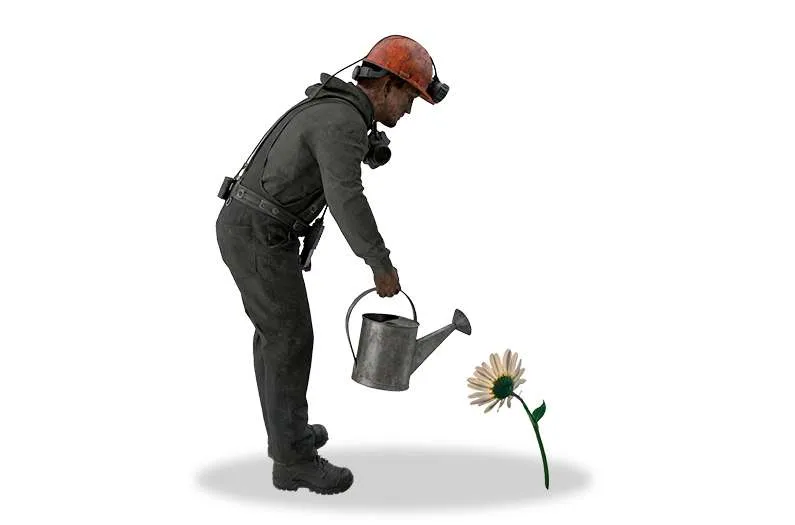
Instead of traditional mining, imagine fields of flowers extracting valuable metals. This is the idea behind phytomining. It uses plants to pull critical minerals like nickel from the soil. This method could help power electric vehicles and other green technologies.
Farming Metals with Plants
A single electric vehicle battery needs over 100 pounds of nickel. Getting these metals often involves destructive mining practices. These mines cause deforestation, pollution, and huge carbon emissions, especially in places like Indonesia. Nickel mining is the fourth largest source of emissions in the global mining industry.
A French company called Genomines is changing this picture. They are engineering plants, specifically daisies from the Asteraceae family, to absorb nickel from soils. They envision fields of yellow daisies instead of open pits. This process is called phytomining. It uses plants to extract heavy metals from the ground.
We're a new kind of news feed.
Regular news is designed to drain you. We're a non-profit built to restore you. Every story we publish is scored for impact, progress, and hope.
Start Your News DetoxMining has historically harmed the planet, causing water pollution and environmental damage. But plants can quietly work to clean up soils, especially in areas damaged by industry or old mines. About 700 of the world's 320,000 plant species can hyperaccumulate metals. This trait protects them from predators and allows them to grow in toxic, metal-rich soils.
Phytomining isn't new. Scientists used plants to clean up cesium near Chernobyl after the 1986 nuclear disaster. The US Department of Agriculture also tried it in the late 1980s. However, that project stopped when a test plant became an invasive species. At the time, traditional metal mining was cheap, so plant-based methods weren't widely adopted.
Now, demand for metals and better science are bringing phytomining back. As the need for electric battery metals grows, phytomining offers a new way to get resources and clean up waste. Rupali Datta, a biochemist at Michigan Technical University, notes that supply chain issues and the need for nickel have renewed interest in this method.
Most nickel comes from Indonesian mines. High-grade nickel reserves could run out this decade, and lower-grade ore by 2050. Building new mines and refineries is slow and costly. Alicja Babst-Kostecka, an environmental scientist, sees phytomining as a promising nature-based solution. It cleans contaminated land and recovers valuable metals, restoring ecosystems. This dual benefit drives its current momentum.
To make phytomining work, advances in plant biology, ecology, chemistry, and biotechnology are needed. It also requires suitable environments where soils have limited other uses.
From Farm to Battery
Several startups are making phytomining a reality. Genomines researchers are bioengineering daisies to be taller with larger leaves, so they can store more metal. They also created a soil microbiome to help plants absorb more metal. They've increased the metal stored in plants from about 2% to nearly 8% of their body mass. To get the metal, the plants are mashed and heated, releasing a "bio-ore" that can be purified.
Fabien Koutchekian, cofounder of Genomines, believes phytomining can create smaller, more eco-friendly mines. These mines could fit alongside farms or towns. He says it could have the economics of a farm but the revenues of a mine.
Genomines starts growing plants in France for stability. After eight weeks, seedlings move to South Africa. Six months later, plants are harvested. The company recovers metal using techniques like bioleaching and heating. They use pyrolysis, heating plants without oxygen, to create a nickel-rich bioconcentrate. This process also captures carbon dioxide for renewable energy. Genomines expects 2.5 tons of nickel per hectare, which is about 40,000 plants. They aim to produce battery-grade nickel at about 40% of the cost of traditional methods.
This process offers multiple benefits. It creates valuable metal and cleans up degraded land. Since the plants are perennials, they can last up to 15 years without replanting. Genomines has raised $45 million and plans to produce 150,000 tons of bio-nickel per year by 2030. This could supply batteries for three million electric cars.
About 80 countries have nickel-rich deposits, offering many potential sites for metal extraction. Naturally metal-rich soils and former mine dump sites are good locations.
Genomines is not alone. Metalplant has a phytomining farm in Albania using the shrub Odontarrhena chalcidica. This area has soil so rich in nickel that traditional crops struggle. Botanickel works in Malaysia and Greece to create plant-generated stainless steel. Two-thirds of the world's nickel is used for stainless steel.
New Research and Future Potential
New research supports the growth of phytomining. The US Department of Energy’s ARPA-E awarded $9.9 million to seven phytomining projects. The agency wants to boost domestic nickel supply from nickel-rich soils in California, Oregon, Pennsylvania, and Maryland.
Rupali Datta's team in Michigan is studying soil chemistry, microbes, and specific plants to increase nickel uptake. They are also developing a biosensor to measure nickel in plants, which is currently a difficult process. When hyperaccumulator plants are burned, their ash can contain up to 20% pure metal, requiring little refining.
Datta's team is testing vetiver grass, known for cleaning lead contamination, for its ability to accumulate nickel. Initial results show it accumulates a lot of metal in its roots. The project aims to move the metal into the leaves and stem for easier harvesting. Vetiver grass is native to the US and is not genetically modified, which could simplify deployment.
Alicja Babst-Kostecka's team is researching which plant species thrive in different soil conditions. Many hyperaccumulators grow slowly and have specific needs. Her team studies how plants absorb, store, and move metals, especially in metal-rich environments like old mine sites. She emphasizes that soil microbiomes and root-microbe associations also affect plant performance and metal availability.
Metalplant, another DOE grantee, plans to genetically modify its Albanian plants for North America. They will also introduce sterility to prevent invasive behavior, which caused problems in early phytomining experiments.
Phytomining may be most effective where traditional mines are not feasible due to technical difficulty, environmental damage, or social unacceptability. Babst-Kostecka believes it may not replace large-scale mining but can fill important gaps.
Nickel is a good starting point for phytomining, but researchers are exploring other minerals like cobalt, thallium, and selenium. These are crucial for semiconductors and batteries and are mostly controlled by China. Scientists could also engineer artificial hyperaccumulators for specific metals, locations, and conditions.
Mines leave lasting damage on Earth. Phytomining can help heal these landscapes, restore soil health, and address past and future mining impacts. Babst-Kostecka says using biological processes to recycle metals and rehabilitate land aligns deeply with sustainability and environmental justice.
Phytomining won't solve all resource or environmental problems. However, it offers unique benefits for neglected or hard-to-restore contaminated lands and old mine sites. It encourages people to rethink what they consider waste. Many damaged landscapes could become productive again, both ecologically and economically, thanks to the unseen power of plants.