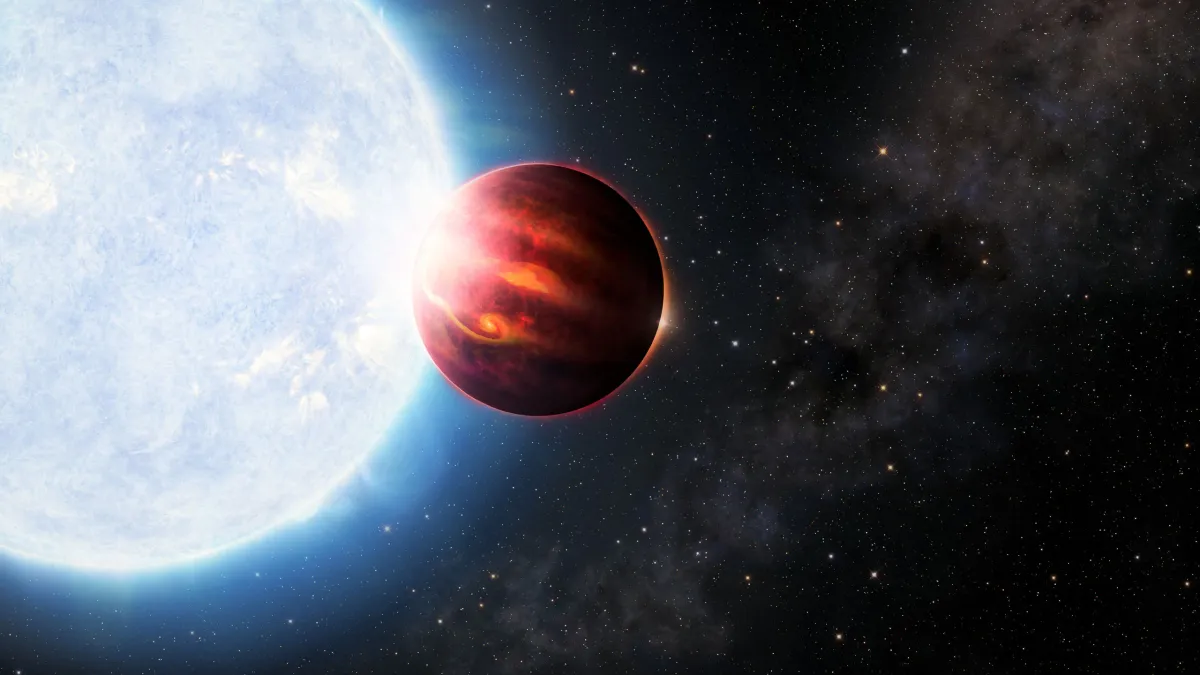
Scientists have confirmed that an exoplanet's chemical makeup mirrors its star. This finding validates a core assumption about how planets form and change over time.
Astronomers found that the giant exoplanet WASP-189b closely matches its parent star's chemical composition. This is the first direct confirmation of a key idea in astrobiology.
This breakthrough came from the first simultaneous detection of gaseous magnesium and silicon in a planet’s atmosphere. Researchers used the Gemini South telescope for these observations. The U.S. National Science Foundation partly funds this telescope.
We're a new kind of news feed.
Regular news is designed to drain you. We're a non-profit built to restore you. Every story we publish is scored for impact, progress, and hope.
Start Your News DetoxAn Ultra-Hot Jupiter
WASP-189b is about 320 light-years away in the Libra constellation. It is an "ultra-hot Jupiter" (UHJ). These planets are hot enough to vaporize rock-forming elements like magnesium, silicon, and iron.
This makes them perfect for spectroscopy. This method separates light into its different wavelengths to find chemical signatures.
Jorge Antonio Sanchez, a graduate student at Arizona State University (ASU), led the study. His international team used the Immersion GRating INfrared Spectrograph (IGRINS) on the Gemini South telescope in Chile. This allowed them to measure magnesium and silicon in the planet’s atmosphere at the same time.
A slow zoom into WASP-189b, an ultra-hot Jupiter exoplanet. Astronomers discovered that WASP-189b echoes the composition of its host star. This is the first direct evidence of a foundational concept in astrobiology. Credit: International Gemini Observatory/NOIRLab/NSF/AURA/DSS/N. Bartmann/E. Slawik/D. de Martin/M. Zamani
The results show that the planet has the same magnesium-to-silicon ratio as its host star. This is the first direct evidence supporting a long-held idea about how planets form. It also offers a new way to study how exoplanets begin and change.
Gemini Telescope's Role
Chris Davis, NSF Program Director for NOIRLab, noted Gemini's ability to help understand exoplanets. He said these discoveries are only possible because of Gemini’s advanced instruments.
Scientists believe that hot giant planets like WASP-189b have outer atmospheres shaped by the disks they formed in. These disks are made of gas and dust. Researchers have long assumed their chemical makeup matches the host star. This is because both come from the same cloud of material.
Until now, this link between stars and their planets was only guessed from studies in our solar system. It had not been directly seen in exoplanets.
Linking Star and Planet Chemistry
Sanchez explained that WASP-189b gives scientists a real observation to confirm their understanding of planet formation. It validates the idea that stellar composition and the amount of rocky material around stars are similar.
This relationship is important for understanding how planets form. It also matters for astrobiology, which looks at conditions that support life. By studying a star’s chemical makeup, scientists can estimate the amount of rock-forming elements in its planets.
These elements affect important planetary features. They influence magnetic fields, plate tectonics, and the release of chemicals needed for life into the atmosphere, oceans, and soil.
Astronomers discovered that a giant planet, WASP-189b, echoes the composition of its host star. This provides the first direct evidence of a foundational concept in astrobiology. Credit: International Gemini Observatory/NOIRLab/NSF/AURA/DSS/N. Bartmann/E. Slawik/D. de Martin/M. Zamani/J. Pollard, ESA/Hubble (M. Kornmesser & L. L. Christensen), NASA/JPL-Caltech/NASA’s Goddard Space Flight Center Motion graphics: Mik Garrison Music: Cryodisco – Mik Garrison
Study co-author Michael Line, an Associate Professor at ASU, said their work shows what ground-based instruments can do. They can find key elements like magnesium and silicon, which are building blocks for rocky planets. This new ability opens up a whole new way to study exoplanet atmospheres.
Future observations will help us understand exoplanet atmospheres even more. These efforts will show the full range of chemicals on distant worlds. They will also give deeper insight into how planets form, change, and might support life.
Deep Dive & References
A Stellar magnesium to silicon ratio in the atmosphere of an exoplanet - Nature Communications, 2026