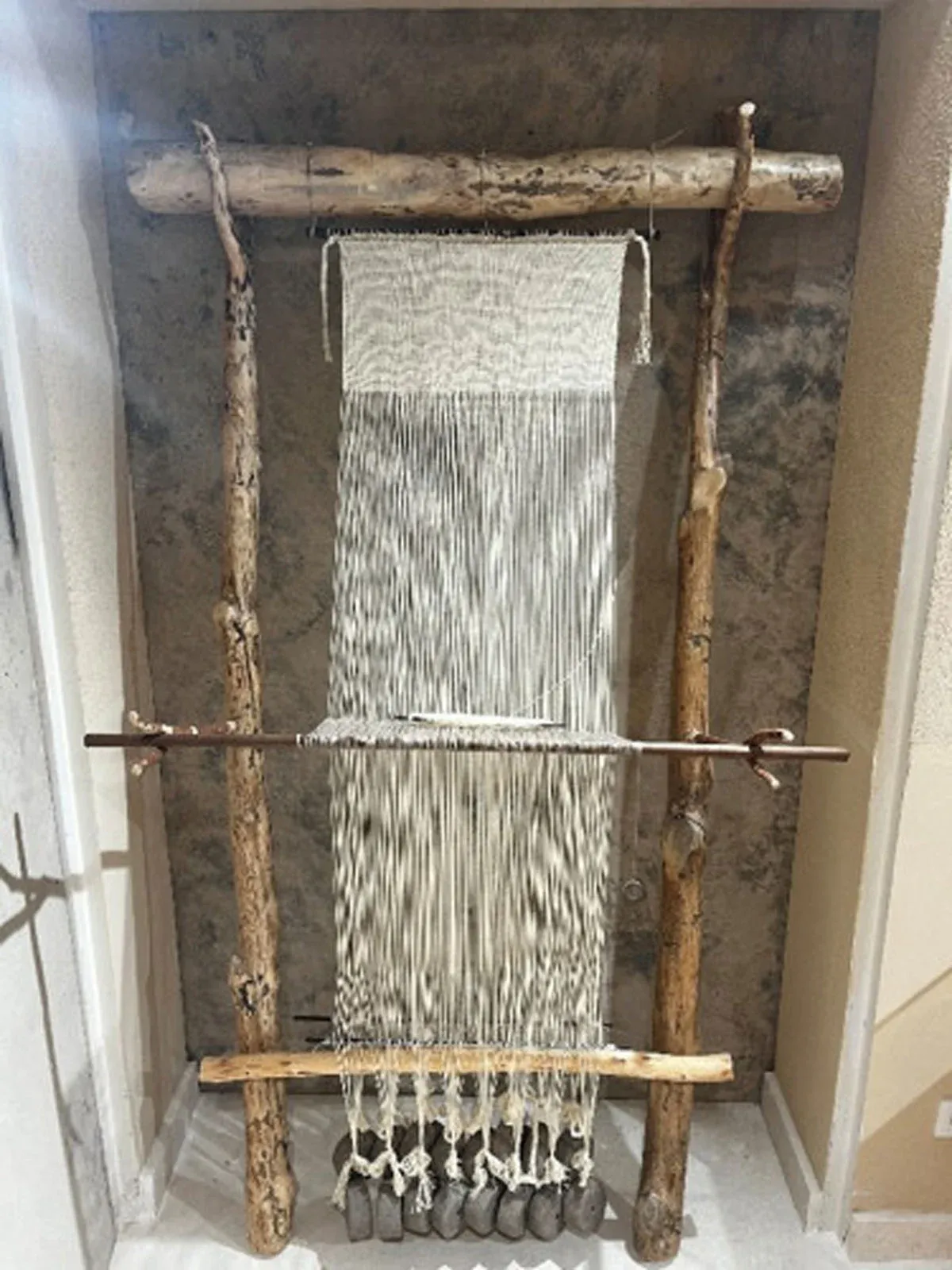
Turns out, you can learn a lot about ancient fashion from a pile of charred wood and some clay weights. Researchers in Spain just pieced together a 3,500-year-old loom, and it’s giving us a surprisingly detailed look at Bronze Age textile production.
Now, warp-weighted looms — essentially threads hanging down, pulled taut by weights — were standard issue in ancient Europe. But the actual wooden bits? They usually vanish faster than a free sample at Costco. Most of what we knew came from the weights themselves. Dr. Ricardo E. Basso Rial, who led the research at the University of Granada, put it simply: the weights proved textiles existed, but the looms themselves were basically ghosts.
Unearthing an Ancient Wardrobe
Then came Cabezo Redondo, a Bronze Age site in southern Spain. Here, alongside the usual clay loom weights, archaeologists found something extraordinary: charred wooden beams and plant fiber ropes. It was like stumbling upon the IKEA instruction manual for a truly ancient piece of furniture, miraculously preserved.
We're a new kind of news feed.
Regular news is designed to drain you. We're a non-profit built to restore you. Every story we publish is scored for impact, progress, and hope.
Start Your News DetoxThis isn't just any old find. It's one of the best-preserved examples in the entire western Mediterranean. Which means, for the first time, we can actually see how these weavers were getting their craft on during the Bronze Age in Iberia.
The team meticulously studied the wood (Aleppo pine, common to the area) and those crucial weights. And here’s where it gets interesting: these weights were significantly lighter than others found in the region. This isn't just a fun fact; it suggests they were making finer, more intricate fabrics. Think haute couture, but with more dirt.
Dr. Basso Rial thinks this loom could handle simple tabby fabrics, sure. But it also might have been capable of more complex textiles, possibly even early twill weaves. If you’re not a textile historian, just know this is a big deal. Tabby was basically the t-shirt of the Stone Age. Twill, which usually used wool, showed up much, much later, becoming widespread closer to 1000 BC.
So, the idea that twill weaving was happening at Cabezo Redondo a millennium earlier? That’s not just a wardrobe upgrade; it suggests the site was a hub of a full-blown “textile revolution.” More wool, more variety, more reasons for ancient influencers to show off their new threads. It’s a rare, tangible snapshot of a daily craft, frozen in time, nearly 3,500 years ago. Pretty neat for a bunch of old wood.