Imagine a material that can't quite make up its mind. One moment it's conducting electricity one way, the next it's doing the exact opposite. This isn't a sci-fi plot; it's a real-world phenomenon called polarity inversion in polymer semiconductors, and for years, scientists have been scratching their heads trying to figure out why only some materials pull off this electrical identity swap.
Good news: a research team from Sungkyunkwan University, alongside collaborators from Gyeongsang National University and Gachon University, just figured it out. Their findings, published in Advanced Functional Materials, finally explain this quirky behavior.
The Electrical Flip-Flop
Polymer semiconductors are the rockstars of next-gen electronics. They're light, flexible, and can be printed or coated onto surfaces, making them perfect for everything from bendable screens to cheap solar cells. The magic happens when you add a "dopant" — essentially, an impurity that changes how the material conducts electricity.
We're a new kind of news feed.
Regular news is designed to drain you. We're a non-profit built to restore you. Every story we publish is scored for impact, progress, and hope.
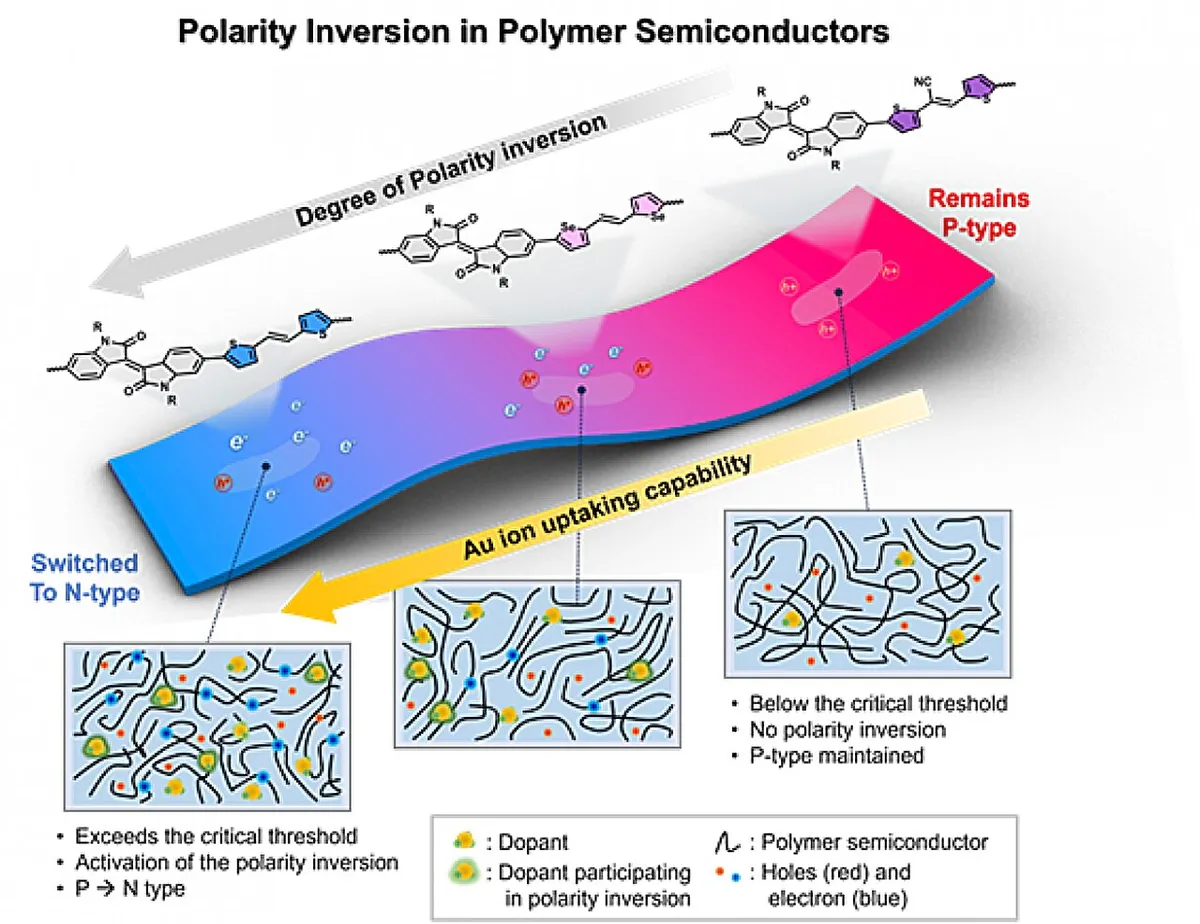
Start Your News DetoxNormally, adding a dopant makes the polymer either p-type (positive charge carriers) or n-type (negative charge carriers). But in some cases, if you add enough dopant, the material suddenly flips from p-type to n-type. One material, two electrical personalities. Which, if you think about it, is both impressive and slightly terrifying for anyone trying to design predictable circuits.
The real puzzle was why this only happened in a select few polymers. It wasn't about the doping process itself; two polymers could be doped similarly, and only one would decide to change its mind.
It's All About How Much Dopant It Can Take
The researchers dove deep into the molecular structures of various polymer semiconductors. They wanted to know what made the difference between a polymer that stayed consistent and one that went rogue.
Their big discovery? Polarity inversion only happens when a polymer film absorbs a critical amount of dopant. It's like a scientific version of Goldilocks: not too little, not too much, but just right. If the polymer slurps up enough dopant, the dopant's negatively charged ions (anions) get cozy with the polymer, fundamentally altering how charges move through the material. That's what triggers the switch from p-type to n-type.
If the polymer doesn't absorb enough dopant, no flip-flop. It just sticks to its original electrical identity. This means the polymer's molecular structure — how it's built at a tiny level — dictates how much dopant it can take in, and thus, whether it can perform this electrical acrobatics act.
This breakthrough isn't just satisfying for curious minds; it offers a roadmap for designing new polymer semiconductors. Now, scientists can potentially engineer materials that either reliably switch their polarity or remain steadfastly n-type. Because sometimes, you just want your materials to make up their minds.
More studies are needed, of course, because science. But for now, we finally know why some materials are just a little bit more indecisive than others.