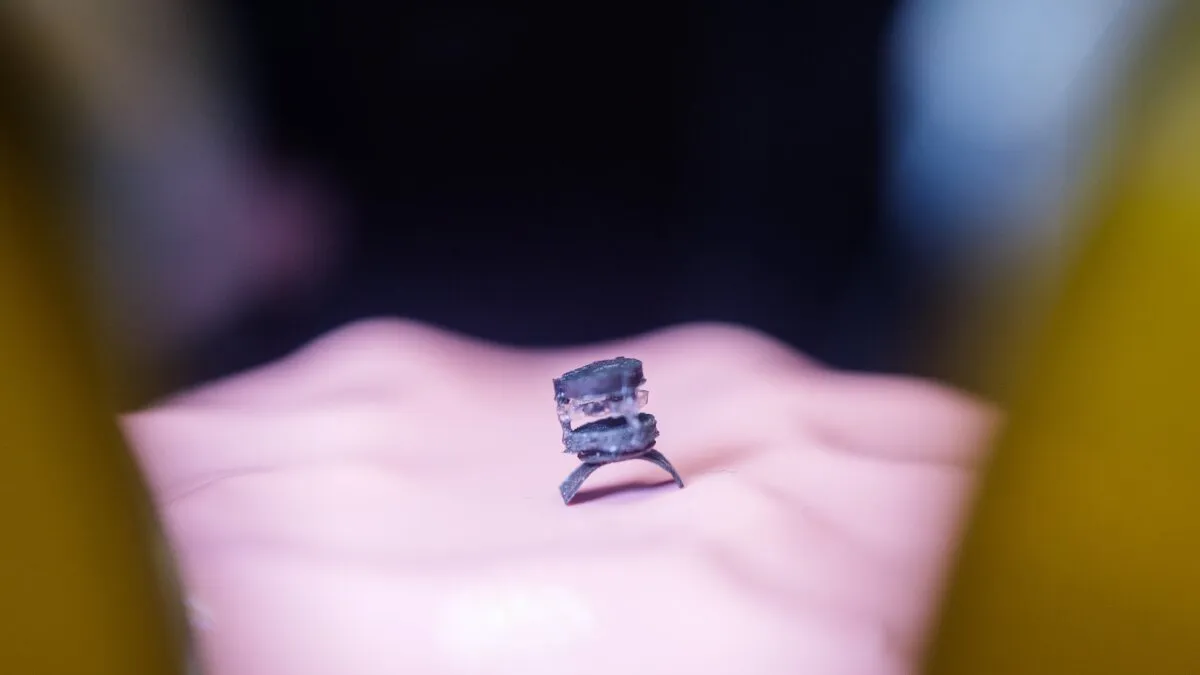
Imagine a surgical robot that can move, cut tissue, release drugs, grip samples, and generate heat wirelessly. Now imagine it fitting on your fingertip. Scientists have created a 5-in-1 robot that is just 4.4 mm (0.17 in) long.
This tiny robot was developed at Nanyang Technological University (NTU) in Singapore. It can crawl across soft tissues, cut biological material, release drugs, collect tissue samples, and create therapeutic heat. It can switch between these five functions in less than a second. It does all this without wires, electronics, or batteries.
A New Kind of Surgical Robot
This robot is a breakthrough in magnetic medical robotics. This field uses external magnetic fields to guide tiny devices inside the body. These systems could be a future alternative to some minimally invasive surgeries. They might allow procedures in hard-to-reach areas without large cuts or bulky tools.
We're a new kind of news feed.
Regular news is designed to drain you. We're a non-profit built to restore you. Every story we publish is scored for impact, progress, and hope.
Start Your News DetoxMost magnetic microrobots are specialists. One might deliver drugs, while another collects tissue. Combining many abilities into one device has been hard. This is because magnetic fields usually affect an entire robot at once. If one part moves, the rest often moves too.
The NTU team says they have solved this problem after seven years of work.
Lum Guo Zhan, the team leader, said most magnetic robots can only do one or two things. Their new invention can do five. Their goal is for doctors to use these mini robots inside the body for treatments.
The robot uses a special magnetic module that can be reprogrammed. It can be magnetized, demagnetized, and remagnetized in different ways. Each magnetic setting unlocks a different function, like moving or cutting.
The researchers also designed different parts of the robot to react differently to the same magnetic field. This means individual sections can be turned on while others stay still. This independent control is a key advance.
The robot is made from soft, silicone-based materials like PDMS and Ecoflex. Tiny magnetic particles, about five micrometers in size, are embedded in these materials. By carefully arranging and magnetizing these particles, researchers can control the robot remotely. They use weak magnetic fields from outside coils.
The result is a tiny, powerful "Swiss Army Knife" robot.
The Robot's Five Functions
In cutting mode, the robot uses a tiny blade to cut biological tissue. For biopsies, a gripper collects and stores tissue samples. This could allow biopsies in hard-to-reach places. The drug-delivery mode releases preloaded drugs precisely where needed.
The fourth function is heating. The robot generates localized heat when exposed to a high-frequency alternating magnetic field. This could support magnetic hyperthermia treatments for cancer. This therapy uses heat to damage tumors while protecting healthy tissue.
The robot's fifth function is movement. Most magnetic microrobots move with five degrees of freedom. This means movement along three axes and rotation in two directions. The NTU robot adds a sixth degree of freedom: rolling motion. It can rotate around its own length.
This extra maneuverability could help it navigate the narrow, irregular, and often slippery environments inside the human body.
Unlike some newer soft robots that look like slime, the NTU design is solid but flexible. The researchers say this makes it more robust and easier to retrieve after a procedure. This is important for future medical use.
The team tested the robot on gelatin tissue models and chicken liver. It successfully cut tissue, released drug-like particles, collected samples, and generated heat.
They also checked if the robot's materials were safe for human cells. Over 99% of human skin cells stayed alive after exposure. This suggests the materials are largely non-toxic in lab settings.
Looking Ahead
This technology is still far from being used in patients. The current prototype works in a lab with external magnetic coils. It is also not autonomous. Doctors would need to guide and control it.
However, this project could greatly improve minimally invasive medicine. Instead of using many instruments, doctors might use one tiny robot for diagnosis, treatment, sampling, and therapy.
The team is now exploring how to add imaging and sensing systems to future versions. They are also working with surgeons to see how these mini robots could fit into real clinical procedures.
Deep Dive & References: Magnetic medical robotics - ScienceDirect, 2025 PDMS - ScienceDirect