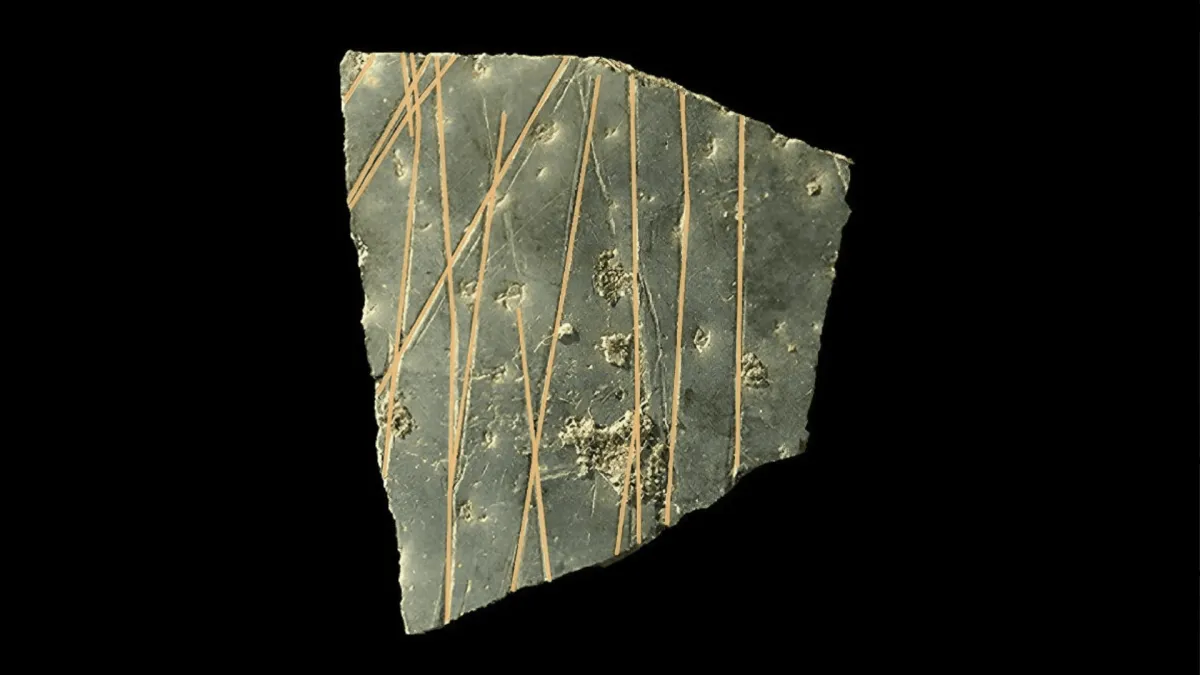
Our ancestors were thinking in geometry long before they had words for it. Researchers analyzing 112 fragments of carved ostrich eggshells from South Africa—dating back 60,000 years—have found evidence that early humans were already organizing their minds in deeply structured ways, laying the groundwork for everything from mathematics to writing.
The markings look simple at first glance: boxes, hatched bands, grids, diamonds etched into shells that once held water. But when Silvia Ferrara's team at the University of Bologna reconstructed these patterns in detail, they discovered something unexpected. Eighty percent of the configurations weren't random doodles. They showed what Ferrara calls "a surprisingly structured, geometric way of thinking"—parallel lines, angles close to 90 degrees, repeated motifs arranged with intention.
 Ostrich eggshell fragments reveal early human cognition through geometric patterns
We're a new kind of news feed.
Regular news is designed to drain you. We're a non-profit built to restore you. Every story we publish is scored for impact, progress, and hope.
Start Your News DetoxWhat's remarkable is what this tells us about how those minds worked. The people engraving these shells weren't just copying a pattern they saw. They were visualizing the finished design before they started—planning the overall composition, then executing it with precision. That's mental work we usually associate with much later human development: the ability to hold an abstract image in your mind and translate it into physical form.
The patterns reveal operations like rotation, translation, repetition, and embedding—the ability to layer signs within signs, creating hierarchies of meaning. In essence, they were building a visual language. "This demonstrates a mastery of geometric relationships," Ferrara explains in the study, published in PLOS One. The consistency across different shells suggests these weren't individual experiments but a shared system—a grammar that multiple people understood and could replicate.
Why This Matters Now
This discovery reframes a crucial moment in human history. We often think of writing as the birth of symbolic thought, but these shells suggest the cognitive machinery was already there, already refined. By the time Homo sapiens left Africa, they possessed something deeper than the ability to make marks: they could abstract, organize, and systematize.
That capacity—to take a simple form and build it into something complex by following rules—is distinctly human. It's what allowed us to create languages, mathematics, art, and ultimately the entire apparatus of civilization. We see it echoed across 60,000 years: the same drive to take chaos and impose order, to think about thinking itself.
The next frontier for researchers is understanding how this geometric thinking eventually became the symbolic systems we recognize as writing. But the shells already tell us something vital: our ancestors were abstract thinkers from the start. They just didn't have paper yet.