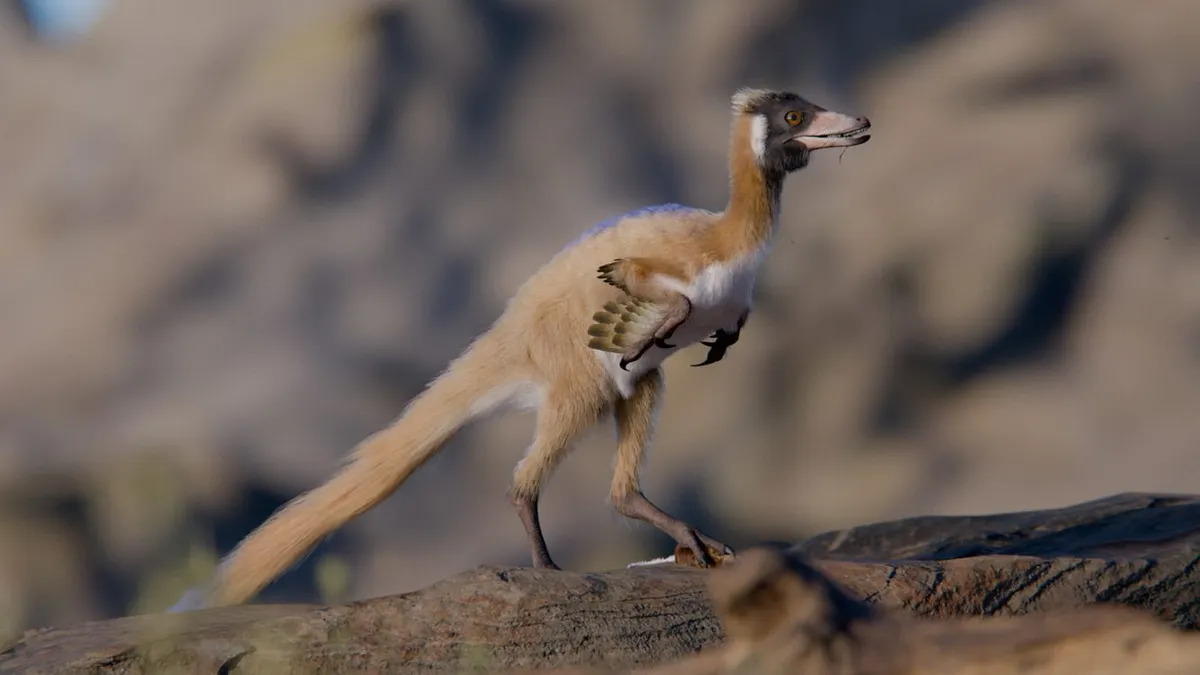
For decades, paleontologists found themselves staring at puzzle pieces that wouldn't fit. Fragments of a strange group of bird-like dinosaurs kept turning up across the globe—stubby arms, tiny teeth, single oversized thumb claws—but the picture remained maddeningly incomplete. Then, in 2014, a team digging in northern Patagonia unearthed something that changed everything: a nearly complete skeleton of Alnashetri cerropoliciensis, a dinosaur so well-preserved it became what researchers are calling a "paleontological Rosetta Stone."
The find solves a mystery that had puzzled scientists for more than two decades. Alnashetri belongs to the Alvarezsaurs, a group of small dinosaurs that thrived 90 million years ago. Most well-preserved examples came from Asia, leaving South American fossils fragmented and nearly impossible to interpret. A single near-complete skeleton changed that entirely.
Peter Makovicky from the University of Minnesota and his Argentinean colleague Sebastián Apesteguía spent a decade carefully preparing the bones—a painstaking process necessary to avoid damaging such delicate material. What emerged was a revelation. Alnashetri weighed less than two pounds, making it one of the smallest dinosaurs ever found in South America. Microscopic analysis of the bones showed the animal was at least four years old when it died, meaning this was a fully grown adult.
We're a new kind of news feed.
Regular news is designed to drain you. We're a non-profit built to restore you. Every story we publish is scored for impact, progress, and hope.
Start Your News DetoxBut the real breakthrough came from what the skeleton revealed about evolution. Unlike its later relatives, Alnashetri had relatively long arms and larger teeth—features scientists had assumed evolved much later in the group's history. This discovery rewrites the timeline entirely. These dinosaurs didn't gradually shrink while developing specialized features for eating ants. Instead, they got tiny first, then their bodies adapted in other ways. It's a reminder that evolution rarely follows the linear path we imagine.
The global spread of Alvarezsaurs tells another fascinating story. These small dinosaurs appear on multiple continents, a distribution that puzzled researchers until the answer became obvious: they were riding the breakup of Pangea. As the supercontinent fractured and continents drifted apart over millions of years, these animals spread across the ancient world, evolving separately in isolation. What looked like a global mystery was actually a window into one of Earth's most dramatic geological events.
"Going from fragmentary skeletons that are hard to interpret to having a near complete animal is like finding a Rosetta Stone," Makovicky explained. "We now have a reference point that allows us to accurately identify more scrappy finds and map out evolutionary transitions." That reference point matters because La Buitrera, the fossil site in Argentina, has yielded far more than this single specimen. The team has already uncovered the next chapter of the Alvarezsaurid story, currently being prepared in the lab. One fossil opened a door; what lies behind it could reshape our understanding of how small dinosaurs thrived for millions of years before birds finally took flight.