Making fertilizer is a dirty business. The traditional method for producing urea — the stuff that helps your garden grow — guzzles energy and spews out over 200 million tons of carbon dioxide every year. That's more than two percent of the entire world's energy consumption, just for plant food.
But what if you could make it cleaner? What if you could use electricity, CO2, and even nitrate waste to whip up a batch? Scientists have been trying, but scaling it up has been tricky. At the high power levels needed for industrial production, catalysts tend to get distracted, producing unwanted hydrogen gas or other carbon byproducts instead of the good stuff.
Enter the National University of Singapore, where a team led by Assistant Professors Pengfei Ou and Lei Wang decided to bring in some heavy-duty help: AI.
We're a new kind of news feed.
Regular news is designed to drain you. We're a non-profit built to restore you. Every story we publish is scored for impact, progress, and hope.
Start Your News DetoxThe Catalyst Whisperer
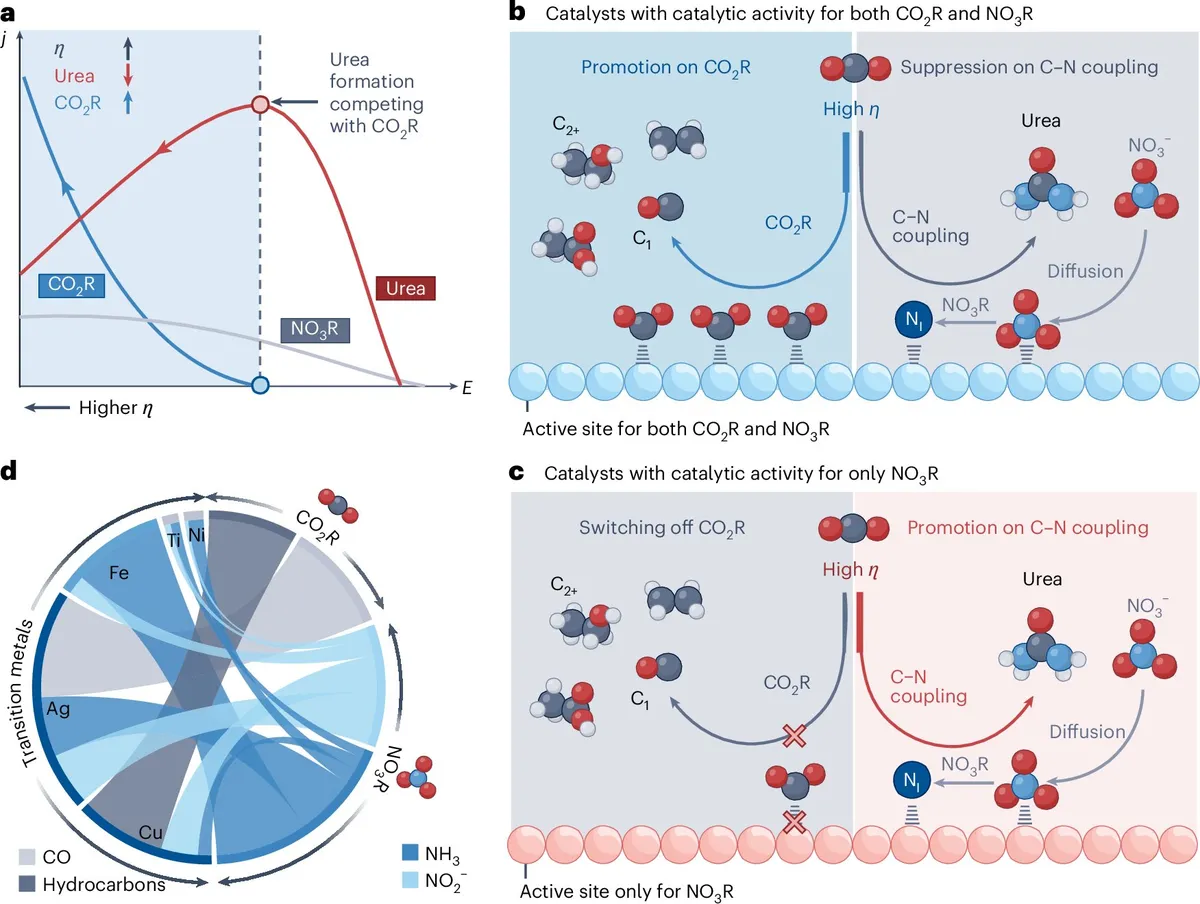
Their mission: find a catalyst that could handle the heat of industrial production without getting sidetracked. They started with a large language model, which, in a move that feels very 21st-century, scoured past research on electrochemical urea production. The AI quickly spotted the core issue: many catalysts worked great at low production rates but choked at the speeds factories actually need.
Turns out, you need a urea production rate of at least 100 mA cm−2 to make it cost-effective on an industrial scale. Armed with this very specific target, the researchers then used theoretical calculations to find materials that could both shut down those pesky side reactions and activate nitrate, a key ingredient for urea.
This led them to iron oxide as a promising base. But iron oxide had its own little problem: carbon monoxide on its surface could still lead to hydrogen gas forming. The solution? Cadmium. Because apparently that's where we are now: adding cadmium to iron oxide to make fertilizer more eco-friendly.
This new cadmium-modified iron oxide catalyst, dubbed Cd–Fe2O3, hit a urea production rate of about 140 mA cm−2. Let that satisfying number sink in. It’s well above the industrial target, and it converted more than half of the electrical energy into urea — a massive leap in efficiency for high-speed production. Plus, it worked steadily for over 100 hours, which is crucial if you don't want your fertilizer factory to constantly be swapping out parts.
So, what's the cadmium doing? It subtly tweaks the electronic structure of the iron, making it harder for unwanted substances like carbon monoxide and hydrogen to cling to the catalyst. This allows the catalyst to focus on forming the carbon-nitrogen bonds essential for urea.
Assistant Professor Ou noted that this whole process proves AI and quantum simulations aren't just for explaining what happened; they can actually design solutions from scratch. Which, if you think about it, is both impressive and slightly terrifying. But mostly impressive, especially when it comes to making the stuff that feeds the world a whole lot cleaner.
This work, published in Nature Synthesis, isn't just about urea; it’s a blueprint for using AI and simulations to fast-track other sustainable chemical processes. Next up: making the catalyst even more durable and scaling it up. Because a greener future, apparently, needs a little AI-enhanced cadmium.