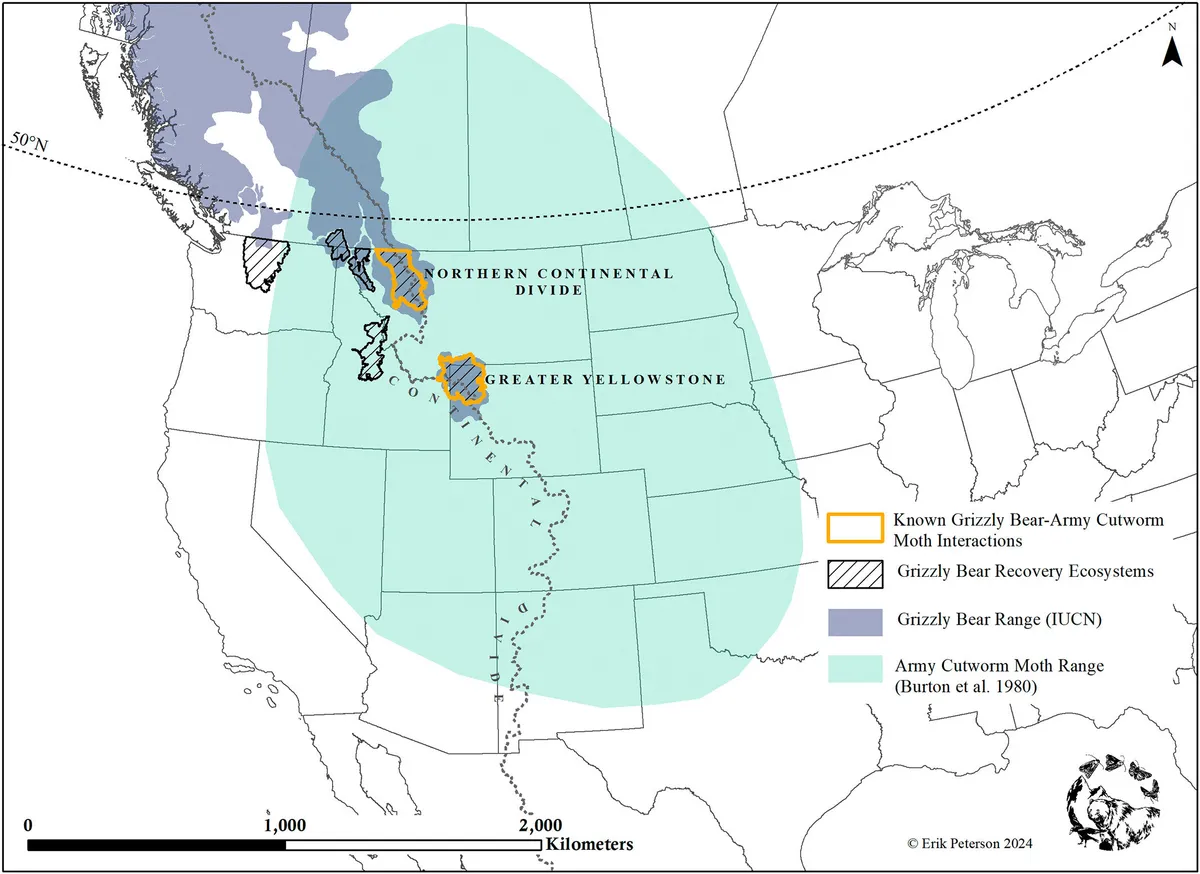
When grizzly bears climb the rocky slopes of Glacier National Park, they are looking for a fatty meal: army cutworm moths. These moths are about an inch long. They hatch on the Great Plains and fly in large groups to the cool, stony areas of the Rocky Mountains to escape the heat.
Grizzlies eat thousands of these moths. Each moth provides about half a calorie. This helps the bears get fat before winter.
Erik Peterson led a three-year study on these moths. He was a graduate student at Washington State University's School of the Environment. Peterson noted that the moths are full of fat and protein, which are important for a grizzly's diet. He called them "bear butter" because their abdomens are swollen with liquid fat.
We're a new kind of news feed.
Regular news is designed to drain you. We're a non-profit built to restore you. Every story we publish is scored for impact, progress, and hope.
Start Your News DetoxThese moths gather in only 0.3% of the park, in high, hard-to-reach spots. Peterson and his team mapped this habitat. This map helps park managers protect grizzly foraging sites as more people visit the backcountry. Their new research was published in Biological Conservation.
Finding Moths in Steep Places
From 2019 to 2021, the team studied moth and bear activity. They surveyed potential moth habitats on the ground. Then, they used helicopters to survey bear activity in those areas. This allowed them to create separate models for moth habitat and bear foraging sites. The work was difficult and took a lot of time.
Daniel Thornton, a co-author and associate professor, stressed how much effort went into collecting the data. He highlighted the challenge of climbing steep slopes to find moths and using helicopters to search for bears in a national park. He praised Peterson for successfully gathering such important data.
The study also helped researchers better understand how bears and moths interact. They found specific features of the rocky environments that attract the moths, like stone size and soil moisture. The research showed that the presence of moths is a key reason grizzlies forage in these areas.
Peterson worked for the National Park Service in Glacier for ten years before going to graduate school. He did this research in Thornton's lab. Peterson earned his master's degree at WSU and now works at the University of British Columbia-Okanagan. Other researchers who helped with the study include John Waller, Don White Jr., and James Pierce.
The Moths' Journey to the Mountains
Army cutworm moths are not as famous as grizzly bears, but they play a big role in the Rocky Mountain ecosystem. They hatch on the Great Plains and in lower parts of the Rockies. As caterpillars, they can harm crops.
In late spring, they become adult moths and fly to the high Rocky Mountains. They hide in cool, shaded spots within rocky fields. Bears find them there and eat many of them. In early autumn, the moths that survive fly back to the plains to mate and lay eggs. This cycle is similar to salmon returning from the ocean to spawn.
Peterson called the moth's story "the most amazing" of all the foods a grizzly bear eats.
People and Bears Share the Slopes
This research can help park managers protect grizzly foraging areas. Glacier National Park has many grizzlies compared to other wild places. However, it also has many visitors, about 3 million each year.
Most visitors stay near roads. But backcountry recreation, like climbing, is also growing. When people are near foraging areas, it can disturb grizzlies. Grizzlies need to eat enough calories in the summer to survive the winter.
Peterson noted that some moth sites in Glacier see many climbing groups daily. He said that on some days, more than 20 bears might be eating moths at major sites. If a grizzly has to watch people pass by, it takes away from their main goal: eating.
Deep Dive & References
Broad-scale models of a foundational alpine insect: Implications for grizzly bear ecology and conservation - Biological Conservation, 2026