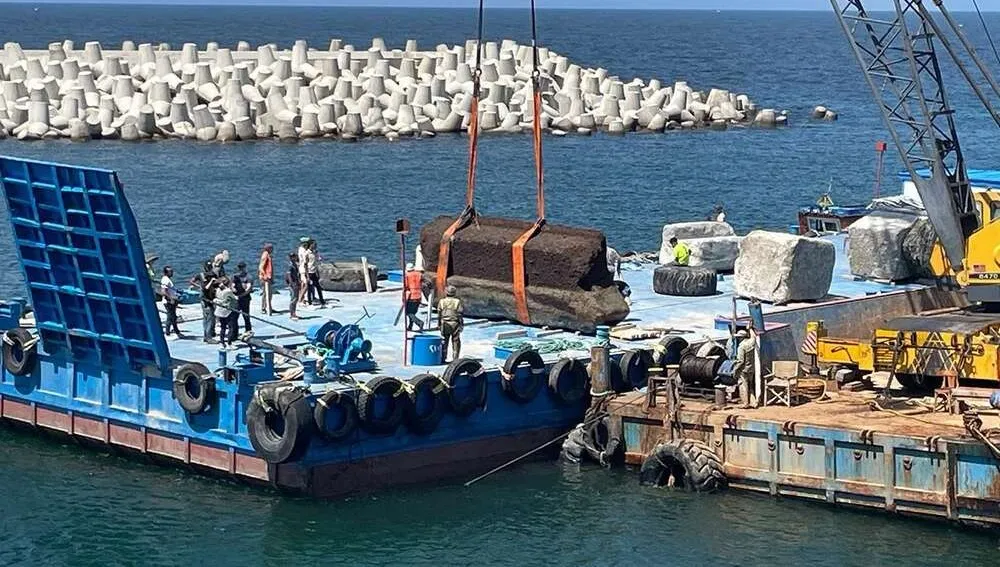
Twenty-two massive granite blocks hauled from Alexandria's harbor are telling researchers something unexpected about how the ancients engineered one of the world's most famous structures.
These aren't small artifacts. Each block weighs dozens of tons—pillars, frames, crossbeams that once formed the entrance to the Lighthouse of Alexandria, one of the Seven Wonders of the Ancient World. Earthquakes in the 10th century CE toppled it into the sea, where it lay for a thousand years until French and Egyptian researchers decided to listen to what the rubble had to say.
Over a decade, teams from France's National Center for Scientific Research (CNRS) and Egypt's Center for the Studies of Alexandria (CEAlex) mapped the seabed methodically. They found around 3,000 blocks and 5,000 stone pieces scattered across a 4-acre area—essentially the entire monument, fragmented but still there.
We're a new kind of news feed.
Regular news is designed to drain you. We're a non-profit built to restore you. Every story we publish is scored for impact, progress, and hope.
Start Your News DetoxReading stone like code
The real work began in the lab. Every recovered block was photographed in exhaustive detail, then converted into precise 3D digital models using photogrammetry. Isabelle Hairy's team at CNRS could now see what the naked eye couldn't: the exact texture of rough and fine edges, the pattern of chips, the marks left by ancient tools. These details became a language.
Using sophisticated digital modeling software, researchers began virtually reassembling the lighthouse block by block, the way you'd solve a three-dimensional puzzle with thousands of pieces. When two segments seemed to fit, they could run simulations—testing what force, what angle, what magnitude of earthquake would have cracked and toppled that specific joint. The stones became witnesses to their own destruction.
The story the stones tell
What emerged was a portrait of cultural synthesis. Many blocks bore Egyptian imagery carved with Hellenistic techniques—the visual language of the Ptolemaic dynasty, when Greek and Egyptian worlds merged. But some granite monoliths came from Abu Rawash, an Old Kingdom site 2,000 years older than the lighthouse itself. The ancients had recycled stone from a pharaoh's monument to build their wonder.
Egyptian authorities, protective of the blocks against salt damage, won't allow recovery of pieces heavier than 220 pounds. The largest elements were photographed and returned to the harbor—a practical compromise between preservation and study.
The 3D model now exists as pure data, waiting. Museum directors are already imagining how visitors might experience the lighthouse anew: perhaps a holographic projection rising above the harbor at dusk, just as the original beacon did for over a thousand years. The monument that earthquakes couldn't permanently erase might soon be seen again—not in stone, but in light.