A seven-million-year-old skull and bones are rewriting what we thought we knew about when human ancestors first stood up on two legs.
Researchers at New York University used 3D imaging to examine Sahelanthropus tchadensis, a fossil so old it predates most of what we call "human" by millions of years. What they found was surprising: this creature—which had a chimpanzee-sized brain and spent much of its time in trees—was already walking upright on the ground.
"Sahelanthropus tchadensis was essentially a bipedal ape," says Scott Williams, who led the analysis. "Despite its superficial appearance, it was adapted to using bipedal posture and movement on the ground."
We're a new kind of news feed.
Regular news is designed to drain you. We're a non-profit built to restore you. Every story we publish is scored for impact, progress, and hope.
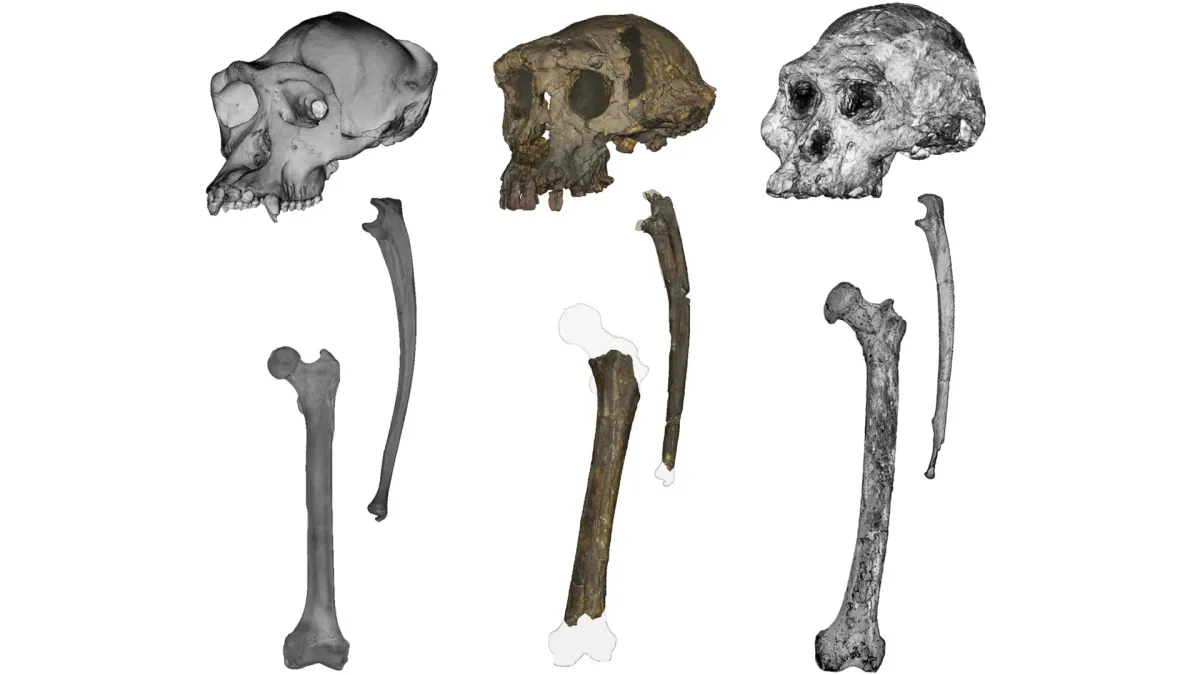
Start Your News DetoxThe evidence is in the bones themselves. The researchers compared the fossil's leg and arm bones to both modern apes and other ancient hominin species like Australopithecus. They identified three key anatomical features that point to upright walking: a specific attachment point on the thighbone for a ligament critical to standing, a natural twist in the femur that falls within the human range for efficient walking, and muscle evidence suggesting hip stabilization similar to early human ancestors.
The proportions matter too. Sahelanthropus had a relatively long thighbone compared to its arm bone—more like later human ancestors than like modern chimpanzees or bonobos.
This pushes back the emergence of bipedalism—one of the defining traits that eventually led to humans—much earlier in our evolutionary story than previously thought. It suggests that walking upright wasn't some dramatic innovation that suddenly separated our ancestors from apes. Instead, it was a gradual adaptation that began in creatures that still looked and behaved much like the apes we see today, climbing trees and foraging for food but increasingly comfortable moving across open ground on two legs.
The finding opens a new window into how our lineage diverged from our closest living relatives. It also raises fresh questions: if bipedalism evolved so early, what other traits we thought were uniquely human might have deeper roots in our family tree.