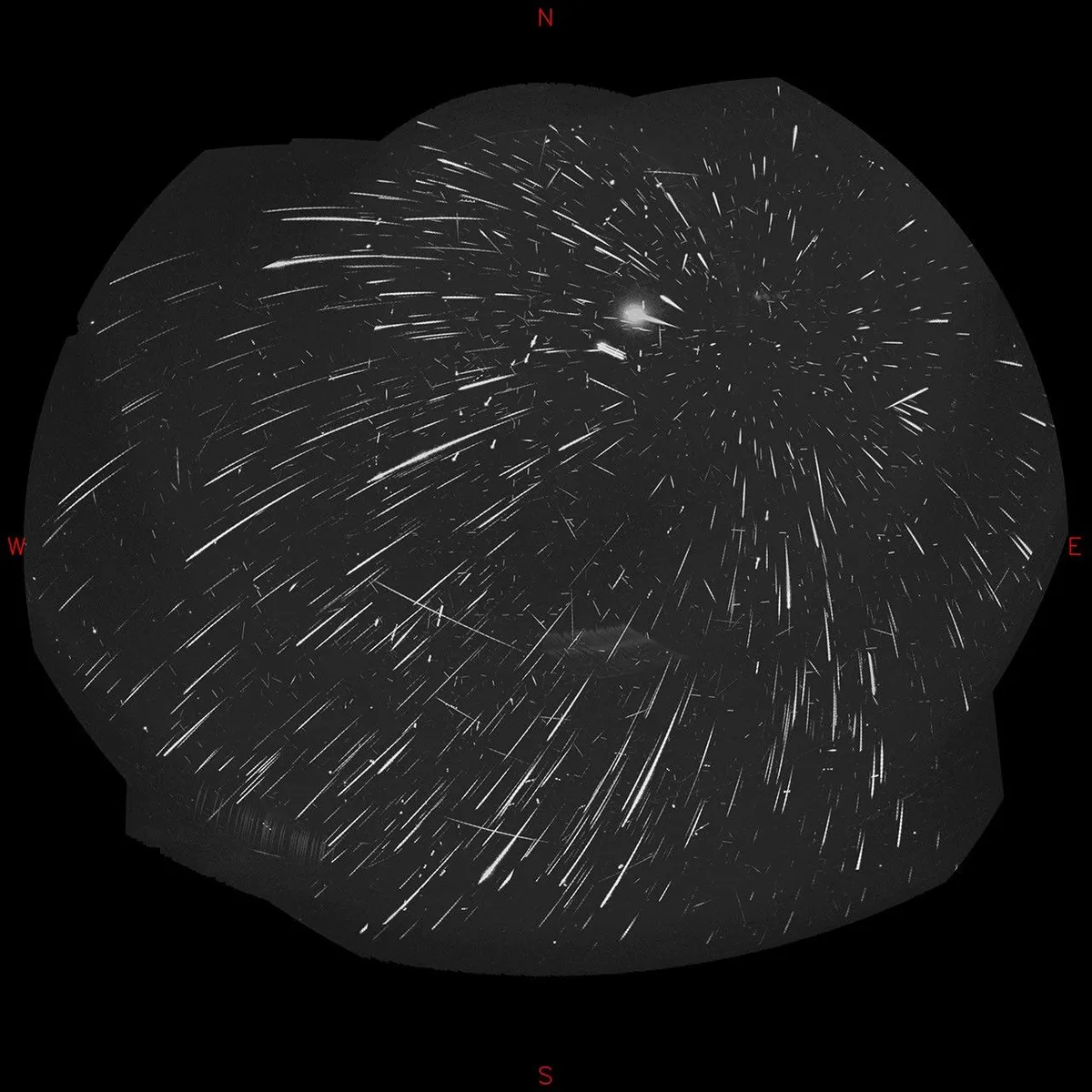
Imagine setting up four cameras, pointing them at the sky, and capturing 1,706 meteors in one glorious night. That's precisely what happened on August 12-13, 2026, when an astronomical observatory in Czechia hit the cosmic jackpot.
This wasn't just any random light show. This was the peak of the 2026 Perseid Meteor Shower, which means the vast majority of those fleeting streaks of light were Perseids. Let that satisfyingly precise number sink in: 1,706. Someone's job was literally to count shooting stars.
The Sky's Cosmic Bullseye
Now, if you're wondering how they knew these were Perseids, it's all about the radiant. Every meteor shower has one – a specific spot in the sky where all the meteor trails appear to originate. For the Perseids, that spot is in the upper right of the image, nestled within the constellation Perseus. It's like a cosmic bullseye, except the bullseye is constantly flinging debris at us.
We're a new kind of news feed.
Regular news is designed to drain you. We're a non-profit built to restore you. Every story we publish is scored for impact, progress, and hope.
Start Your News DetoxOf course, space is a busy place. While the Perseids were putting on their main event, a few stragglers from other, less active showers decided to crash the party. You can spot some faint trails crossing the Perseid paths, which turn out to be Kappa Cygnids, with their own radiant over in Cygnus. Because apparently, even meteor showers have their own neighborhoods.
Then there's the wonderfully named antihelion complex, a general area near Aquarius that's opposite the Sun. It's like the quiet, unassuming background noise to the main celestial concert. So, while you were (presumably) sleeping, the universe was putting on a truly spectacular, multi-faceted show, and these cameras were there to catch every single, fiery moment.