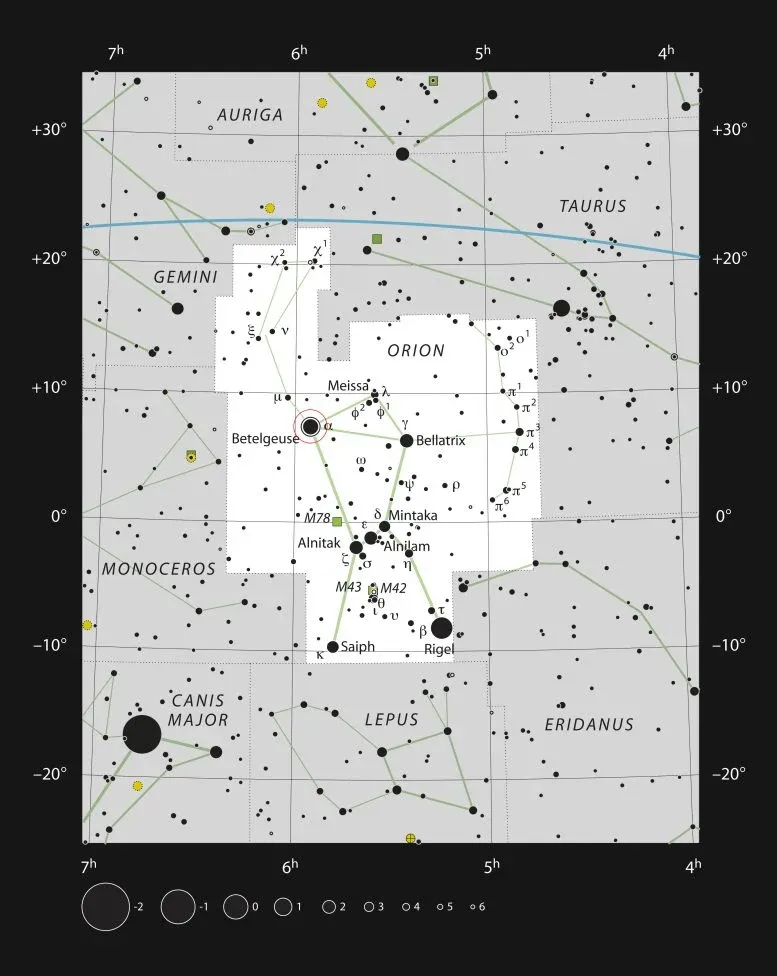
For generations, Betelgeuse has appeared as a single reddish point in the constellation Orion. Now, astronomers have strong evidence that this famous star has a companion.
A team led by French astronomer Miguel Montargès used the European Southern Observatory’s (ESO) Very Large Telescope (VLT). They captured the clearest image yet of what is likely Betelgeuse B, a star orbiting the red supergiant.
Montargès, an astronomer at the Observatoire de Paris – PSL, France, noted that this discovery concludes a century-long search. He said, "We have shown that Betelgeuse is not single, it is accompanied by a faint stellar companion."
We're a new kind of news feed.
Regular news is designed to drain you. We're a non-profit built to restore you. Every story we publish is scored for impact, progress, and hope.
Start Your News DetoxBetelgeuse has been observed for thousands of years and is known for its changing brightness. Even so, this nearby star continues to challenge astronomers.
A Century-Long Search Pays Off
Montargès recalled, "I jumped from my chair when I saw the processed images."
The idea that Betelgeuse had a companion was first suggested about 100 years ago. It was thought to explain some of the star's brightness changes. Many searches followed, but none found clear proof.
Two studies published in 2024 predicted that the companion would be farthest from Betelgeuse in December of that year. This would make it easier to see, separate from the much brighter main star.
Montargès and his team observed Betelgeuse with ESO’s VLT during December 2024. They spent several months carefully processing the observations to find the faint object.
Montargès explained, "Honestly, I thought we did not have the sensitivity to detect Betelgeuse B as it was predicted. Because it is more massive than predicted, we see it!"
Earlier estimates suggested the companion might be about the same mass as the Sun. However, the new observations show that Betelgeuse B is about two to three times as massive as the Sun.
Montargès said, "The fact that we can still discover a nearby companion, more massive and brighter than the Sun, around such a well-studied star is remarkable. These are among the best moments in science: seeing something new, unexpected."
Direct Imaging Confirms the Discovery
The researchers detected light directly from Betelgeuse B using the SPHERE instrument on ESO’s VLT in Chile’s Atacama Desert.
Previous observations had hinted at the companion's existence. This included a possible direct detection with the Gemini North Telescope in Hawaiʻi, USA. However, the latest result provides the clearest image and strongest evidence for Betelgeuse B.
Co-author Anthony Boccaletti, also an astronomer at the Observatoire de Paris, noted, "It is remarkable to see how SPHERE and advanced post-processing techniques, originally developed to find exoplanets, also excel at detecting a companion around a massive, evolved star like Betelgeuse."
The researchers still need to watch the object continue its expected orbit to fully confirm the discovery.
Montargès added, "To be certain that the companion is really there, we still need to observe it in one year on the other side of the star, but there is very little space left for doubt."
How a Companion Might Change Betelgeuse's Future
Betelgeuse gained a lot of attention a few years ago when it became much dimmer. Since the aging supergiant is expected to explode as a supernova eventually, this change led to ideas that its death might be near.
Montargès and other astronomers used ESO’s VLT to study the dimming. They found a simpler explanation: a cloud of dust had temporarily blocked part of the star.
The likely discovery of Betelgeuse B now brings up a new question. Astronomers will investigate if the companion could affect how Betelgeuse evolves or how its supernova explosion will happen.
Montargès concluded, "The question is truly opened whether this companion is going to have an impact on the evolution of the red supergiant."
Deep Dive & References
VLT/SPHERE images of the candidate companion of Betelgeuse - Astronomy & Astrophysics, 2026
A Buddy for Betelgeuse: Binarity as the Origin of the Long Secondary Period in α Orionis - The Astrophysical Journal, 2024
Radial Velocity and Astrometric Evidence for a Close Companion to Betelgeuse - The Astrophysical Journal, 2024