Imagine Earth's early oceans: murky, devoid of much oxygen, and apparently, seriously low on molybdenum. So, naturally, ancient microbes were using the stuff anyway, 3.7 billion years ago.
Yes, you read that right. Scientists funded by NASA just dropped a paper in Nature Communications revealing that some of the earliest life forms on Earth were already hooked on molybdenum. Which is a bit like finding out your ancestors were driving Teslas before wheels were invented.
Today, molybdenum is a cellular superstar, essential for countless biochemical reactions. It's the tiny turbocharger for enzymes, helping them speed up crucial processes like the nitrogen cycle. Without it, life as we know it would grind to a halt. Betül Kaçar, who runs the Kaçar Lab at the University of Wisconsin Madison and leads the NASA MUSE group, puts it plainly: molybdenum is at the heart of enzymes driving major carbon, nitrogen, and sulfur reactions.
We're a new kind of news feed.
Regular news is designed to drain you. We're a non-profit built to restore you. Every story we publish is scored for impact, progress, and hope.
Start Your News DetoxAnd understanding when life started using it tells us when certain key metabolic strategies became possible.
The Metal That Wasn't There (But Was)
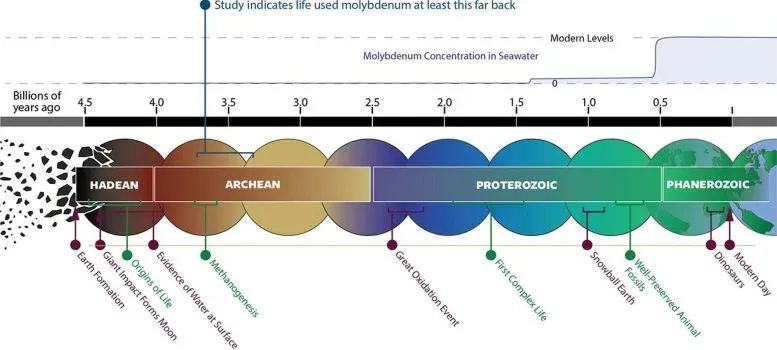
Here's the rub: while molybdenum is common now, geological records show early Earth's oceans had only trace amounts. Its availability didn't really ramp up until about 2.45 billion years ago, when microbes started photosynthesizing, leading to the Great Oxidation Event and a massive oxygen boom.
This scarcity led astrobiologists to wonder if early life used other metals, like tungsten, which performs a similar cellular dance. The prevailing theory was a switch: tungsten first, then molybdenum when it became more abundant. Turns out, life didn't bother with such niceties.
The research reveals that ancient microbes were using both molybdenum and tungsten even when both were rare. Kaçar notes this pushes molybdenum's essential role back much further than previously thought – to around 3.7 to 3.1 billion years ago, long before the Great Oxidation Event.
So, how did these ambitious little organisms get their hands on such a rare commodity?
Earlier work from the MUSE group suggests hydrothermal vents deep beneath the ocean floor were the likely culprits. These volcanic chimneys spew out trace metals, including molybdenum, creating localized hotspots of availability even when the surrounding ocean was barren. It seems molybdenum was simply too good to pass up. Its catalytic advantages, its ability to help reactions happen under diverse conditions, made it worth the evolutionary effort to scavenge and utilize, despite its scarcity. Which, if you think about it, is both impressive and slightly terrifying.
This discovery isn't just a fascinating peek into our planet's past. It's a cosmic reminder for anyone looking for life beyond Earth. We shouldn't just be searching for Earth 2.0. We should be open to biochemical possibilities that might look wildly different from what we see on our modern, oxygen-rich planet. Life, apparently, finds a way, even when the ingredients are scarce.
Kaçar explains that mapping the evolutionary history of essential elements on Earth can help predict what life on other worlds might use. Different environments could lead to different choices. So, when we're scanning distant exoplanets, we should be thinking about their oxygen levels, their metal availability, and the biochemical strategies that make sense for their unique histories. Because the universe is probably full of organisms making do with whatever metal is lying around.