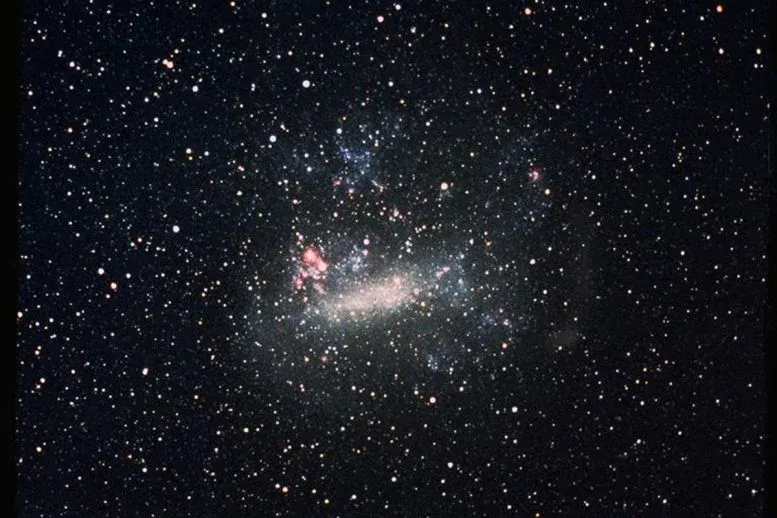
Picture this: December 18, 2019. Astronomers are minding their own business, gazing at a distant star in the Large Magellanic Cloud. Suddenly, its light doesn't just flicker or explode. It smoothly brightens, then smoothly dims, all within about an hour. It was as if something invisible, something massive, had just waltzed between us and that star, bending its light like a cosmic magnifying glass.
Scientists dubbed this mysterious interloper 'Phoebe,' and ever since, figuring out what the heck Phoebe is has become one of astronomy's most intriguing puzzles. The phenomenon itself is called gravitational microlensing, a party trick Einstein's theory of relativity predicted way back when. Because apparently, gravity doesn't just keep your feet on the ground; it also warps spacetime and plays peek-a-boo with starlight.
What Exactly Is Microlensing?
When a really heavy object passes directly between us and a far-off star, its gravity acts like a giant, invisible lens. This lens briefly magnifies the star's light, creating a very specific, tell-tale pattern of brightening. It's not a flare, not a variable star, not even a rogue asteroid doing something dramatic. It's distinctly gravitational, and astronomers from Swinburne University in Melbourne, sifting through survey data, were certain Phoebe's fleeting appearance fit the bill. The only question left: what is Phoebe?
We're a new kind of news feed.
Regular news is designed to drain you. We're a non-profit built to restore you. Every story we publish is scored for impact, progress, and hope.
Start Your News DetoxUnpacking Phoebe's Possible Identities
The leading theories about Phoebe's true nature are all delightfully wild. Idea number one: it's a free-floating planet, a lone wolf of the cosmos, booted out of its home solar system and now just drifting through our galaxy. Idea number two: it's still a planet, but one that belongs to the Large Magellanic Cloud itself, making it the first planet ever found via microlensing outside our own Milky Way. Which, if you think about it, is both impressive and slightly terrifying.
But then there's option three, and this is where things get truly mind-bending: Phoebe could be a primordial black hole. Not your garden-variety black hole that forms when a giant star collapses. Oh no. These primordial ones are ancient, tiny, and formed from quantum fluctuations in the universe's first moments, before stars or even atoms existed. Talk about an old soul.
The key clue here is how long the light show lasted. Phoebe's event was about 60 minutes. The duration of the brightening is directly tied to the mass of the object doing the lensing. Lighter objects zip past quicker, making the event shorter. Working backward through the physics, the team estimated Phoebe's mass to be about three times that of Earth's Moon. That's far too small to be any known planet and definitely too puny to be a stellar black hole (those are typically five times the mass of our Sun). The only kind of black hole that fits the lunar-mass bill? A primordial one.
The Primordial Punchline
The team crunched the numbers, calculating the likelihood of Phoebe belonging to various cosmic groups: Milky Way stars, Large Magellanic Cloud stars, or the mysterious dark matter halo that surrounds everything. The dark matter halo was 100,000 times more likely. Let that satisfying number sink in. Phoebe, it turns out, is far more likely to be a dark matter object than anything made of regular, shiny stellar matter.
If this theory holds, Phoebe would be one of the oldest objects ever detected. We're talking something that formed before the first stars flickered to life, before the first atoms settled down. This ancient, dark wanderer, silently drifting for 13 billion years, briefly revealed itself by bending the light of a distant star for one fleeting hour in December 2019. And then, presumably, went right back to its quiet, cosmic business.