A new method has transformed a tiny photonic chip into a powerful light source. This chip can now generate many new light frequencies.
Normally, a laser produces light of just one color. But a small device, no bigger than a fingertip, can change that single color into hundreds of precise frequencies. This makes it useful for measuring time, identifying chemicals, sending data, and studying space.
Scientists have found a way to make two materials in these chips work together. They used the chip's outer layer, which was once just seen as packaging, to create extra light frequencies. The chip's main material couldn't make these frequencies well on its own.
We're a new kind of news feed.
Regular news is designed to drain you. We're a non-profit built to restore you. Every story we publish is scored for impact, progress, and hope.
Start Your News DetoxHow the New Chip Works
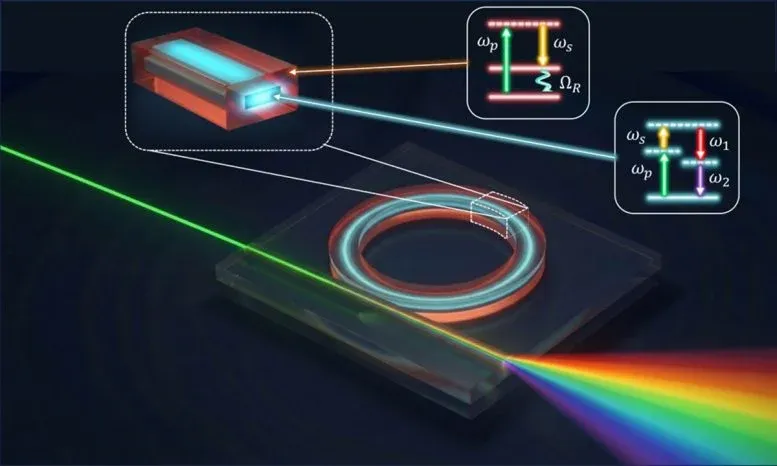
The device uses a silicon nitride core surrounded by a silica layer. Inside the core, light goes through a process that creates an "optical frequency comb." This is like a ruler with many evenly spaced light frequencies.
In the silica layer, another process called Raman scattering shifts some of the light to new frequencies. By combining these two effects, the researchers made Raman lasing happen in the silica-clad silicon nitride circuit. This interaction then created broad frequency combs. These findings were published in Advanced Photonics.
Photonic chips guide light through tiny channels called waveguides. Most of the light stays in the waveguide's core. A surrounding layer, called cladding, helps keep the light contained.
Some light always spills out from the core into the cladding. Engineers usually ignore this, but the researchers saw it as an opportunity. They designed a silicon nitride ring resonator where about 31% of the light overlaps with the silica cladding. As light travels around the ring, it interacts with both materials.
Two Materials, One Goal
Silicon nitride creates the optical frequency comb. Its strong "Kerr nonlinearity" allows light from a continuous laser to mix, making many evenly spaced frequencies around the original laser light.
Silica has a different job. It provides the "Raman response" needed to create light at a shifted frequency. During Raman scattering, incoming light exchanges energy with the silica's molecules. If this shifted light gets strong enough, it can produce Raman lasing.
Instead of making one material do everything, this chip lets each material do what it does best.
A New Signal and Wider Spectrum
To test their idea, the scientists sent continuous laser light into the silica-coated silicon nitride rings. A second light signal appeared 11 terahertz away from the original laser frequency. This matched silica's known Raman shift.
When they changed the laser's wavelength, the new signal moved with it, always staying 11 terahertz apart. This proved the extra light came from Raman scattering in the silica.
At first, Raman lasing created "Stokes and anti-Stokes sidebands," which are signals above and below the original laser frequency. With more power, the silicon nitride core's mixing grew stronger. This created more frequencies around both the original light and the Raman-shifted signals. These frequencies then multiplied, forming broad clusters of evenly spaced comb lines.
The team also slightly widened the silicon nitride waveguide. This small change helped control how different light wavelengths travel through the material. This improved the alignment of optical modes, making the interactions more efficient.
With this change, the frequency comb stretched over 400 nanometers. Comb lines formed not only near the original laser light but also around several Raman-shifted frequencies. This greatly expanded the range of light produced.
Different wavelengths of light are useful for different things. For example, in spectroscopy, molecules absorb specific frequencies like chemical fingerprints. A broad comb can check many of these signatures at once. In communications, each comb line could act as a separate data channel.
Optical frequency combs are also vital for precise measurements, like in optical clocks and astronomical tools. Traditional comb generators can fill a lab bench, but microresonators offer a way to make much smaller, more practical versions.
Matching Theory with Reality
The researchers calculated that Raman lasing should start when the optical power reaching the chip was about 140 milliwatts. In their experiment, the actual power needed was 143 milliwatts. This close match strongly suggested that the silica cladding was indeed responsible for the Raman gain. The team believes that improving the resonator's quality could lower the required power even further.
While the generated combs were not perfectly "coherent" (meaning the phases of all comb lines weren't perfectly locked), which is important for the most demanding timing applications, the system was very efficient. It converted over 32% of the incoming light into new frequencies. This shows the hybrid approach can produce strong output, not just a weak lab signal.
A Broader Strategy for Chip Design
Integrated photonics often tries to find one material that has many good qualities, like low light loss, easy manufacturing, and strong nonlinear behavior. But no single material is perfect at everything. Adding separate components can help, but it can also make chips bigger or harder to make.
This new research offers another solution: use the existing layers of a photonic circuit as a coordinated system. Similar designs could combine other materials with complementary properties. This could lead to new light sources, tunable lasers, or "self-referenced" frequency combs, which are needed for highly precise clocks.
Deep Dive & References
Hybrid nonlinear effects in photonic integrated circuits - Advanced Photonics, 2026