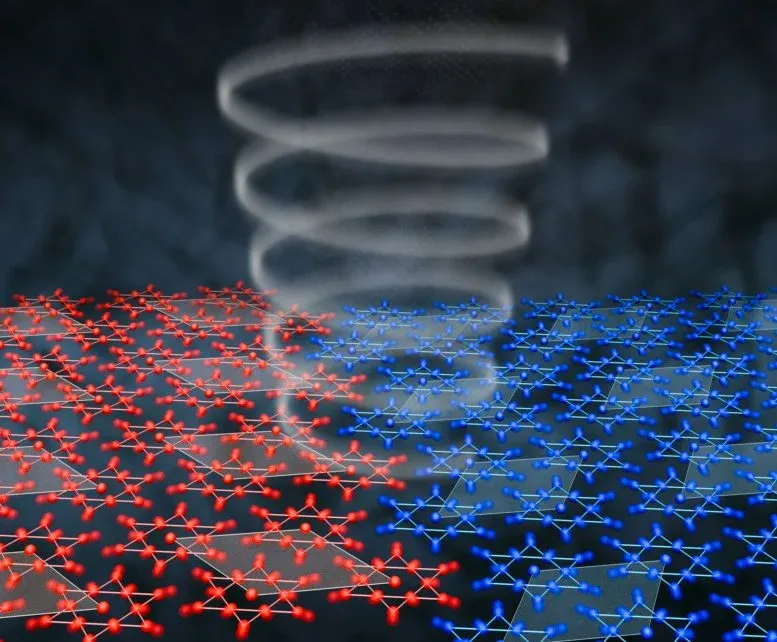
The Korea Institute of Civil Engineering and Building Technology (KICT) has created a new cubic equation of state (EOS). This equation explains a mathematical structure used in the chemical and petroleum industries for over 50 years. Until now, there was no fundamental explanation for why it worked.
Equations of state are vital for designing things like distillation columns and natural-gas processing. They predict how a fluid's volume changes with temperature and pressure. Since the 1970s, common cubic equations like Soave–Redlich–Kwong (SRK) and Peng–Robinson (PR) improved accuracy. They did this by using a specific quadratic form for the attractive-force term. However, this mathematical structure was found mostly by trial and error, and its success was a mystery.
Tetrode's Idea Revisited
Dr. Jai-Yeop Lee from KICT's Environmental Research Division looked into this problem. He found the structure's origin in a little-known idea from 1913 by Dutch physicist Hugo Tetrode. Tetrode described fluids as vibrating oscillators, not just free-moving particles. This research is published in Chemical Engineering Science.
We're a new kind of news feed.
Regular news is designed to drain you. We're a non-profit built to restore you. Every story we publish is scored for impact, progress, and hope.
Start Your News DetoxThe study added Tetrode's vibrational correction using a new parameter, "d." This showed that the familiar quadratic structure is not random. Instead, it is the simplest form that meets three basic requirements. It correctly simplifies to the ideal-gas law at low density. It also remains solvable as a cubic equation. Finally, it is flexible enough to match each substance's critical compressibility.
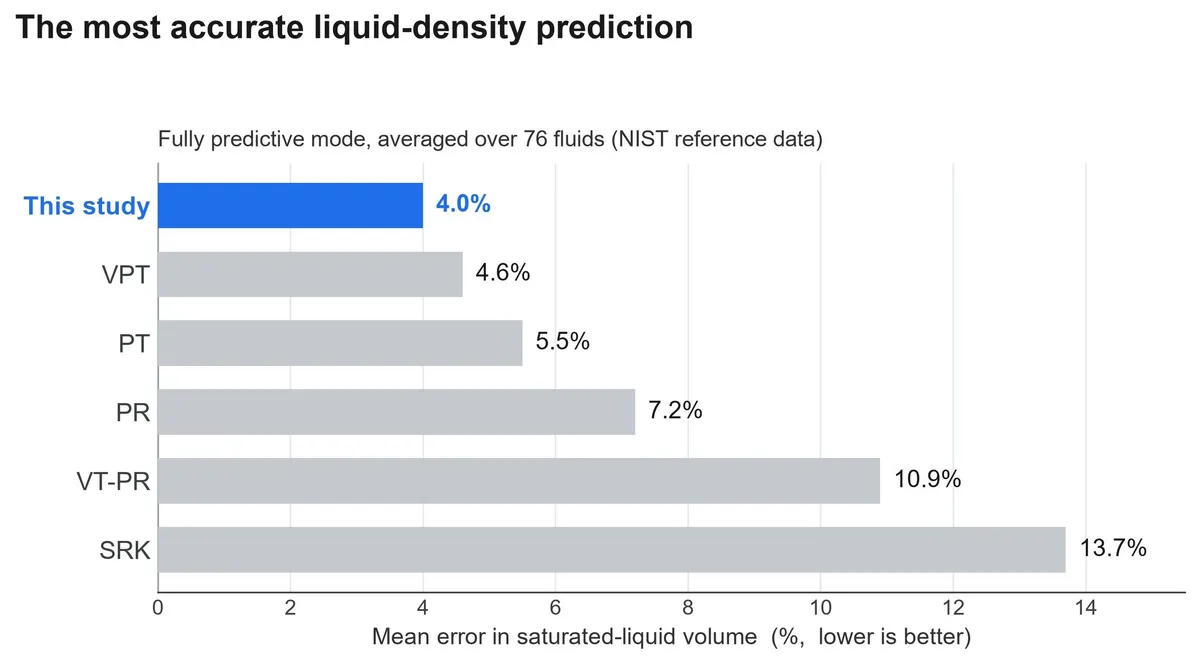
; the new model gives the lowest deviation, 4.0%. Credit: Korea Institute of Civil Engineering and Building Technology")
Testing Across 76 Fluids
The new equation was tested against highly accurate data (NIST REFPROP) for 76 different fluids. These included simple gases like argon and methane, and strong interacting substances like water and ammonia.
In its fully predictive mode, the new model used only a substance's basic critical properties. It did not use any adjustable "volume-translation" correction. It achieved the lowest average error in saturated-liquid volume at 4.0%. This was better than VPT (4.6%), PT (5.5%), PR (7.2%), and SRK (13.7%).

A Parameter Tied to Interactions
The new parameter "d" also showed clear physical meaning. Its values closely matched an empirical constant used in vapor-pressure equations. The theoretical basis for this constant was previously unclear. The parameter also grouped the 76 fluids into four distinct chemical families.
The size-scaled value of "d" steadily increased from weakly interacting argon to strongly hydrogen-bonded water. This shows that the parameter reflects the strength of molecular interactions in each fluid.
"Modern cubic equations of state are very useful," Lee said. "But their success has partly relied on empirical math, not physical understanding."
The new model predicts both liquid and vapor behavior directly from a substance's critical properties. It does not need extra empirical corrections like other methods. This offers a clearer basis for design calculations in chemical, petroleum, and refrigeration industries.
Its validation includes fluids like hydrogen, carbon dioxide, and ammonia. This suggests it could be used in chemical-process modeling for the low-carbon era. This includes hydrogen energy, carbon capture, and clean-ammonia fuels.
Deep Dive & References
A theoretically grounded cubic equation of state: justifying quadratic attractive terms via Tetrode's vibrational correction - Chemical Engineering Science, 2026