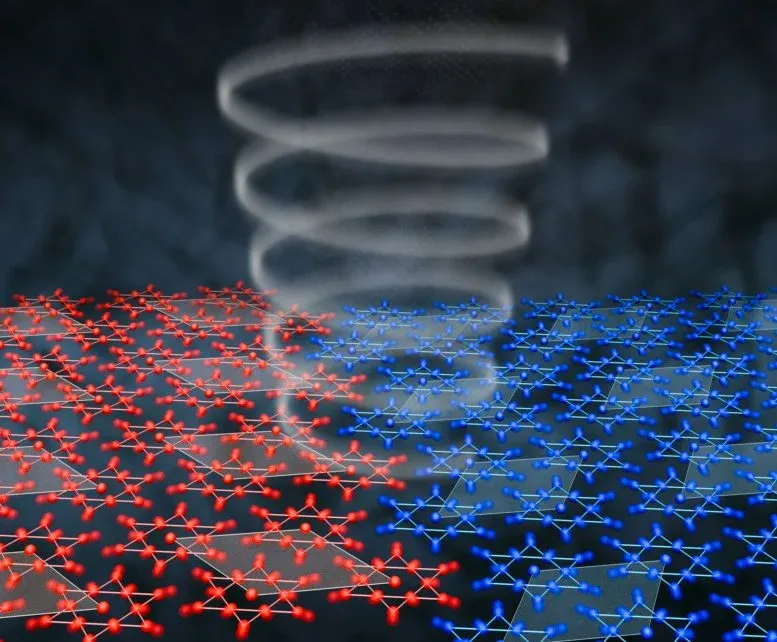
Symmetry is a big deal in physics. It's the elegant blueprint that dictates how everything from subatomic particles to entire galaxies behave. In crystals, symmetry decides how atoms and electrons arrange themselves, even preventing certain atomic vibrations from ever interacting. Like a bouncer at an exclusive club, symmetry keeps the wrong elements from mingling.
Well, apparently, that bouncer can be bribed. New research suggests that sometimes, these strict rules get a little… bendy. And the secret ingredient? Electronic fluctuations. Think of them as tiny, fidgety electrons creating a dynamic bridge where no bridge should be.
When Electrons Play Matchmaker
A study published in Nature Physics by researchers from the University of Texas at Austin and the Max Planck Institute for the Structure and Dynamics of Matter (MPSD) in Hamburg found that these electronic jitters can forge unexpected connections between vibrations that symmetry would normally keep eternally separate. It’s like discovering two distant cousins can actually communicate via a very energetic, very tiny matchmaker.
We're a new kind of news feed.
Regular news is designed to drain you. We're a non-profit built to restore you. Every story we publish is scored for impact, progress, and hope.
Start Your News DetoxThis discovery revolves around a peculiar material called a ferroaxial crystal. Inside this crystal, light, vibrations, and electrons are all getting cozy. And the implications? A whole new way to study and potentially control those elusive quantum states that scientists are always chasing.
This isn't just any old crystal. It's a layered material that, at room temperature, settles into an unusual quantum state. Its ions and electrons arrange themselves into a fixed, wave-like pattern, which scientists charmingly call a “charge-density wave” (CDW). Visually, these patterns look like tiny, interconnected Star-of-David clusters. Which, if you think about it, is both impressive and slightly terrifying.
These clusters can point in two different directions, giving the crystal an internal 'handedness' – a planar chirality. This is known as ferroaxial order, and it's notoriously difficult to study. Unlike, say, a ferromagnet, which you can just nudge with a magnetic field, ferroaxial order doesn't respond directly to standard electric or magnetic fields. It's the quiet kid at the quantum party, hard to get a read on.
But here's the kicker: these ordered structures aren't completely static. Those Star-of-David clusters can actually move together in a collective vibration dubbed an amplitudon. This motion periodically changes the strength of the CDW. The big question was whether this unusual oscillation could somehow influence the crystal’s other vibrations.
Light Finds the Crystal's Handedness
To figure this out, the team employed a light scattering method. Essentially, they track how crystal vibrations react to light with a specific 'helicity' – meaning light polarized to spin clockwise or counterclockwise. When this specialized light hit the ferroaxial crystals, some vibrations responded more strongly when the light's handedness matched the crystal's own internal twist. The result? A measurable difference in intensity between the two polarizations. “By looking at how vibrations respond to left- and right-circularly polarized light, we can see the handedness of the CDW and map individual ferroaxial domains,” explained Xinyue Peng, a graduate student at UT Austin. It's like using a special decoder ring to reveal a hidden message.
The real magic happened when the researchers fiddled with the temperature, adjusting the energy of the amplitudon. The difference in response between left- and right-handed light was strongest under one very specific condition: when the energy of a regular crystal vibration perfectly matched the energy of the amplitudon.
“When these two energies align, the vibrational response changes,” said Francesco Barantani, a lead author of the paper. “Our observations show that CDW fluctuations can actively connect crystal vibrations that symmetry would normally keep apart.” Basically, when the electron jitters hit the right frequency, they become a resonant bridge, linking atomic motions with the higher energy world of the electronic sector.
This “resonant chiral dressing” effect works at room temperature, which is a big deal. It means scientists might be able to use ultrafast laser pulses, precisely tuned, to activate these normally forbidden interactions. Suddenly, controlling quantum states with light doesn't seem quite so far-fetched. Which, if you ask us, is a pretty bright idea.