New observations from the James Webb Space Telescope (JWST) are challenging what scientists thought they knew about how galaxy clusters form. Researchers found a surprisingly mature galaxy cluster in the early universe. This discovery could change leading ideas about how the cosmos evolved.
Scientists at IPAC, a Caltech science and data center, led a group that studied this cluster. They published three papers showing that this cluster is the most distant known example of strong gravitational lensing.
An Unexpectedly Mature Cluster
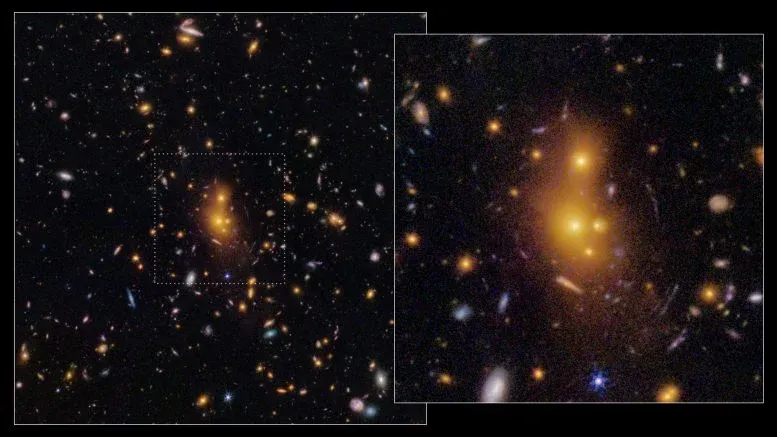
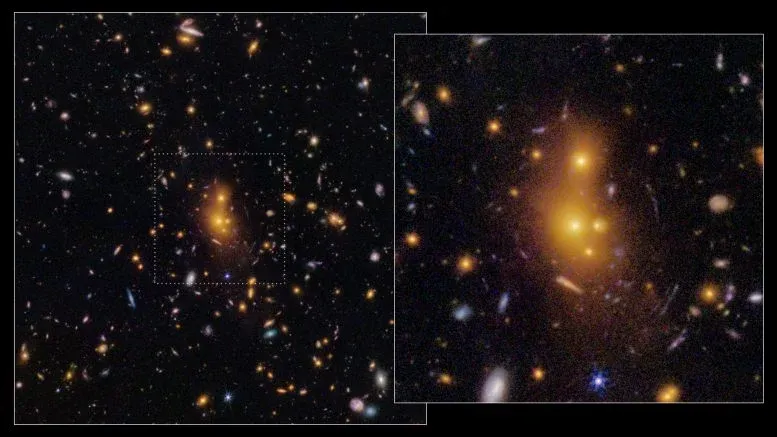
The galaxy cluster, named XLSSC 122, is over 10 billion light-years away. This means we see it as it was 10 billion years ago. At that time, other galaxy groups were just starting to form. However, XLSSC 122 already looked large and organized, much like modern galaxy clusters. This maturity was unexpected for such an early period in the universe.
We're a new kind of news feed.
Regular news is designed to drain you. We're a non-profit built to restore you. Every story we publish is scored for impact, progress, and hope.
Start Your News DetoxJWST's powerful vision helped scientists see something special. XLSSC 122 lines up with even more distant galaxies. The cluster's strong gravity bends the light from these background galaxies. This creates a rare effect called strong gravitational lensing. This effect allowed scientists to measure XLSSC 122's mass with new precision.
Kyle Finner, an IPAC staff scientist and lead author of the first paper, noted the surprise. "When we got those first images back from JWST, we said, 'wow, look at this, there’s strong lensing coming from this cluster!'" Finner said. "XLSSC 122 has now set the record for the most distant galaxy cluster displaying strong lensing." This lensing is a valuable tool for astronomers.
This alignment gave astronomers their most detailed look yet at how mass is spread inside an early galaxy cluster. This was during "cosmic noon," about 10 billion years ago. This period was critical because many galaxy clusters began forming, and stars were created up to 100 times faster than today.
XLSSC 122 continued to surprise researchers. Its mass is tightly packed toward its center. Finding such a concentrated structure so early in cosmic history is hard to explain with current models. These models predict a much slower buildup of massive structures.
"XLSSC 122 is one of the first clusters we know of that formed in the universe," Finner explained. "It has a mass concentration that doesn’t agree with our cosmological model predictions."
Peering into Dark Matter
XLSSC 122 was first found in 2014 by the European Space Agency’s XMM-Newton spacecraft using X-rays. Later, the Hubble Space Telescope confirmed its distance and its unexpectedly mature structure. However, Hubble didn't clearly show strong lensing. JWST images, with their clear arcs of light around the cluster's center, revealed this effect.
Most of the strong lensing effect comes from dark matter. This invisible substance has gravity but doesn't produce any direct signal. Scientists believe dark matter outweighs ordinary matter by about five to one.
Dark matter is crucial for understanding how galaxies are held together and how the universe's large-scale structure formed. Measuring dark matter in XLSSC 122 helps test how well our current models explain cosmic growth since the Big Bang.
"Strong lensing is a way to measure the dark matter without actually seeing the dark matter," Finner said. "It gives us a sensitive probe of our cosmological models."
A Complete Picture of the Cluster
In a second paper, Finner and his team looked at weak lensing. This is a subtler form of gravitational lensing that causes tiny distortions in galaxy shapes. Strong lensing helped measure the cluster's central region. Weak lensing helped reveal the mass farther out, including the wider cluster environment.
This broader view, combined with X-ray and radio observations, showed that XLSSC 122 is still merging. The second study confirmed the cluster's very large, centrally concentrated mass.
The third paper used JWST to trace XLSSC 122’s intracluster light. This faint glow comes from stars drifting between galaxies. This is the earliest known detection of such light. It supports the idea that XLSSC 122 is merging, with stars being thrown out of colliding galaxies.
The team also found that the central shape of the intracluster light closely matches the dark matter concentrations seen by strong lensing. If this pattern holds true for other early galaxy clusters, it could offer another way to find hidden dark matter.
"In this cluster, the intracluster light essentially traces the dark matter," Finner noted. "That light tells us that the cluster is in a merging state."
Looking Ahead
Finner and his colleagues hope to find and study many more distant galaxy clusters. If more objects like XLSSC 122 are found, with unusual dark matter concentrations and early maturity, cosmologists might need to rethink parts of their models for how the universe developed.
"It’s still early in the JWST era," Finner said. "If we can start to get data on tens or hundreds of these types of objects at this stage in the universe, then we can really start putting our cosmological models to the test."
Deep Dive & References
- JWST Discovery of Strong Lensing from a Galaxy Cluster at Cosmic Noon: Giant Arcs and a Highly Concentrated Core of XLSSC 122 - The Astrophysical Journal Letters, 2025
- An Active Galaxy Cluster Merger at Cosmic Noon Revealed by JWST Weak Lensing and Multiwavelength Probes - The Astrophysical Journal Letters, 2026
- Mature but Still Growing: JWST Detection of the Earliest Intracluster Light at z ∼ 2 - The Astrophysical Journal Letters, 2026