Imagine living on a planet that, every 8.7 years, gives you a front-row seat to the most extreme cosmic show: a supermassive black hole filling your sky, looking like a portal to another dimension. Because that's the life of a hypothetical resident of S301, the fastest star ever seen, currently whipping around the Milky Way's central behemoth, Sagittarius A*.
For decades, scientists knew something massive lurked at our galaxy's heart – some four million times the mass of our Sun. In 2002, they confirmed it was a supermassive black hole. But seeing a black hole is like trying to spot a ninja in a coal mine; their gravity is so intense, not even light escapes. So, how do you study the invisible?
Our Galactic Drag Strip
Turns out, you find something that gets really, really close to it. Enter S301. An international team of astronomers, led by Stefan Gillessen, has been using four telescopes in Chile to peek through the cosmic dust and gas, gathering infrared light. A few years ago, Ph.D. student Felix Mang noticed a faint star moving very fast.
We're a new kind of news feed.
Regular news is designed to drain you. We're a non-profit built to restore you. Every story we publish is scored for impact, progress, and hope.
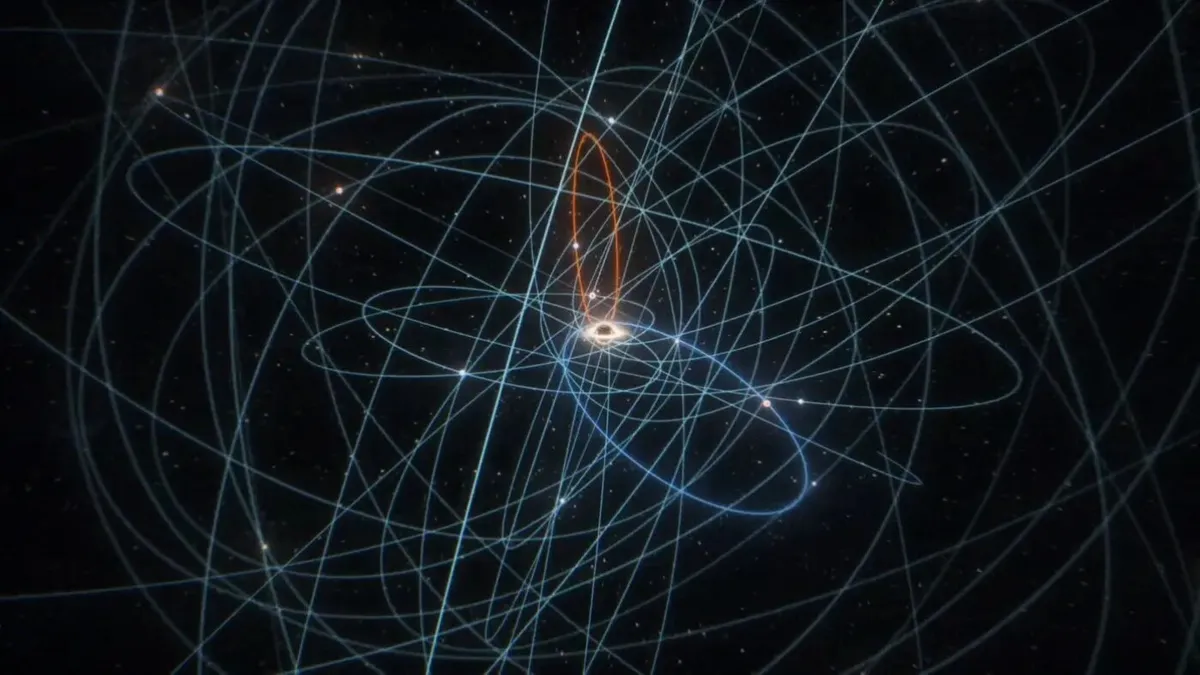
Start Your News DetoxMang tracked S301, applied Newton's laws with a dash of Einstein's general relativity, and confirmed something truly wild: this star isn't just fast; it's practically scraping the black hole's event horizon. Its orbit is a wildly stretched-out ellipse, with Sagittarius A* sitting at one end, like a gravitational anchor.
As S301 approaches the black hole, it slams on the cosmic gas pedal, hitting over 15,000 miles per second — nearly 8% the speed of light. That makes it the fastest star ever clocked in our galaxy. Then, with a gravitational snap, it makes a hairpin turn and slingshots back out, slowing down until its next terrifyingly close pass. Gillessen calls its predictable, yet utterly insane, path a "Swiss railway system."
Unlocking the Spin Cycle
This isn't just a celestial thrill ride. This star's extreme proximity allows scientists to observe how the black hole warps space and time, essentially giving us a real-time visualization of gravity's most intense effects. It's like having a cosmic laboratory "right in front of our doorstep," as Gillessen puts it.
Erin Kara, an astrophysicist at MIT, is calling this a "really exciting result." The next big goal? Figuring out how fast Sagittarius A* is spinning. A rotating black hole drags space-time with it, a phenomenon that could reveal how our galaxy's central monster formed, and in turn, how the entire Milky Way came to be.
So, while you might not be packing your bags for a vacation on S301, its death-defying dance is giving scientists unprecedented insights into the universe's most enigmatic objects. And if that's not stunning, well, maybe you just need to imagine that pitch-black disk filling your sky.