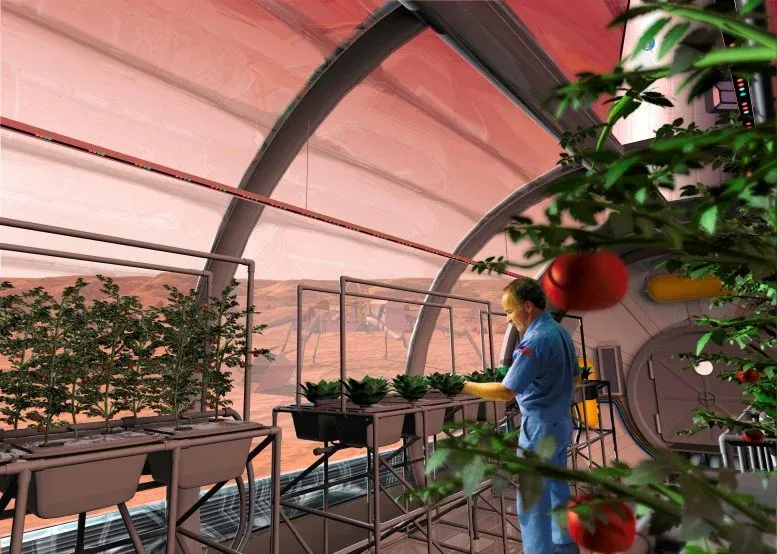
Turns out, if humanity ever wants to set up shop on Mars or the Moon, we might need to send in the fungi. An international team of scientists thinks humble mushrooms could be the unsung heroes of space colonization, transforming toxic, nutrient-poor lunar and Martian soil into actual farmland.
Imagine the red dust of Mars, all dry and desolate. Now imagine it… sprouting potatoes. That’s the dream. Researchers from the U.S. and Brazil published their findings in Frontiers in Astronomy and Space Sciences, detailing how certain beneficial fungi could make this sci-fi fantasy a reality. Because apparently, we're not just bringing ourselves to Mars; we're bringing an entire ecosystem.
The Unsung Heroes of Space Agriculture
The problem with Martian and lunar dirt (affectionately called regolith) is that it's a nutritional wasteland. No nitrogen, potassium, or phosphorus – all the good stuff plants need to, you know, live. On Earth, certain fungal species are like tiny, helpful root extensions, supercharging nutrient absorption even in tough spots. Some have even had a stint on the International Space Station, which is a pretty impressive resume builder for a fungus.
We're a new kind of news feed.
Regular news is designed to drain you. We're a non-profit built to restore you. Every story we publish is scored for impact, progress, and hope.
Start Your News DetoxPlants trying to grow in regolith suffer from "abiotic stress," which sounds exactly as bad as it is. The scientists' solution? Arbuscular mycorrhizal fungi (AMF). These microscopic helpers have been buddies with botanists since the mid-19th century, essentially acting as tiny, underground nutrient delivery services.
While the idea is promising, the scientists are quick to add the standard caveat: more studies are needed. Specifically, studies with actual Martian and lunar dirt, not just simulants. Because, you know, space is particular.
Why Fungi are the Ultimate Space Hack
Shipping anything to space costs an astronomical amount of money. Shipping soil from Earth just to grow a salad on Mars? That's a logistical nightmare wrapped in a financial black hole. This is where the fungi come in. By making the local regolith productive, we could achieve what NASA calls "in situ resource utilization" (ISRU), or, more simply, "living off the land."
The study suggests that adding these plant growth-promoting fungi – like Trichoderma and various AMF – would dramatically boost crop production. They're good at reducing plant stress, moving those crucial nutrients around, and possibly even improving the physical and chemical structure of the regolith itself. Which, if you think about it, is both impressive and slightly terrifying.
It’s not just theory, either. NASA's got ISRU as a core pillar of its Moon to Mars Architecture. And just to show what's possible, another recent experiment managed to grow 27 grams of duckweed from a single gram of cyanobacteria mixed with Martian regolith simulant. Let that satisfying number sink in.
So, while we're still a ways off from a full-blown Martian farm, the idea that a bit of fungal assistance could turn alien dust into dinner is a pretty wild thought. Take that, nutrient-poor soil. The fungi are coming for you.