An estimated six million insect species live on Earth. However, none are found in the ocean. Scientists once thought this was because the insects' breathing systems would collapse under water pressure.
Now, new research challenges this idea. Deep-diving fly larvae in East Africa regularly go more than 650 feet deep in Lake Malawi. They do this using strong air sacs that contain a stretchy protein.
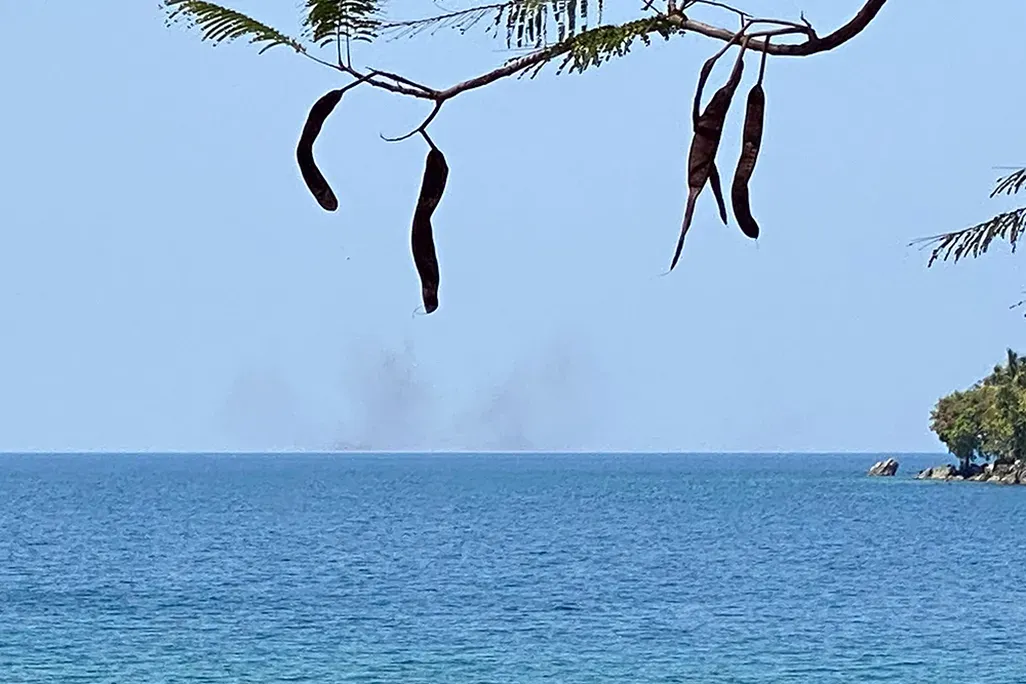
Caption: A swarm of Chaoborus edulis flies over Lake Malawi. Image: Philip Matthews
We're a new kind of news feed.
Regular news is designed to drain you. We're a non-profit built to restore you. Every story we publish is scored for impact, progress, and hope.
Start Your News DetoxPhilip Matthews, a zoologist at the University of British Columbia, called this a "big surprise." He noted that pressure might not be the barrier to ocean insect life that scientists once believed. These findings show an amazing ability in these insects. They could also lead to new types of materials.
How Deep-Diving Larvae Survive
Researchers used an underwater sonar system in Lake Malawi to study Chaoborus edulis larvae. Billions of these insects live there. The data showed their daily routine. In the morning, the larvae sink to the lake's deepest, coldest layer, called the hypolimnion. They go down about 25 feet per hour, reaching depths of up to 850 feet.
In the afternoon, they rise toward the surface at about 65 feet per hour. They finish their journey by late evening. This cycle helps them avoid predators. Matthews explained that they regulate their buoyancy to hide from fish during the day. They go deep into areas with no oxygen, where fish cannot follow. At night, they float up to eat zooplankton in the surface waters when fish cannot see them easily.
The secret to their deep dives is a highly elastic protein called resilin. The larvae's air sacs have alternating bands of resilin and stiff cuticle. This allows the sacs to expand and contract like an accordion, changing the insects' buoyancy. These structures change based on pH levels in the air sac walls.
Scientists also tested how well C. edulis could handle pressure. They placed larvae and pupae in pressure chambers. C. edulis pupae could withstand water pressure found at depths up to 1,519 feet. Other Chaoborus species could only handle much shallower depths. The C. edulis air sacs were stronger, and their strength matched the maximum depth of their environment.
Future Innovations and Unanswered Questions
Natasha Mhatre, a biologist not involved in the study, praised the research. She called the connection between the air sacs' mechanics, biochemistry, and ecology "sweet."
The findings could also inspire new technologies. Evan McKenzie, a study co-author, suggested that Chaoborus resilin could be useful in material science. It could be developed into a dynamic material that changes shape based on its chemical environment. This could lead to artificial muscles or valves activated by different pH levels.
Despite these discoveries, the mystery of why insects don't live in the ocean remains. Matthews suggested that challenges like saltwater or a lack of available ecological niches might be factors. He noted that crustaceans, which are distant relatives of insects, already fill those roles in the ocean.
Deep Dive & References
Insect submariners don’t implode at depth, leaving oceanic mystery unsolved - University of British Columbia, 2026 A deep-diving insect challenges the pressure hypothesis for the absence of insects in the ocean - Science, 2026