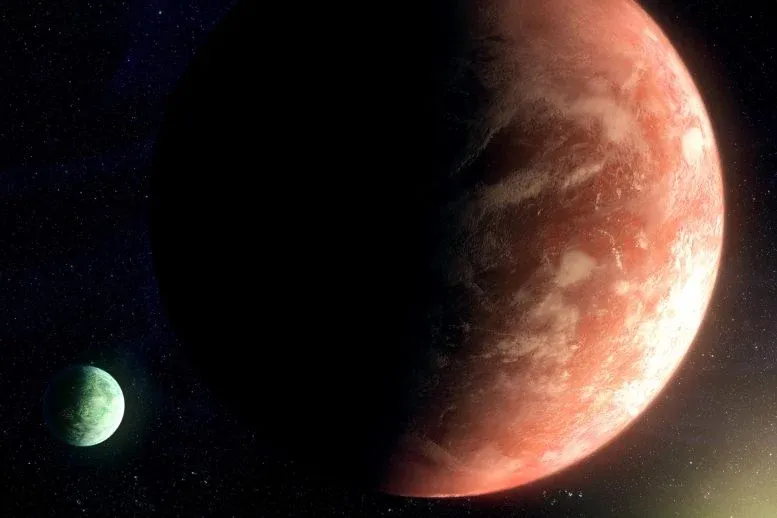
Imagine the universe as a toddler, barely out of its cosmic diapers. Now imagine that toddler already building LEGO castles. That's essentially what new simulations are suggesting: rocky planets, the kind we call home, might have started forming a mere 100 million years after the Big Bang.
For context, the universe is 13.8 billion years old. One hundred million years? That's less than one percent of its current age. Before this, scientists largely figured it took eons for enough heavy elements to gather. Now, it seems our cosmic timeline for potential life just got a serious rewind.
The Universe's First Bakers
The Big Bang was great for hydrogen and helium, less so for the carbon, oxygen, and iron that make up, well, us. Those heavier elements needed to be forged in the fiery hearts of stars. The very first stars, the incredibly massive 'Population III' variety, were the universe's initial bakers. When they died, they didn't just go quietly into the night; they exploded with a spectacular bang, scattering their newly created elements across the infant cosmos.
We're a new kind of news feed.
Regular news is designed to drain you. We're a non-profit built to restore you. Every story we publish is scored for impact, progress, and hope.
Start Your News DetoxSome of these were 'pair-instability supernovae,' explosions so powerful they completely obliterated the star, unleashing a truly staggering amount of fresh elements. We're talking over 100 times the Sun's mass in heavy elements, according to models. This cosmic shrapnel then enriched nearby gas clouds, making them 'metallic' enough to start forming solid grains – the very first ingredients for planets.
Cosmic Dawn's Construction Crew
Researchers, including Daniel Whalen from the University of Portsmouth, modeled what happened next. Their simulations show that the precursors to rocky planets, called planetesimals, could have formed around small, long-lived stars born from the debris of these early stellar explosions. All of this, mind you, during the "cosmic dawn" – the universe's equivalent of sunrise.
These simulations tracked gravity doing its thing, pulling enriched gas into a collapsing cloud. This collapse eventually birthed a relatively small star, surrounded by a spinning disk of material. Sound familiar? It's the same basic setup that formed our own solar system, just billions of years earlier.
The simulated star was about 70 percent the mass of our Sun. Crucially, the disk around it gathered enough dust and solid material to form several Earth masses of planetesimals. These aren't full planets yet, but they're the crucial stepping stones – tiny dust grains sticking together, growing into larger bodies that eventually smash into each other (gently, then less gently) to form planetary embryos.
Wet Worlds, Ancient Origins?
And here's another kicker: these ancient disks also contained a surprising amount of water. Previous work by Whalen's team suggested water could form in these enriched clouds just 100-200 million years after the Big Bang. The new simulations show this water persisting into the planet-forming disks, with concentrations only a few times lower than in our own solar system.
Now, the planetesimals in the model formed inside the 'water snowline' – the region where it's typically too warm for water ice. So, these initial planetary building blocks would have been relatively dry. But developing planets could still snag water from material farther out, much like Earth is thought to have received its oceans. Because apparently, even the early universe knew the importance of hydration.
The stars at the center of this early planet formation were low-mass and long-lived, meaning a star about 40 percent the Sun's mass, formed during this era, could still be twinkling today. This opens up the tantalizing possibility that the universe's very first planetary systems might still be out there, quietly orbiting their ancient suns in our own Milky Way.
It completely reshapes the timeline. Earth formed 4.5 billion years ago, a full 9 billion years after the Big Bang. A rocky world born during cosmic dawn would have seen billions of years pass before our sun even sparked to life. Whether these ancient worlds survived, or even harbored life, remains a cosmic mystery. But it means the universe was in the planet-making business far earlier than we ever dared to imagine. As Whalen put it, "If that’s the case, it raises an intriguing question: could potentially habitable worlds have appeared far earlier in the Universe’s history as well?" Let that sink in.