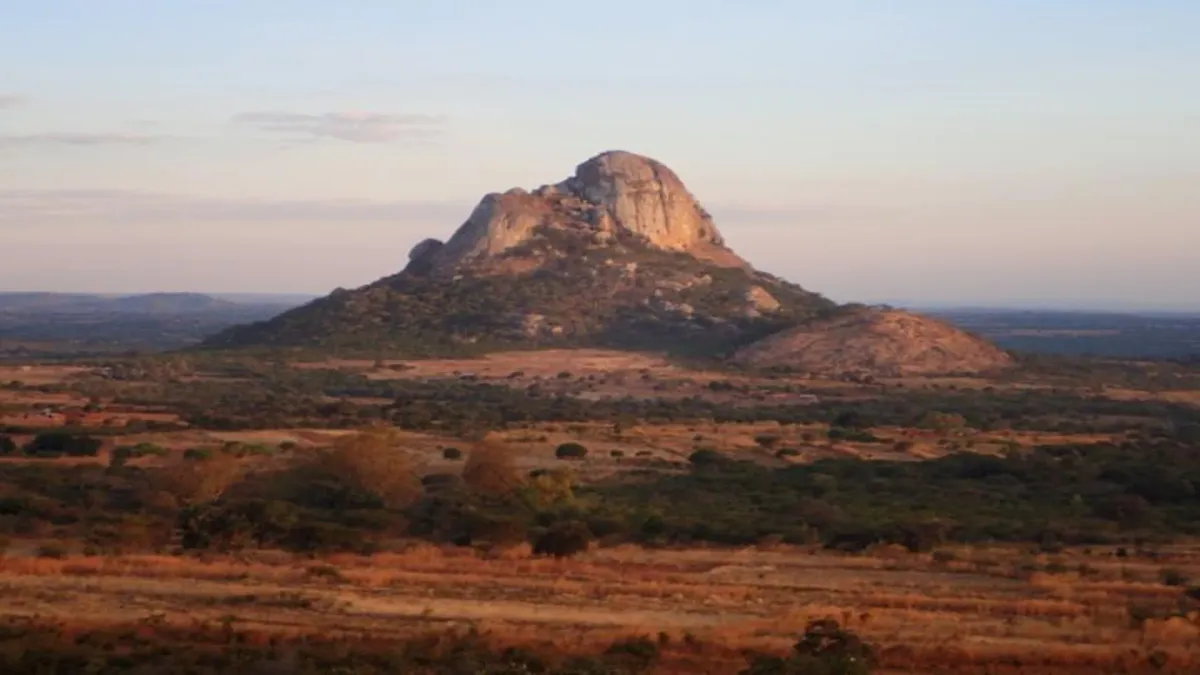
Beneath a rock shelter at the base of an isolated granite hill in Africa, archaeologists uncovered something that shifts our understanding of early human ritual: a carefully constructed cremation pyre, roughly the size of a mattress, built around 8,000 years ago.
The remains belonged to a small adult woman, likely between 18 and 60 years old. What makes this discovery extraordinary isn't just that she was cremated—it's the evidence of how much care went into the process. Her body had been deliberately prepared: limbs cut, flesh removed, head separated from the body. Someone spent time on this. Someone believed it mattered.
The pyre itself required serious effort. Archaeologists found 66 pounds of deadwood and grass arranged to burn at around 500 degrees Celsius. That's not accidental fire; that's intentional knowledge of heat and fuel. Stone tools lay within the pyre, possibly thrown into the flames as part of the ritual, possibly used to prepare the body. And crucially, her skull was missing—not lost, but deliberately removed, likely kept as a token or taken elsewhere for reburial.
We're a new kind of news feed.
Regular news is designed to drain you. We're a non-profit built to restore you. Every story we publish is scored for impact, progress, and hope.
Start Your News Detox"This supports our hypothesis that some of the missing bones from the cremated woman may have been deliberately removed and taken as tokens for curation or reburial elsewhere," explained Dr Ebeth Sawchuk, one of the study's authors. That removal of the skull, the researchers argue, represents an act of remembrance. Ancestral veneration. Social memory. These practices have been documented in various African communities throughout history—but never this far back.
What This Changes
For decades, archaeologists assumed early hunter-gatherers had simpler belief systems and less social cohesion than later settled societies. This discovery demolishes that assumption. Building a cremation pyre at this scale, preparing a body with such deliberation, removing bones as relics—these aren't the actions of people with basic rituals. These are people with complex spiritual lives, with community bonds strong enough to justify hours of labor for a single person's funeral.
Globally, intentional cremation is rare in the archaeological record before around 5,000 years ago, and especially uncommon among hunter-gatherers. This find at Mount Hora, in what is now southern Africa, pushes that timeline back dramatically. It also suggests that the site served as a permanent burial ground for generations—the rock shelter was occupied for at least 13,000 years, from roughly 16,000 to 8,000 years ago, with this woman representing just one of many people laid to rest there.
The discovery doesn't just add a data point to our timeline. It reframes who these early communities were: people with ritual sophistication, with the capacity for collective memory, with beliefs about what happens after death. They weren't waiting for civilization to develop meaning-making. They were already there.