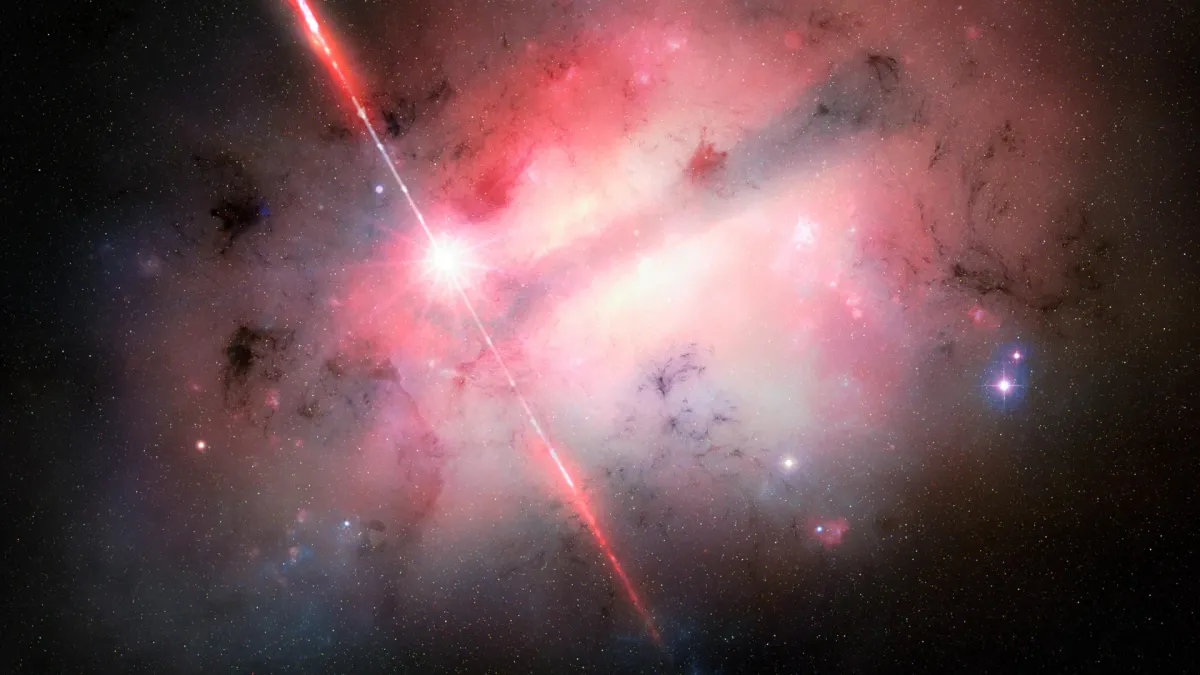
Astronomers have found one of the most ancient stars at the edge of our Milky Way galaxy. This star, named PicII-503, appears to be a second-generation star. This means it formed from the material left behind after the very first stars exploded.
Researchers shared this discovery in the journal Nature Astronomy on March 16. Anna Frebel, an MIT astrophysicist not involved in the study, called it a "fantastic discovery." She noted how rare and difficult these stars are to find.
Tracing the Universe's Early Chemistry
The primitive star was first seen in 2024 using the Víctor M. Blanco Telescope in Chile. It is located in a tiny, faint dwarf galaxy called Pictor II. This galaxy is over ten billion years old and about 150,000 light-years from Earth. Pictor II sits within the "halo" of old stars surrounding the Milky Way. This halo might have formed from smaller dwarf galaxies merging with our larger one.
We're a new kind of news feed.
Regular news is designed to drain you. We're a non-profit built to restore you. Every story we publish is scored for impact, progress, and hope.
Start Your News DetoxFurther observations of PicII-503 showed its unique chemical makeup. The star has very little iron and calcium but a relatively high amount of carbon. This composition suggests the star contains traces of heavy elements from the explosive deaths of the very first stars.
These early stars likely lived for only a few million years. They were mostly made of hydrogen and helium, the lightest elements. However, inside their cores, intense heat and pressure fused these elements into heavier ones like carbon and iron. Astronomers refer to these heavier elements as "metals."
How Second-Generation Stars Formed
One idea is that when the first stars died in low-energy supernovas, the heaviest elements they made, like iron, fell back into the stellar remnants. But lighter, more outer elements, such as carbon, were blasted into space. These elements then became the building blocks for the second generation of stars.
PicII-503 supports this idea because it was found in one of the smallest known dwarf galaxies. If the supernova that created PicII-503 had been high-energy, the elements that formed the star would have been blown away from Pictor II's early form, possibly even tearing it apart.
Anirudh Chiti, an astrophysicist at Stanford University and lead author, said this observation shows the very first elements produced in a primordial galaxy. He noted that PicII-503's chemical signature is similar to other low-metal stars in the Milky Way's halo. This suggests they also came from the remains of the first stars.
Astronomers have found about ten stars as primitive as PicII-503. However, this is the first clear second-generation star found in an ultrafaint dwarf galaxy. This discovery "validates" the idea that these stars were born from the initial ones, Frebel explained.
PicII-503 has so little calcium and iron that researchers believe it was seeded by just one supernova that had no metals. This suggests it could be one of the earliest second-generation stars ever found. Chris Davis, program director for NOIRLab, called these discoveries "cosmic archaeology." He said they uncover rare stellar fossils that hold the "fingerprints of the universe’s first stars."
Deep Dive & References
Astronomers Discover a Rare Primitive Star That Provides a Chemical Snapshot of the Early Universe - Nature Astronomy, 2026