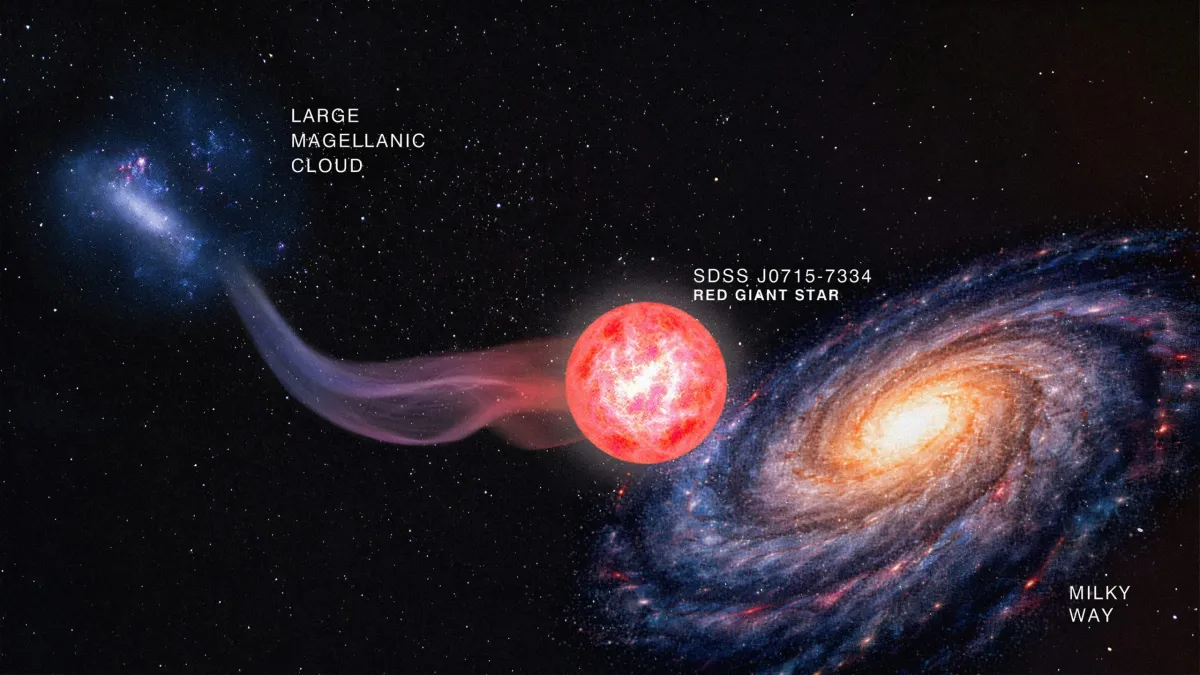
Astronomers have found an incredibly old star. It offers a rare look into the universe's earliest days.
An international team found the most chemically pure star ever seen. It's called SDSS J0715-7334. They used data from the Sloan Digital Sky Survey-V (SDSS-V) and telescopes in Chile. This discovery was published in Nature Astronomy.
University of Chicago astronomer Alexander Ji led the research. He said these pure stars are like windows into when stars and galaxies first formed. The team included undergraduate students from UChicago. Ji took them on an observing trip.
We're a new kind of news feed.
Regular news is designed to drain you. We're a non-profit built to restore you. Every story we publish is scored for impact, progress, and hope.
Start Your News DetoxFrom the Big Bang to the First Stars
The universe started as a very hot, dense mix of particles after the Big Bang. As it grew, it cooled. This allowed neutral hydrogen gas to form. Over hundreds of millions of years, dense areas collapsed. This created the first stars, mostly made of hydrogen and helium.
These early stars burned brightly and died quickly. Before they died, they made heavier elements through nuclear fusion. Then, they spread these materials into space with huge explosions. Later stars formed from this enriched material. This slowly increased the types of elements in the universe.
Why Metal-Poor Stars Are Important
Ji explained that all heavier elements, called "metals" by astronomers, come from stars. They are made from fusion inside stars, supernova explosions, or collisions of dense stars. Finding a star with very little metal means it's special.
Scientists look for second and third-generation stars. These stars hold clues about how star formation changed over cosmic history. We can't see the very first stars directly. So, astronomers look for ancient survivors closer to us.
Juna Kollmeier, an astrophysicist, noted that these stars are rare. Surveys like SDSS-V are designed to find them. This helps test theories about how stars form and explode.
The Sloan Digital Sky Survey is a very important astronomy project. Its current phase collects millions of spectra across the sky. It uses telescopes in both hemispheres.
Ji and his students used SDSS-V data to find stars with very low levels of heavy elements. They then used the Magellan telescopes to get detailed spectra. This confirmed their findings. SDSS J0715-7334 was confirmed as the most pristine star known.
Michael Blanton, Director of Carnegie Science Observatories, said the telescopes at Las Campanas were key to this discovery.
A Collaborative Learning Experience
Las Campanas has four Carnegie telescopes. This project used two of them. This shows how new instruments help scientific discovery.
The students' experience showed this teamwork. They watched SDSS-V data being collected. The next night, they made their own observations.
After the discovery, Ji changed the semester. Students focused on analyzing their results. This gave them direct experience with how flexibility helps science.
Kollmeier said she wants surveys like SDSS-V to make discovery a normal part of learning.
What Makes This Star Unique
Detailed analysis showed SDSS J0715-7334 has less than 0.005% of the Sun's metal content. It has half the heavy elements of the previous record holder. It also has very low levels of iron and carbon. It is 40 times more metal-poor than the most iron-poor star found before.
The team combined these observations with data from the European Space Agency’s Gaia mission. They found the star is about 80,000 light-years from Earth. It likely formed outside the Milky Way and was later pulled into our galaxy.
Ji believes training new astronomers is vital. He said projects like this help young learners see themselves in astrophysics.
Deep Dive & References
A nearly pristine star from the Large Magellanic Cloud - Nature Astronomy, 2026