Inside every living cell, proteins act as gatekeepers. They open and close to let charged particles through, triggering nerve signals, muscle contractions, and countless other functions. These ion channels are impossibly small—just a few atoms wide. For years, scientists have tried to build artificial versions. Now researchers at the University of Osaka have done it.
They've created solid-state pores that match biological ion channels in size and behavior, opening a path toward better DNA sequencing tools, brain-inspired computing systems, and new ways to study how molecules move through impossibly tight spaces.
Building a Gate from the Ground Up
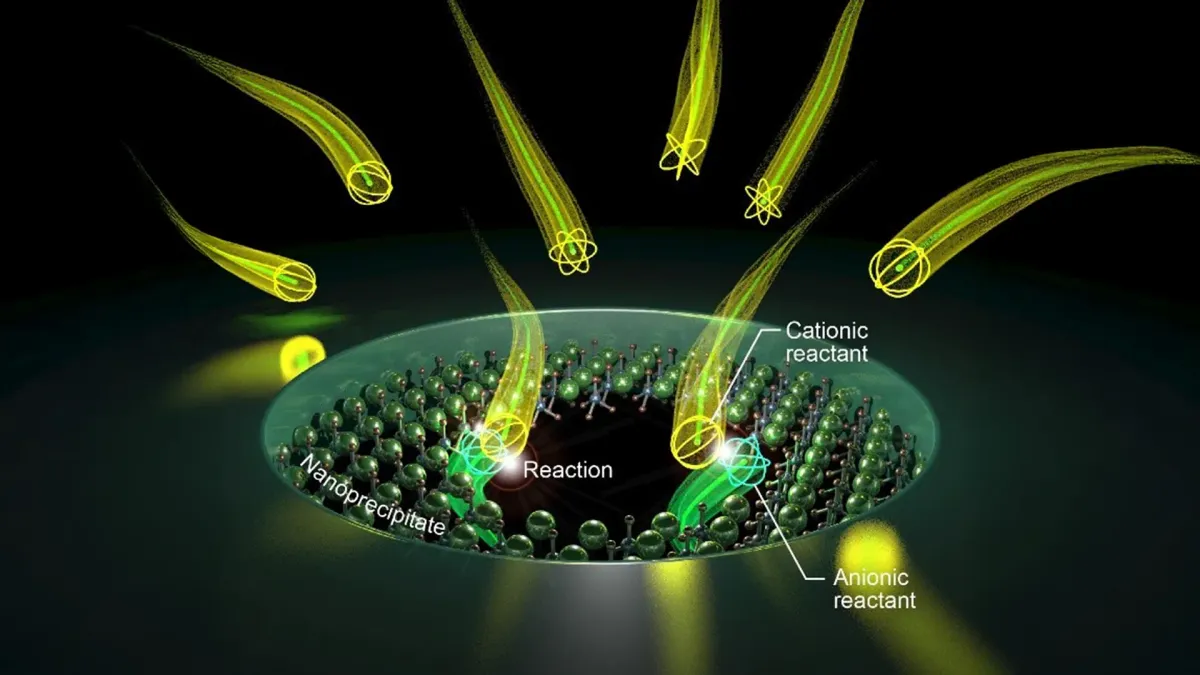
The team started with a silicon nitride membrane and drilled a nanopore through it—tiny, but still much larger than what they ultimately wanted. Then they used that pore as a reaction chamber. By applying a negative electrical charge across the membrane, they triggered a chemical reaction that produced a solid material inside the pore. This material gradually expanded until it blocked the opening completely. When they reversed the voltage, the material dissolved and the pore opened again.
We're a new kind of news feed.
Regular news is designed to drain you. We're a non-profit built to restore you. Every story we publish is scored for impact, progress, and hope.
Start Your News DetoxThey repeated this cycle hundreds of times over several hours. Each cycle worked. "This demonstrates that the reaction scheme is robust and controllable," explains lead researcher Makusu Tsutsui. What emerged was something remarkable: not one tiny pore, but multiple subnanometer openings—structures so small they rival the dimensions of actual biological ion channels.
The researchers knew something unusual was happening because they could see it in the electrical signals. Ion current flowing through the membrane produced sharp spikes, the same pattern you see in living cells. The data confirmed they'd created pores measured in fractions of a nanometer.
Even more useful: they could tune these pores. By adjusting the chemical composition and pH of the solutions used in the reaction, the team could change the size and selectivity of the openings. Different-sized ions could be filtered through by adjusting the pore dimensions—a level of control that mirrors what biological systems do naturally.
What This Unlocks
The breakthrough matters because atom-scale control opens real applications. DNA sequencing using nanopores works by threading genetic material through a tiny opening and measuring how the electrical signal changes as each base passes through. Smaller, more precisely controlled pores could make this faster and more accurate. Neuromorphic computing—building computer chips that work more like brains, using electrical spikes instead of traditional logic gates—could benefit from artificial ion channels that behave like biological ones. And researchers studying how fluids and molecules behave in extreme confinement now have a tool that lets them observe at scales previously only available in living systems.
The work is published in Nature Communications. What started as an attempt to mimic nature's tiniest gateways has produced something that could reshape how we sequence DNA, design computing systems, and understand the physics of molecular transport at the smallest scales.