A study from the University of Birmingham has mapped how autistic and non-autistic faces move when showing emotion — and found something researchers are calling a two-way language barrier rather than a one-way deficit.
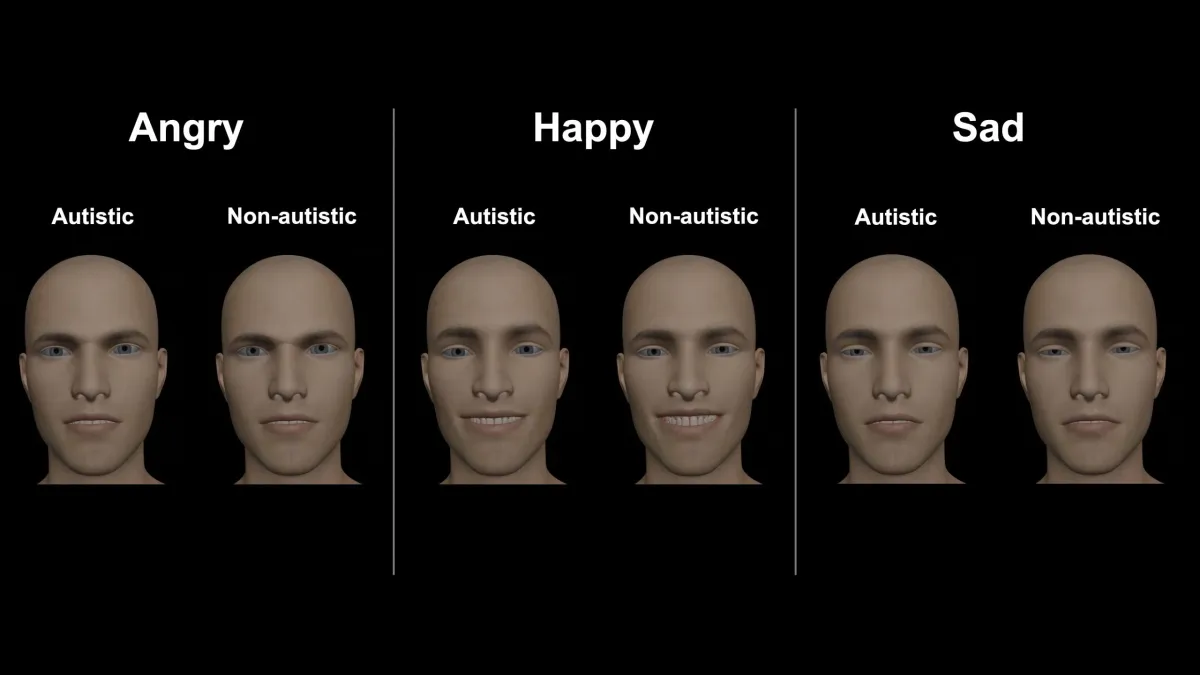
Using advanced facial tracking, researchers analyzed nearly 5,000 facial expressions from 25 autistic and 26 non-autistic adults, capturing more than 265 million data points. Participants were asked to show anger, happiness, and sadness in two contexts: while matching expressions to sounds and while speaking. The patterns that emerged weren't about one group being "better" at expressing — they were genuinely different.
How the expressions diverged
When showing anger, autistic participants relied more on mouth movements and less on eyebrow raises. Their happiness looked subtler — a smile that didn't reach the eyes in the way non-autistic smiles typically do. For sadness, they lifted their upper lip more prominently than non-autistic participants.
We're a new kind of news feed.
Regular news is designed to drain you. We're a non-profit built to restore you. Every story we publish is scored for impact, progress, and hope.
Start Your News DetoxThe research also found that autistic people produced a wider overall range of distinct expressions. Connor Keating, who led the work at Birmingham and now works at Oxford's Department of Experimental Psychology, notes that the differences go beyond how these expressions look. "Autistic and non-autistic people differ not only in the appearance of facial expressions, but also in how smoothly these expressions are formed," he explains. These mismatches may help explain why each group sometimes struggles to read the other's emotional signals.
A secondary finding added nuance: alexithymia — a condition common in autism that involves difficulty identifying one's own emotions — correlated with less clearly defined expressions of anger and happiness, making those emotions appear mixed or unclear.
Reframing the "problem"
Professor Jennifer Cook, the study's senior author, pushed back against the idea that difference equals difficulty. "Autistic and non-autistic people may express emotions in ways that are different but equally meaningful — almost like speaking different languages," she says. "What has sometimes been interpreted as difficulties for autistic people might instead reflect a two-way challenge in understanding each other's expressions."
That reframe matters. For decades, autism research has framed atypical emotional expression as something autistic people needed to fix. This study suggests the real issue is mutual recognition. An autistic person's smile means something; a non-autistic person's anger signals something. They're just not reading from the same playbook.
The researchers are now investigating whether autistic and non-autistic people can learn to recognize each other's emotional expressions more reliably — essentially, whether we can become bilingual in facial language. That work is ongoing.