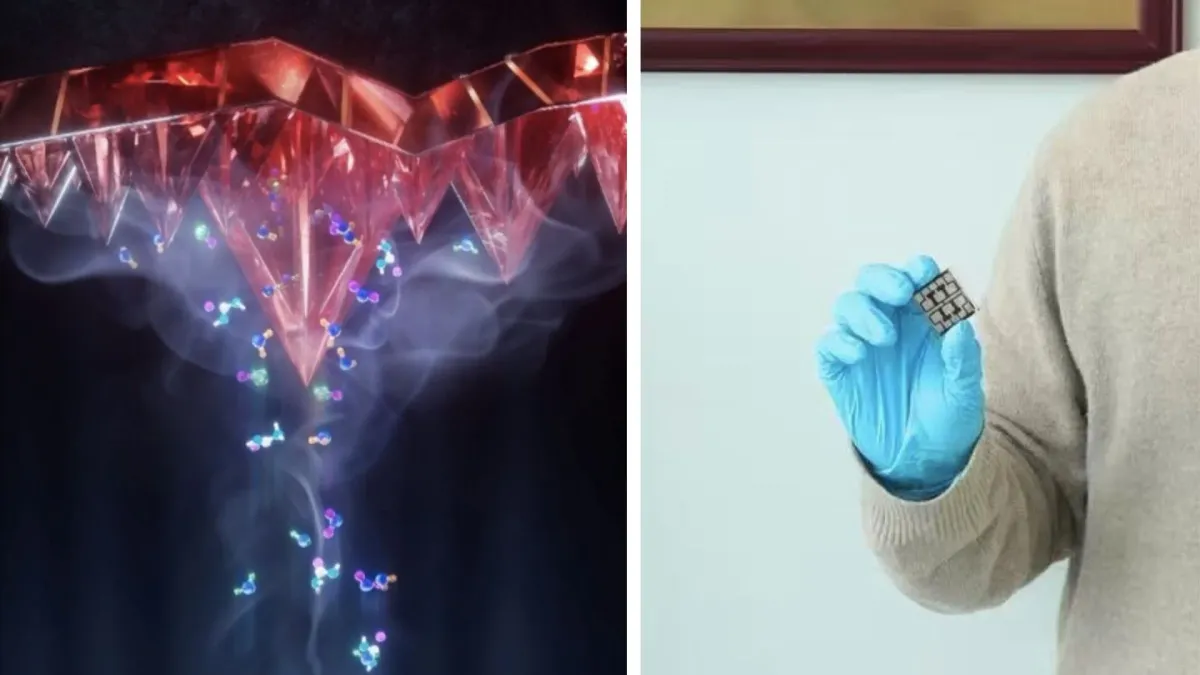
Researchers at Hong Kong University of Science and Technology have solved a stubborn materials problem that's been holding back a faster route to mass-producing perovskite solar cells. By tweaking how they deposit the light-absorbing material in a vacuum chamber, they've created cells that stay stable under real-world stress—a milestone that brings this cheaper, faster manufacturing method closer to factory floors.
The breakthrough centers on controlling how crystals form during the deposition process. When the team introduced lead chloride alongside the other materials being evaporated, it acted like a guide, nudging the crystals to grow in a highly ordered pattern with grains aligned in what's called a "face-up" orientation. This orderly structure is key: it naturally resists the degradation that happens when sunlight and heat pummel the material over time.
The results speak to the durability concern that's haunted this technology. Using industry-standard stress tests—blasting the cells with full-spectrum light at 75 degrees Celsius for 1,080 hours straight—the encapsulated cells retained 80% of their peak power output. That's the kind of longevity that matches what researchers get from the older, solution-based methods of making perovskites, except the vacuum approach is drier, faster, and scales more easily in manufacturing.
We're a new kind of news feed.
Regular news is designed to drain you. We're a non-profit built to restore you. Every story we publish is scored for impact, progress, and hope.
Start Your News DetoxOn the efficiency front, the team achieved certified performance of 18.35% on lab devices, with some cells reaching 19.3% in controlled conditions. Those numbers matter because they prove the vacuum method isn't sacrificing performance for durability—it's delivering both. The 1 cm² cells hit 18.5%, a size closer to what actual solar panels would use, showing the approach works beyond tiny lab prototypes.
Dr. Shen Xinyi, who led the materials work, framed it plainly: "By engineering the evaporation process to control crystal orientation, we have achieved extended thermal and photostability on par with state-of-the-art solution-processed counterparts, but with all the inherent advantages of a dry, industry-compatible vacuum technique." In other words, they've matched the durability without giving up the manufacturing edge that makes vacuum deposition attractive in the first place.
Perovskites have long promised cheaper, faster solar manufacturing than silicon. The catch has been stability—getting them to last as long as traditional panels. This work suggests that gap is narrowing. Tandem cells that pair perovskites with silicon are next, and those could push efficiency even higher while keeping the manufacturing advantages intact.