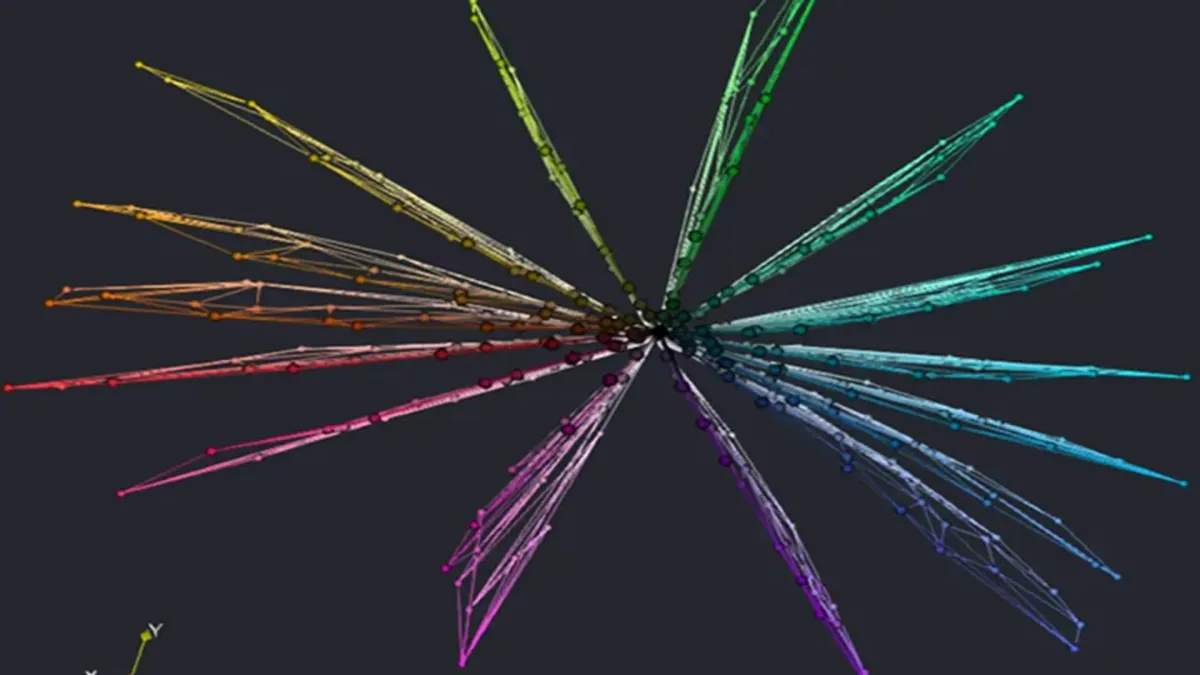
A century after Erwin Schrödinger sketched out how humans see color, researchers at Los Alamos National Laboratory have finished what he started—filling in the mathematical gaps that made his elegant theory incomplete.
Schrödinger's insight, published in the 1920s, was deceptively simple: human color vision works through three types of cone cells in the eye, each sensitive to different wavelengths. Map those responses onto a three-dimensional geometric shape, and you could theoretically describe every color a human can see. The problem was that the math didn't quite work. For a hundred years, physicists and mathematicians knew something was missing but couldn't figure out what.
The Missing Pieces
Computer scientist Roxana Bujack and her team at Los Alamos were working on visualization algorithms when they noticed the cracks in Schrödinger's foundation. The biggest issue: he'd never actually defined the neutral axis—the grayscale line running from pure black to pure white—even though his entire model depended on it. It's like building a house and forgetting to anchor it to the ground.
We're a new kind of news feed.
Regular news is designed to drain you. We're a non-profit built to restore you. Every story we publish is scored for impact, progress, and hope.
Start Your News DetoxThe team also discovered Schrödinger couldn't account for two real phenomena of human color perception. One is the Bezold-Brücke effect, where making a color brighter can shift how we perceive its hue. The other is the way our color perception hits diminishing returns—the difference between a slightly brighter red and a much brighter red feels different to our eyes depending on where you start.
What makes this work genuinely interesting is what it reveals about perception itself. Bujack's team showed that saturation, hue, and lightness—the three qualities Schrödinger identified—aren't learned or culturally shaped. They're baked directly into the geometry of human vision. Your brain doesn't decide that red is red based on experience. The mathematics of your eye's cone cells makes that decision for you.
The fix required stepping outside the mathematical framework Schrödinger used. By using curved paths instead of straight lines in their geometric model, and by working in a non-Euclidean space, the researchers finally made the equations work. The research, published in the Computer Graphics Forum, closes a loop that's been open since the 1920s.
This matters beyond theoretical satisfaction. Better understanding of how humans actually perceive color improves everything from medical imaging to data visualization to how screens render images. When you're trying to show someone a medical scan or a scientific dataset, getting the color right isn't just aesthetics—it's accuracy.