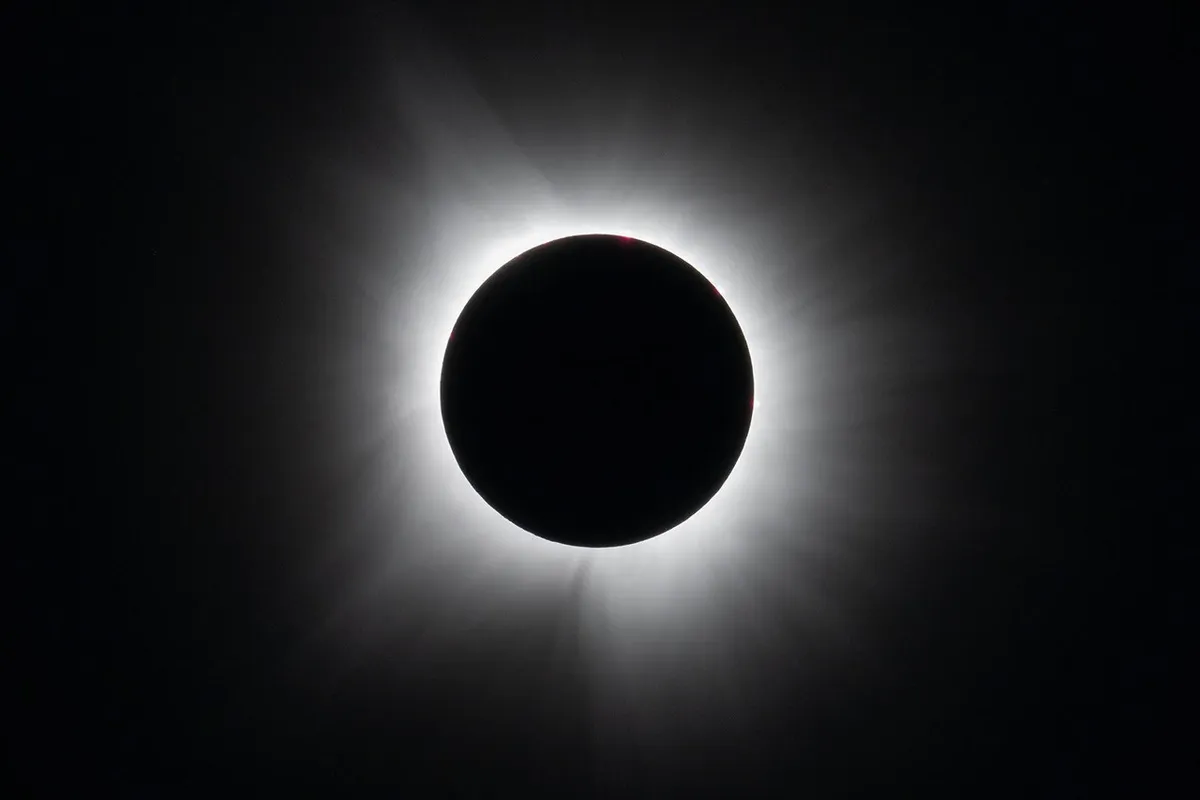
On April 8, 2024, something rare happened: thousands of people with cameras became part of a genuine scientific breakthrough. Volunteers across the United States participated in NASA's Eclipse Megamovie project, racing to photograph the total solar eclipse with precision equipment. Now, their 52,469 photographs—captured from 143 different locations—are reshaping how scientists understand the Sun.
The dataset is live and searchable at eclipsemegamovie.org/database, available to researchers and curious minds everywhere. What makes this significant isn't just the volume of images. It's that these photographs, taken by trained citizen scientists from different vantage points, show something that can only be seen during a total eclipse: the Sun's corona in motion, with enough clarity and consistency to actually study it.
Why this matters for solar physics
The Sun's corona—the ghostly halo visible only during totality—is one of astronomy's enduring mysteries. It's far hotter than the Sun's surface, which shouldn't be possible according to our basic understanding of physics. Solar jets and plumes erupt from the surface constantly, and scientists suspect understanding their motion holds the key to solving this puzzle. But you can't study these phenomena from space telescopes or ground-based observatories. You need the Moon to block the blinding disk of the Sun, which happens for just a few minutes, in a narrow path on Earth.
We're a new kind of news feed.
Regular news is designed to drain you. We're a non-profit built to restore you. Every story we publish is scored for impact, progress, and hope.
Start Your News DetoxThis is where the volunteers became irreplaceable. The Eclipse Megamovie team at Sonoma State University and UC Berkeley, working with NASA's Goddard Space Flight Center, spent months preparing the infrastructure and training participants. But the dataset exists because hundreds of people showed up with cameras, drove into the path of totality, and executed their assignments with enough precision that scientists can now cross-reference observations from multiple angles.
Of the 143 observatories involved, 28 produced the highest-quality calibrated images—clear skies, proper exposure times, and complete calibration frames. The full collection includes more than ninety minutes of cumulative observations stored in FITS format, the standard used by NASA and the International Astronomical Union. Raw, processed, and fully calibrated versions are all available.
Volunteer Jessi McKenna captured something essential about what made this work: "Everyone in the group has been amazingly supportive of each other. And those running things are always so obviously appreciative of everyone who has contributed." That's not sentiment. That's the infrastructure that turned a celestial event into usable science.
Researchers are already using these images to track how solar plumes evolve and move—data that could help predict space weather patterns that affect Earth's technology and power grids. The next total solar eclipse visible from North America won't arrive until 2044. Until then, this April dataset stands as proof that precision science doesn't require billion-dollar telescopes. Sometimes it requires people willing to show up, pay attention, and share what they see.