The James Webb Space Telescope has just delivered something astronomers have never seen before: a detailed three-dimensional map of Uranus's upper atmosphere. And it's revealed something unexpected—the planet's magnetic field is even stranger than we thought, and the whole system has been quietly cooling for 30 years.
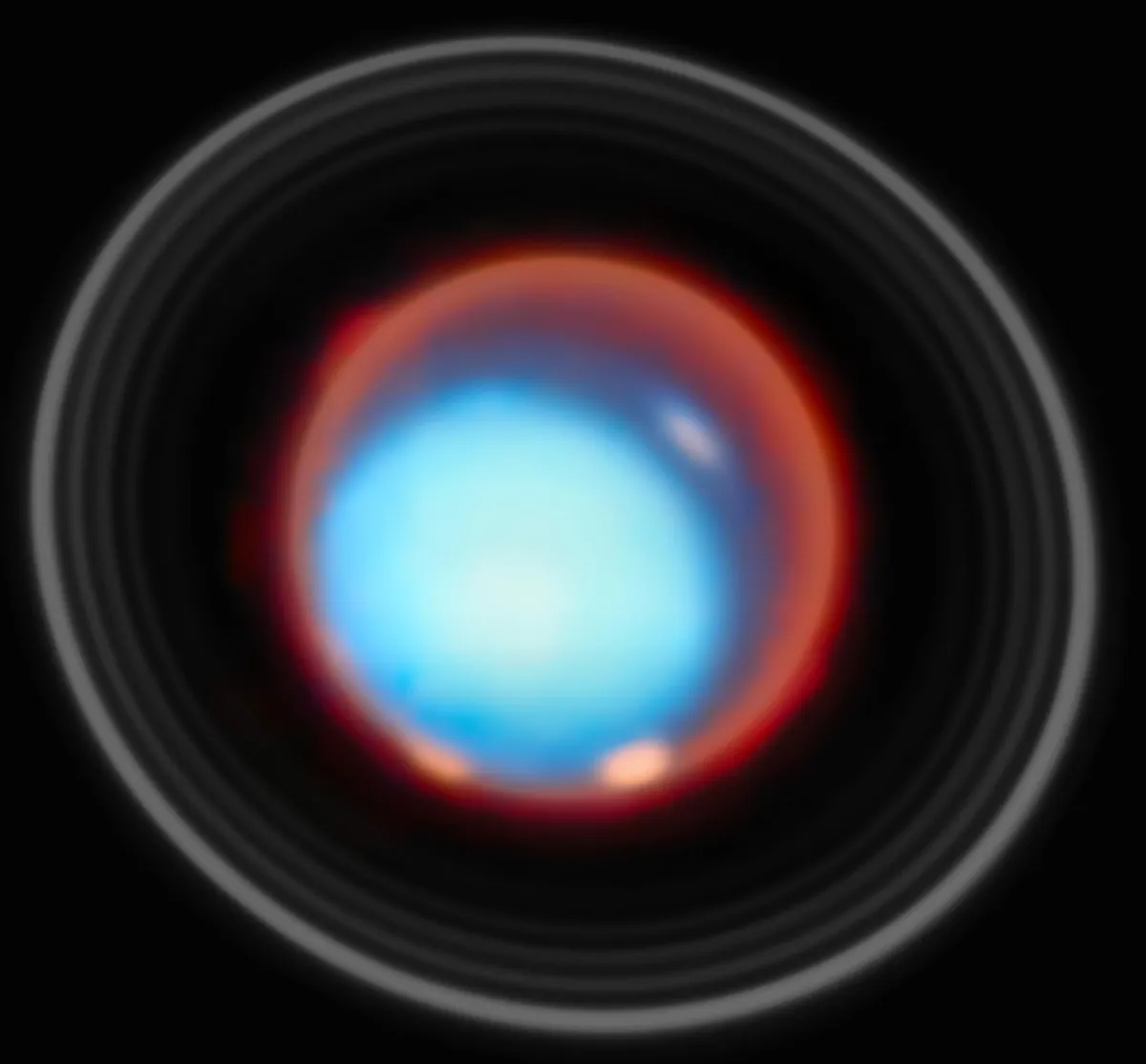
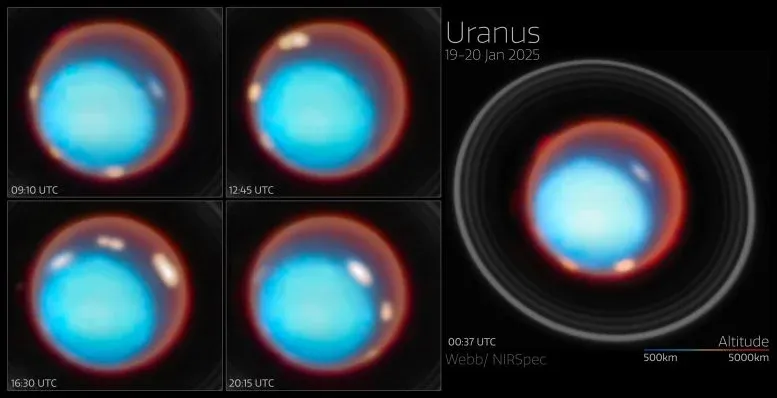
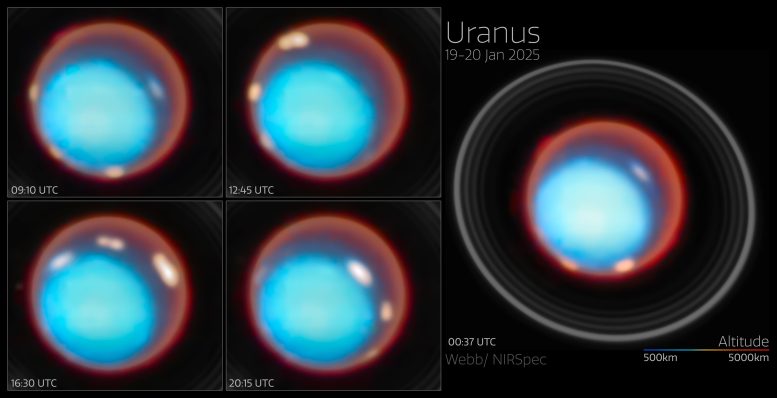
For 15 hours in January, Webb's infrared instruments watched Uranus rotate and captured faint glows of light bouncing through its ionosphere—the electrically charged layer where atmosphere meets magnetic field. By tracking how temperature and charged particles shift with altitude, researchers led by Paola Tiranti at Northumbria University produced the first comprehensive vertical slice of Uranus's atmosphere from cloud tops to 5,000 kilometers above.
A Magnetic Field Like No Other
What makes this map remarkable isn't just that it exists—it's what it shows about Uranus's bizarre magnetic personality. Unlike most planets, Uranus's magnetic field is tilted at a wild angle and doesn't even line up with its rotation axis. This lopsided geometry creates auroras that sweep across the planet in complex, shifting patterns.
We're a new kind of news feed.
Regular news is designed to drain you. We're a non-profit built to restore you. Every story we publish is scored for impact, progress, and hope.
Start Your News DetoxWebb spotted two bright auroral bands near the magnetic poles, with a noticeable dark gap between them. That gap tells a story: it marks where the planet's magnetic field lines transition from one configuration to another, channeling charged particles in ways that leave their mark on the atmosphere. Similar patterns show up at Jupiter, but Uranus's tilted field makes the effect more pronounced and harder to predict.
"This is the first time we've been able to see Uranus's upper atmosphere in three dimensions," Tiranti said. "With Webb's sensitivity, we can trace how energy moves upward through the atmosphere and even see the influence of its lopsided magnetic field."
The temperature map itself tells another story. Peak temperatures hit around 150 degrees Celsius—but not where you'd expect. They cluster between 3,000 and 4,000 kilometers above the clouds, while the highest concentration of charged particles peaks much lower, around 1,000 kilometers up. This vertical separation suggests different processes are at work at different altitudes, something ground-based telescopes couldn't resolve until now.
A Planet Cooling Down
The data also confirms something astronomers first noticed in the early 1990s: Uranus has been cooling steadily for three decades. Webb's measurements show an average upper-atmosphere temperature of about 426 kelvins (150 degrees Celsius), lower than previous spacecraft and ground-based observations recorded. That's not a dramatic drop—it's subtle enough that you need consistent, precise measurements to detect it. But it's real, and it raises a question: why is one of the Solar System's coldest planets getting even colder.
Understanding Uranus matters beyond curiosity. Ice giants like Uranus are common around other stars—we've found thousands of exoplanets in this size range. But we still don't fully understand how they manage energy in their atmospheres, how their magnetic fields shape their upper layers, or why some cool while others heat up. Uranus, with its extreme tilt and unusual magnetosphere, is our closest laboratory for studying these questions.
"Uranus's magnetosphere is one of the strangest in the Solar System," Tiranti noted. "By revealing Uranus's vertical structure in such detail, Webb is helping us understand the energy balance of ice giants. This is a crucial step towards characterizing giant planets beyond our Solar System."
The findings, published in Geophysical Research Letters, are based on 15 hours of continuous observation in January 2025 using Webb's infrared spectrograph. As the telescope continues scanning the outer planets, expect more surprises from the Solar System's most tilted world.
JWST Discovers the Vertical Structure of Uranus' Ionosphere - Geophysical Research Letters, 2026