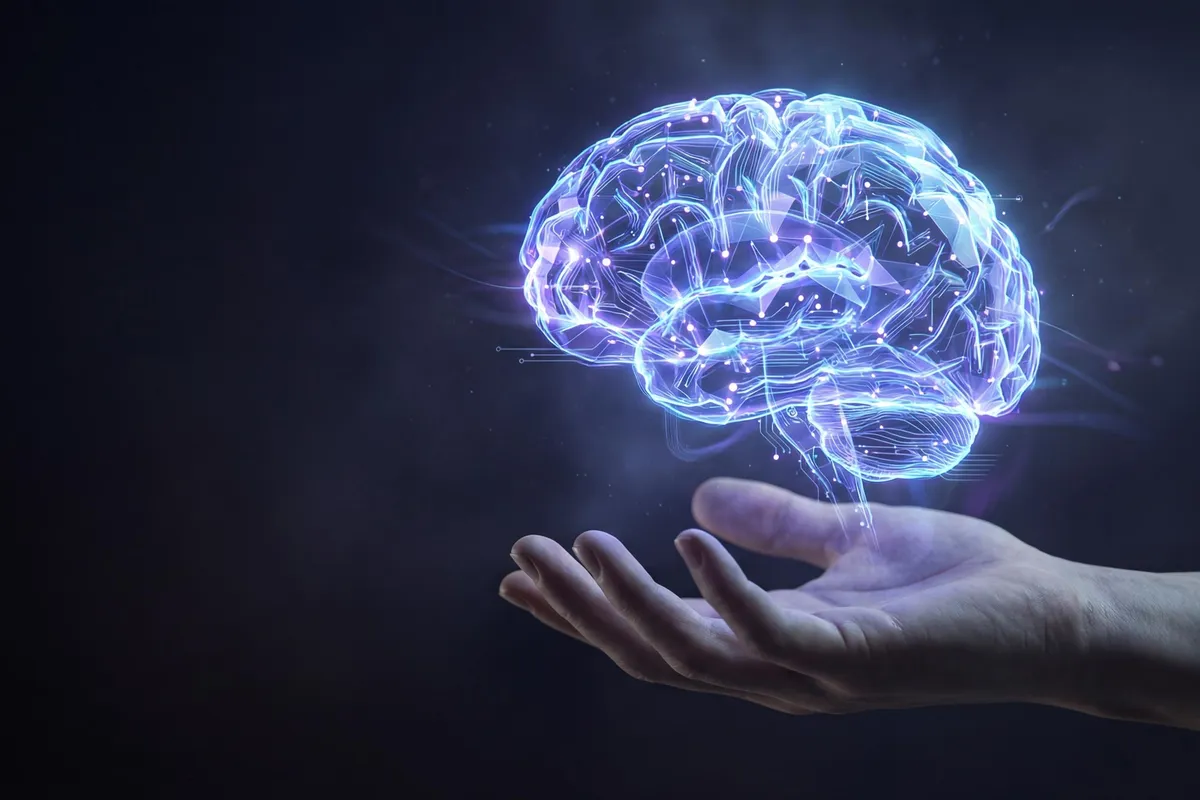
Your brain doesn't file away memories as single, self-contained packages. Instead, it splits the job: one set of neurons holds what happened, while another tracks where and when it happened. A team at the University of Bonn has now watched this division of labor in action, offering the first detailed look at how the human brain keeps memories flexible enough to recognize your friend at a dinner party and again at a board meeting.
The researchers recorded electrical activity from over 3,000 neurons in patients with drug-resistant epilepsy who had electrodes implanted in their hippocampus — the brain's memory hub. While undergoing clinical monitoring, these patients completed simple tasks on a laptop: they'd view pairs of images and compare them based on different prompts. One moment they'd answer "Is this bigger?" looking at a biscuit. The next, they'd answer "Is this the same color?" looking at the same biscuit.
What emerged was striking. The neurons split into two mostly separate populations. Content neurons fired when they saw a specific image — the biscuit — regardless of what question was being asked. Context neurons fired in response to the task itself — the "Bigger?" question — regardless of which image appeared. Very few neurons did both jobs at once.
We're a new kind of news feed.
Regular news is designed to drain you. We're a non-profit built to restore you. Every story we publish is scored for impact, progress, and hope.
Start Your News Detox"A key finding was that these two independent groups of neurons encoded content and context together and most reliably when the patients solved the task correctly," says Dr. Marcel Bausch, who led the analysis at the University of Bonn.
But here's where it gets interesting: as the experiment progressed, the two groups began to talk to each other. The content neuron would fire, and tens of milliseconds later, the context neuron would follow — as if the biscuit neuron was learning to trigger the "Bigger?" neuron. This coordination acts like a gatekeeper, ensuring that when you retrieve a memory, you also retrieve the right context to go with it.
This architecture explains something fundamental about how human memory works: flexibility without chaos. Your brain can reuse the same concept — a friend's face, a biscuit, a song — across countless different situations without needing a separate neuron for every possible combination. It stores content and context in separate libraries, then links them on demand. This is why you can recognize the same person in wildly different settings, and why you can remember not just what happened, but where and why.
The findings, published in Nature, were gathered during routine clinical monitoring — a window into the living human brain that's rarely available to researchers. The next step is to test whether these same mechanisms handle passive contexts, like the room you're sitting in, and whether deliberately disrupting the connection between content and context neurons actually impairs memory retrieval. That work will likely reshape how we understand memory loss and, eventually, how we might treat it.