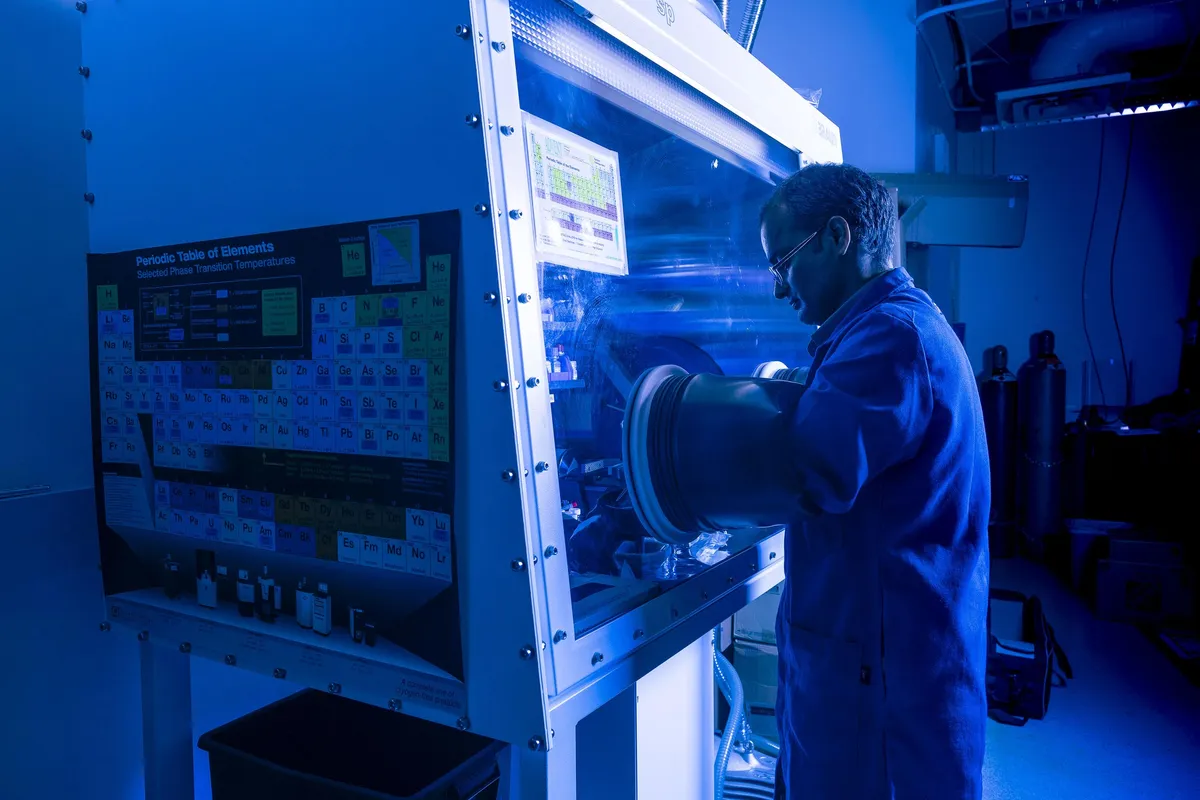
A team at Hong Kong University of Science and Technology has cracked a problem that's been slowing calcium-ion battery development for years: getting calcium ions to move fast enough, and keeping them moving reliably.
Lithium-ion batteries power your phone and electric car, but lithium is scarce and expensive to extract. Calcium is abundant—it's in seawater, limestone, bones. It has the electrochemical properties needed for a good battery. The catch: calcium ions don't move through conventional battery materials as easily as lithium ions do, and the whole system tends to degrade quickly.
The architecture shift
The HKUST researchers engineered something called redox covalent organic frameworks—think of them as structured, porous carbon scaffolds with carbonyl groups (carbon-oxygen bonds) lining the pathways. When calcium ions enter this material, they move along these aligned carbonyl groups like runners on a track. The result: ionic conductivity of 0.46 mS cm⁻¹ and calcium-ion transport above 0.53—both competitive with lithium-ion systems at room temperature.
We're a new kind of news feed.
Regular news is designed to drain you. We're a non-profit built to restore you. Every story we publish is scored for impact, progress, and hope.
Start Your News DetoxIn real-world testing, a full calcium-ion battery cell held 74.6% of its capacity after 1,000 charge-discharge cycles at high current. That's the kind of durability that matters for a car battery or grid storage.
Why this matters: If calcium-ion batteries reach commercial scale, they could reshape energy storage economics. Calcium costs a fraction of lithium. It's geographically distributed—no dependence on a handful of mining regions. The batteries themselves could be cheaper to manufacture and safer (calcium is less reactive than lithium). For developing countries building out renewable energy grids, or for any application where cost per kilowatt-hour matters, this is significant.
The research was published in Advanced Science. The team is now working on scaling the design and testing it in larger prototype cells. The path from lab breakthrough to factory floor usually takes years, but calcium-ion batteries are no longer theoretical—they're starting to prove they can actually work.